English
 Français
 Türkçe
 Español
 Русский

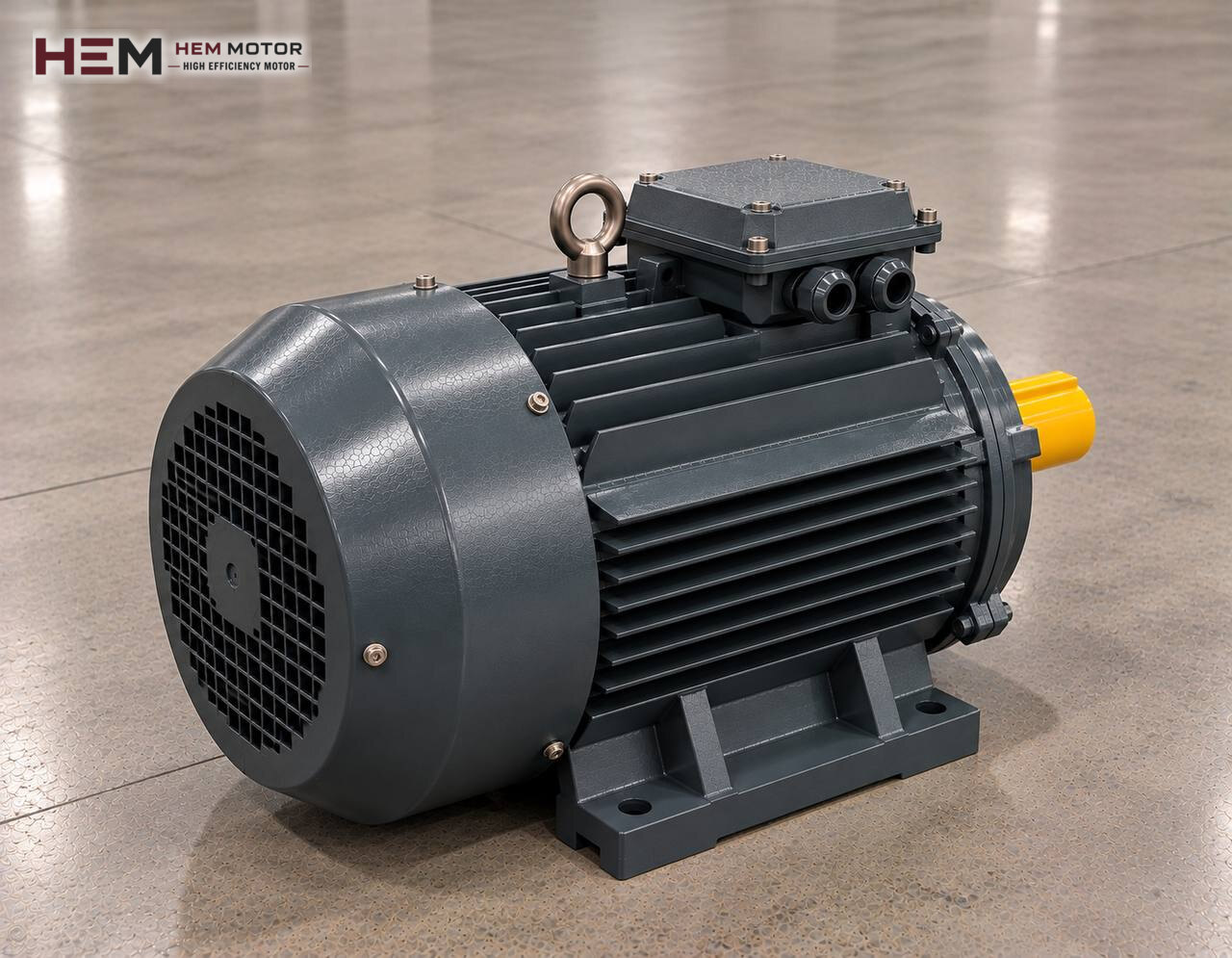
In a bread or biscuit plant the oven gets its heat from a burner or heating elements, but the belt that carries dough inside, the fans that move hot air and the turntable that spins the rack trolley all run on electric motors. This page is part of the section where we cover motors for food processing and preparation machines; it looks at which motor does which job in an industrial oven and how heat affects motor selection.

What the motor does in each oven type
Industrial ovens are grouped less by heating method than by how the product travels through the baking chamber. From the motor's point of view three layouts stand out:
- Tunnel oven: Dough or trays ride on a wire-mesh or steel belt tens of metres long, entering at one end and leaving baked at the other. The drive drum that pulls the belt sits at the outlet; the motor turns it very slowly and without interruption through a gearbox. Belt speed sets the baking time.
- Rotating rack oven: A tray trolley is pushed in, and a hook in the ceiling or a turntable in the floor rotates it during baking. A small geared motor provides this rotation, alongside a fan motor that blows the hot air.
- Deck oven: The product rests on stone or steel decks. Motors are usually found only in the steam system, the flue draught or the loading carriage.
Belt drive: low speed, long line
A tunnel oven belt moves at low speeds, often a few metres per minute. The drive therefore pairs a 4- or 6-pole motor with a high-ratio gearbox; the output speed and torque of the gearbox come from the oven builder's calculation. When the motor is replaced, keep the gearbox ratio, flange type and shaft diameter unchanged. For motors coupled to gearboxes see our geared drive page.
Because belt speed is adjusted whenever the product changes, most tunnel ovens drive the motor through a frequency converter. HEM's three-phase series is suitable for speed adjustment by converter. If the belt runs very slowly yet fully loaded, the motor's own fan may not move enough air; in such cases an independent cooling fan is added. When the converter is far from the motor, a dv/dt or sine filter is considered according to cable length. Sharing this information with your order is enough; details are on the motors used with inverters page.
Starting the belt is easy, but during the first morning heat-up the metal belt expands and its tension changes; if the take-up is set wrongly the motor current rises. Sensors that stop the line when the belt slips or breaks belong to the oven builder's control system.
Convection and circulation fans
In convection and rack ovens a radial fan circulates the air in the baking chamber. The fan wheel is in the hot compartment while the motor sits on the outer face of the oven wall and turns the wheel at the end of a long shaft. Two points matter here: fan power changes roughly with the cube of speed, so raising speed quickly increases motor load; and heat travels along the shaft towards the motor bearing. Oven builders therefore fit cooling vanes or an insulating spacer on the shaft.
Burner ovens have a separate fan supplying combustion air; this is covered on the burner fan motors page, while high-temperature process fans are discussed on the process and kiln fan page. HEM Motor supplies standard three-phase motors for these fans and makes no claim of a certified motor for high temperature or smoke extraction.
Hot surroundings, flour dust and cleaning
On an oven line the motor's worst enemy is the heat around it. Heat radiating from the oven wall and hot air collecting under the ceiling warm the motor's cooling air. If the temperature where the motor stands exceeds the ambient limit in the catalogue, state it in your order; it may then be necessary to leave a power margin or to move the motor away from the heat. PTC or PT100 sensors for monitoring winding temperature can be added at the ordering stage.
Flour dust from the dough preparation area sticks to the fan cover and turns into paste when it meets moisture. Cleaning the cover regularly preserves cooling. IP55 protection guards against dust ingress and water splashes; washing with pressurised water, contact with food or hygienic design requirements are not part of this standard motor's design. If such a requirement exists, a protective measure by the machine builder or a special motor is needed; state it in your order.
Mounting and placement
For belt drives the motor is usually flanged (B5 or B14) to the gearbox; fan motors are placed on a bracket on the oven wall in foot-mounted (B3) or foot-and-flange (B35) form. Turntable drives with a vertical shaft need vertical arrangements such as V1. HEM offers foot, flange, foot-and-flange and vertical options depending on frame size; we confirm flange and shaft dimensions with you when you order. For rack ovens in small patisseries without a three-phase supply, our single-phase motor series covering 0.18–5.5 kW can be considered.
Example HEM models for an oven line
| Oven section | Motor's job | Value to check | Example HEM model |
|---|---|---|---|
| Rack oven turntable | Rotating the trolley slowly | Gearbox ratio, single- or three-phase supply | 0.75 kW 80M2-4 (1,420 rpm) |
| Convection fan | Circulating baking air | Fan speed, shaft heat | 1.5 kW 90S-2 (2,895 rpm) |
| Tunnel oven belt | Continuous, low-speed pulling | Converter speed range, separate fan | 2.2 kW 100L1-4 (1,450 rpm) |
| Tunnel oven circulation fan | Hot air between zones | Ambient temperature, PTC option | 4 kW 112M-4 (1,450 rpm) |
The models in the table are examples only; the final choice is made by considering the oven's load, required speed, mounting and operating conditions together.
Information needed for a motor request
If the nameplate of the failed motor is readable, sending a photo speeds things up; the method is explained in our article on finding an equivalent motor from the nameplate. Without a nameplate, send: machine type (tunnel, rack or deck oven) and the motor's position (belt, fan, turntable), motor power (kW), speed (rpm), supply voltage, mounting type, the estimated temperature near the motor and the quantity you need.
All models and prices are listed in our shop. For quotes and technical questions you can reach us via WhatsApp or phone; the numbers are on our contact page.
Frequently Asked Questions
Can I replace the oven fan motor with a higher-speed motor?
It is not recommended. Fan power grows quickly as speed rises; a faster wheel can overload the motor and upset the air distribution inside the oven. Staying at the speed the machine was designed for is the safest route.
Why does the tunnel oven belt draw more current at the first morning start?
In a cold oven the belt and drums have not yet expanded; if the take-up was set for the hot condition, the belt stays tight. Current returns to normal as the oven heats up. If the difference is large, have the tension setting and drum bearings checked.
Why do the fan motor bearings need replacing so often?
Heat travelling along the shaft from inside the oven ages the grease in the motor's front bearing. Check that the cooling vane and the insulating part on the shaft are in place, and state the temperature around the motor in your order.
Why does the trolley stop turning when the rack oven turntable motor stops?
The turntable motor rotates the trolley through a gearbox; if the motor has stopped, check the thermal protection first, then the gearbox and the hook connection. If the motor runs but the trolley does not turn, the problem is usually in the mechanical transmission.