English
 Français
 Türkçe
 Español
 Русский


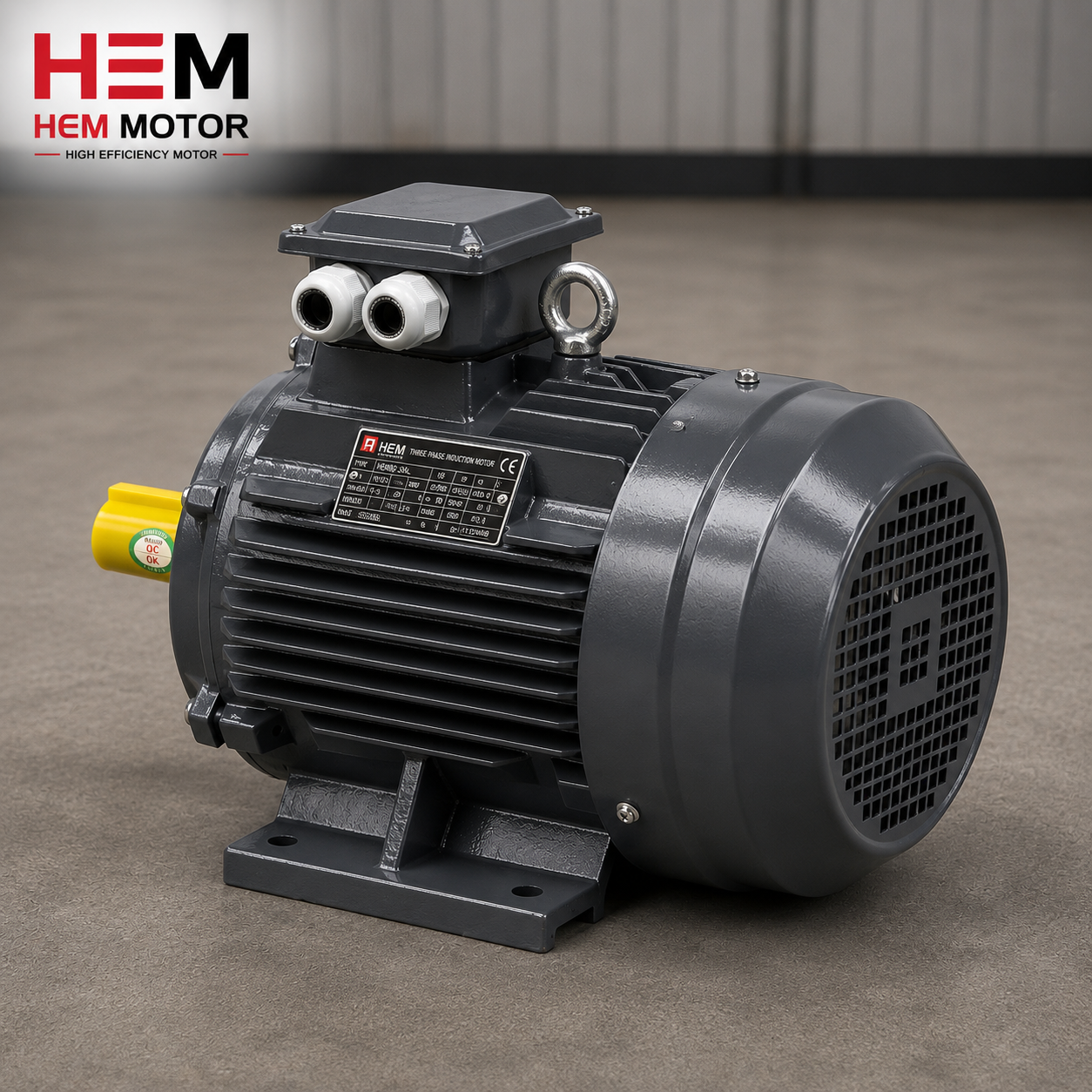
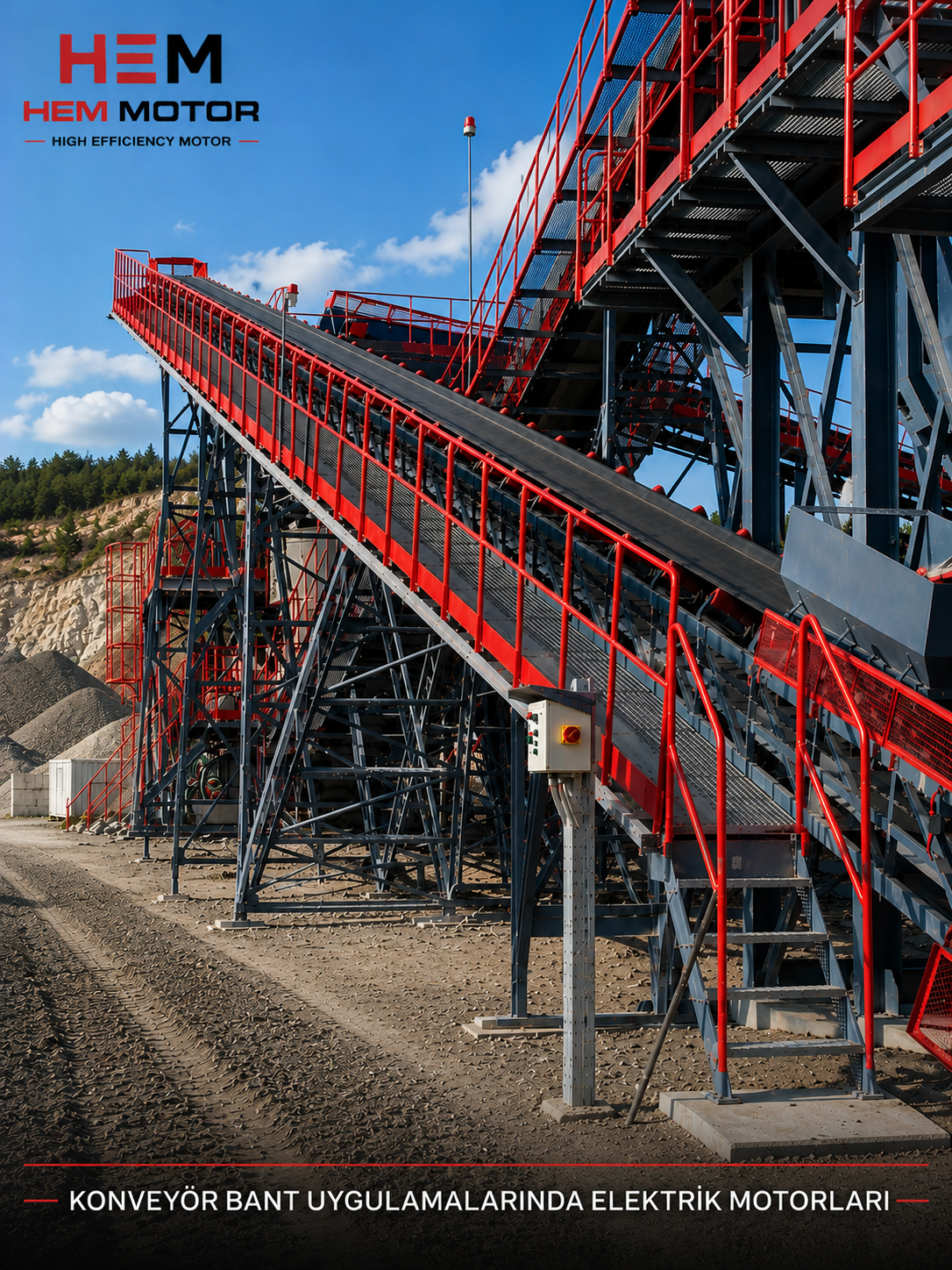
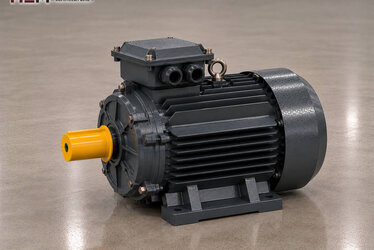
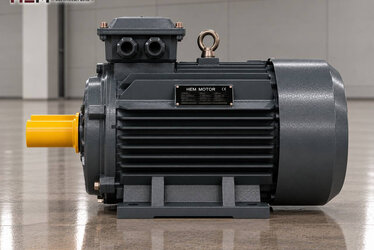
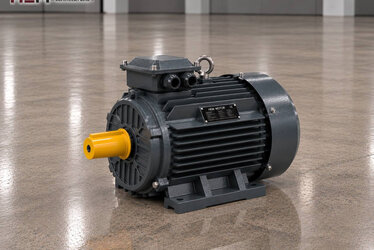
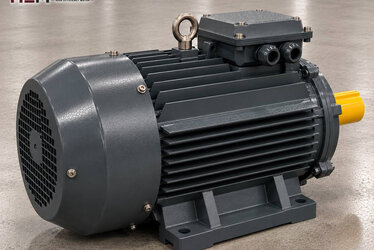
In a factory or warehouse, moving material usually requires an electric motor. The belt that takes raw material into the plant, the roller line carrying products from station to station, the elevator lifting bulk material, the screw conveyor pushing a dusty product through a closed trough and the crane that lifts a load and sets it down elsewhere all belong to the same family. What they have in common is that the motor moves a load from one place to another at a given speed; what differs is how the load starts, how often it stops and starts, and whether the movement is horizontal or vertical. This page looks at handling systems through these differences; conveyors and cranes are not found in our 2026 catalogue, we supply the standard three-phase motors that power these machines.

Horizontal, inclined, vertical: how the direction of travel changes the motor
On a horizontal belt the motor mainly overcomes friction; once the load is moving, the power demand levels off. On an inclined belt or screw conveyor, the work needed to push material upwards is added. In vertical handling, that is elevators and cranes, the weight of the load bears directly on the motor shaft: when the movement stops, the load wants to run back, which is why the machine has a device that prevents reversal.
This distinction also splits the motor choice. With horizontal conveyors the burden is at the moment of starting; with vertical ones starting, stopping and holding all become critical. Belt and line drives are detailed on the conveyor belt electric motors page together with its belt, screw, bucket elevator and roller conveyor sub-pages; here the general framework of handling systems and the lifting side come to the fore.
Lifting and handling machine (crane) motor
The lifting and handling machine (crane) motor sub-page deals separately with the hoisting, bridge travel and trolley travel movements of overhead and monorail cranes. In hoisting the motor carries the load directly and starts very often at short intervals; in the travel movements the real load is accelerating and stopping a heavy mass horizontally.
On cranes the brake that holds the load in the air is vital. If you need a brake motor, state it in your order; values such as brake type, brake torque and supply voltage are clarified together at order stage. On the hoisting side, speed and torque are usually set through a gearbox; the exact values follow from the lifting capacity and speed given by the crane manufacturer.
Stop-start, frequent reversing and heating
What heats a handling motor most is not continuous load but frequent starting. At every start the motor briefly draws several times its rated current, and this current heats the winding. A transfer conveyor on an automation line may stop and start dozens of times an hour; a crane hoist motor may run even more often. That is why, when asking for a quote, writing the number of starts per hour and the on/off ratio gives far more information than the power value alone.
On lines with frequent starts or reversing, a PTC or PT100 sensor can be added to monitor winding temperature; these sensors are order options. A soft starter reduces the starting shock, while a frequency converter both smooths the start and allows the line speed to be adjusted to the product.
Gearbox, flange and mounting
Almost all conveyors run at low speed; motor speed is reduced by a gearbox. For motors connected directly to a gearbox, the flange type and shaft size are the most important details of the job. Connection details of geared arrangements are explained on the electric motors for reducers page, and flange motors on the B5 and B14 flange-mounted electric motors page.
At HEM Motor, depending on frame size, foot-mounted B3, flange-mounted B5 and B14, foot-and-flange B34 and B35 can be chosen; for vertical positions such as an elevator head, V1, V3, V5, V6 and V15 arrangements are also available. Flange and shaft dimensions that must fit the gearbox input are mutually confirmed in the order.
Speed adjustment and long lines
On packaging and automation lines the conveyor speed is often matched to the previous machine. Our three-phase series is suitable for frequency converter operation. If the belt is to run at low speed under full load for long periods, the motor's own fan may not be enough for cooling; in that case an independent fan is added. If the drive is in the panel and the motor at the far end of the line, with a long cable in between, a filter may be needed at the output to protect the motor winding. When these two facts are written in the order the motor is prepared accordingly; general information is on the inverter-compatible electric motors page.
Handling systems meet different environments in food, feed, mining and warehouse facilities. Our motors have IP55 frames and class F winding insulation. At the bottom of a dusty silo, regular cleaning of the frame and fan cover is enough, but for a motor on a line washed directly with pressurised water the standard IP55 frame is not designed with this job in mind; at that point a protective measure by the machine builder or a special motor is needed, and this must be written in the order. For motors standing for long periods in cold stores, an anti-condensation heater can be added.
Sample motor table by handling system
| Handling system | Direction and type of movement | What matters in selection | Sample HEM model |
|---|---|---|---|
| Horizontal transfer belt | Horizontal, frequent stop-start | Starts per hour | 1.5 kW 1500 rpm 90L-4 |
| Inclined bulk material belt | Inclined, loaded start | Starting torque, gearbox ratio | 11 kW 1500 rpm 160M-4 |
| Crane hoist drive | Vertical, very frequent starts | Brake requirement, duty ratio | 7.5 kW 1500 rpm 132M-4 |
| Crane bridge/trolley travel | Horizontal, accelerating a mass | Soft start, pairing of two motors | 2.2 kW 1500 rpm 100L1-4 |
| Bucket elevator | Vertical, start with full buckets | Preventing run-back, flange | 5.5 kW 1500 rpm 132S-4 |
The table gives a starting idea; the final choice is made according to the machine's load, the required speed, the mounting and the operating conditions. The nameplate of the existing motor is always the most reliable reference.
What to send with your request
When asking for a motor for a handling system, write the machine type (belt, roller line, elevator, crane), the required power and speed, the supply voltage, the mounting type and gearbox details, the number of starts per hour, any brake requirement and the quantity. If a motor is to be replaced, a photo of its nameplate makes finding an equivalent easier.
All models and current prices are in our shop; our WhatsApp and phone details are on the contact page.
Frequently Asked Questions
Can a standard motor be used for a crane hoist?
Hoisting needs a brake that holds the load. If you want a brake motor, state it in your order; brake torque and supply voltage are clarified at order stage. The duty ratio and the number of starts per hour are also needed to assess the motor.
Why does a transfer conveyor motor keep overheating?
Frequent starting produces more heat than continuous load, because the motor briefly draws a high current at every start. Using a soft starter or a drive, reducing the number of starts and monitoring temperature with PTC sensors limit the problem.
Which dimensions matter for a motor that will be connected to a gearbox?
Flange type (B5 or B14), flange diameter, shaft diameter and shaft length must match the gearbox. If you send the input data from the gearbox nameplate or the nameplate of the existing motor, the dimensions are confirmed in the order.
Can two motors be used at the same time on a long belt?
Yes, but for balanced load sharing the motors should be of the same type and started by a common drive or a suitable control. This arrangement should be planned together with the line manufacturer.