English
 Français
 Türkçe
 Español
 Русский

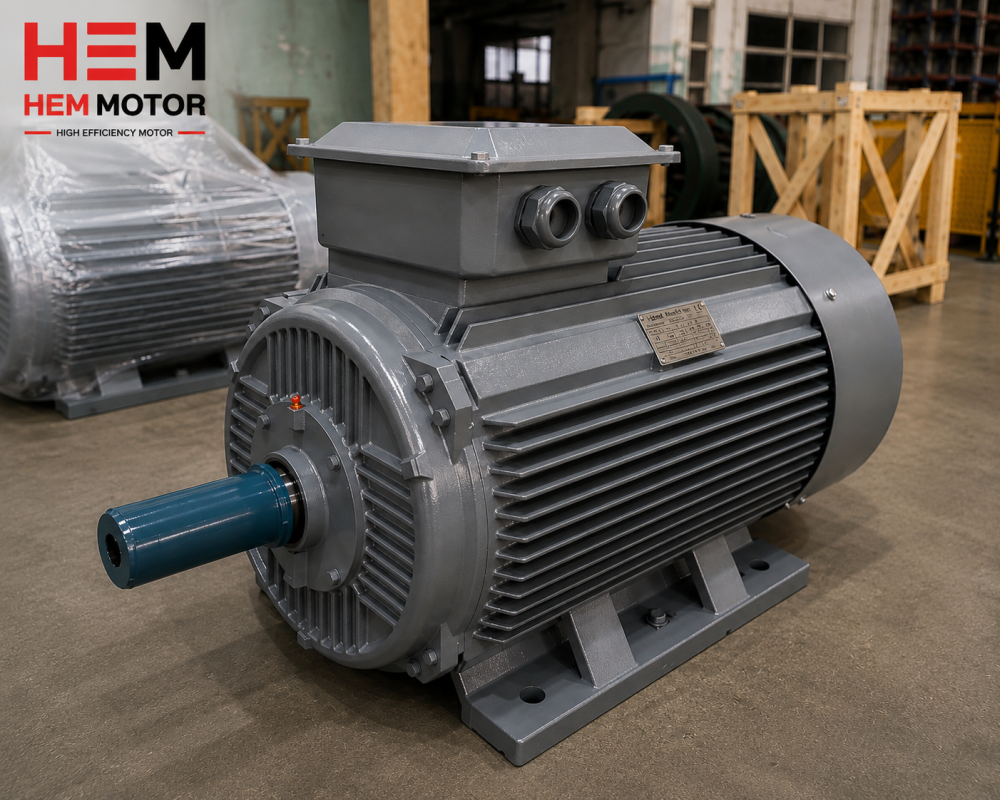
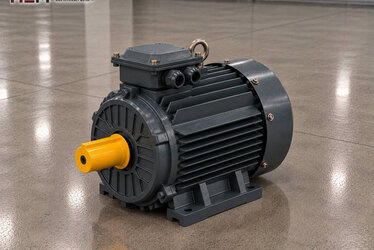
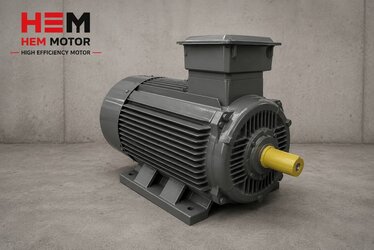
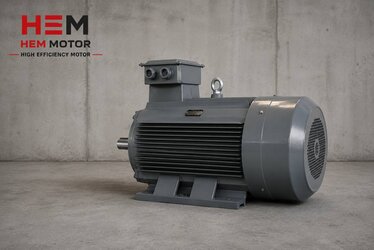
In a mining operation, ore or raw material travels a long way from the moment it leaves the pit until it is shipped as a product: it is crushed, ground, classified, burned, dried, conveyed and stored. Three-phase asynchronous motors work at almost every stop on this route; some are main drives of hundreds of kilowatts, others are small motors for auxiliary jobs such as lubrication, dust extraction or sampling. This page looks at the machines in mining and mineral processing plants from the motor's point of view. Mills, kilns and plants are not found in HEM Motor's 2026 catalogue; what we supply are the standard squirrel-cage motors that set these machines in motion.

From pit to product: where motors work in a mine plant
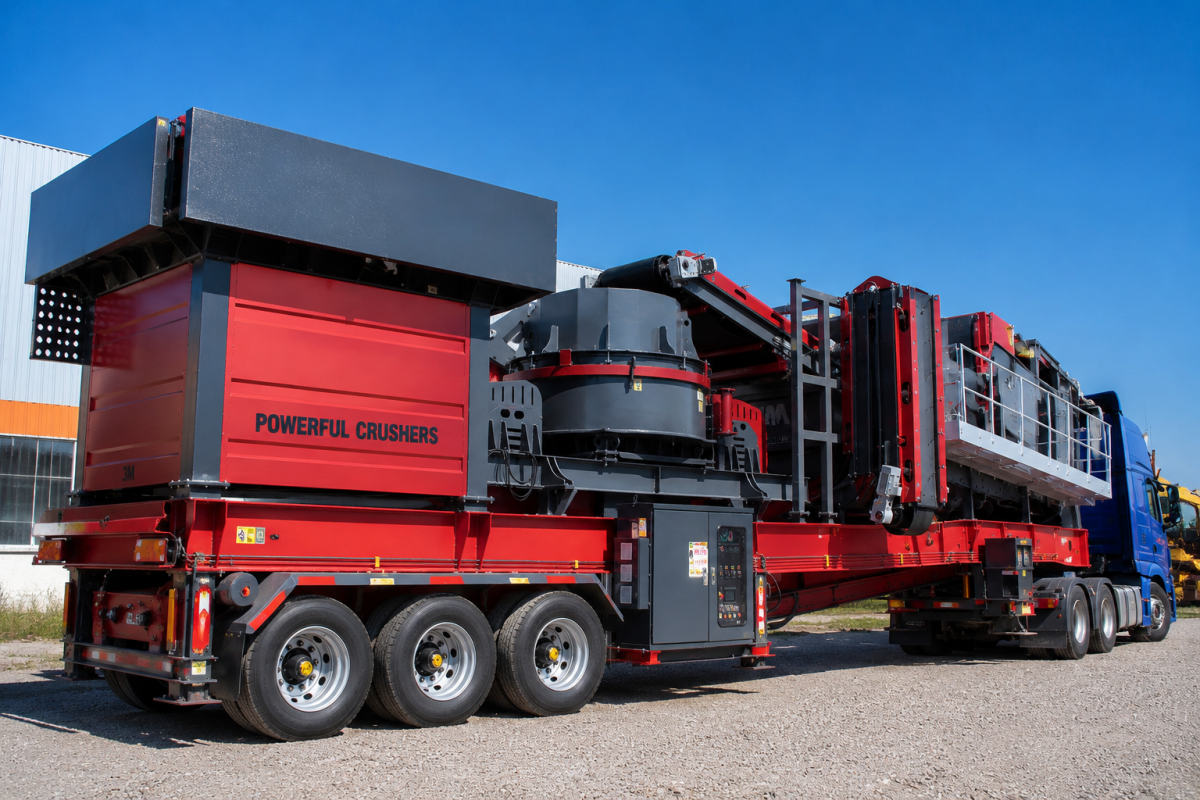
In an open pit, drilling and loading machines come with their own diesel or electrical equipment; the world of stationary motors begins with the first crusher. The crushing and screening stage is detailed on the crusher and stone crushing plant page. Crushed material goes by belt to the grinding building, and from there to classifiers, silos or the burning line.
What sets a mineral plant apart from a quarry are the fine processing stages that follow crushing. Ball mills and hydrocyclone pumps in an ore beneficiation plant, raw meal mills and the rotary kiln in a cement plant, the calcining kiln in a lime and gypsum plant, the drying drum and burner fan in an asphalt plant are examples of these stages. Each brings a different load and a different environment to the motor.
Grinding and burning: large inertia, long starts
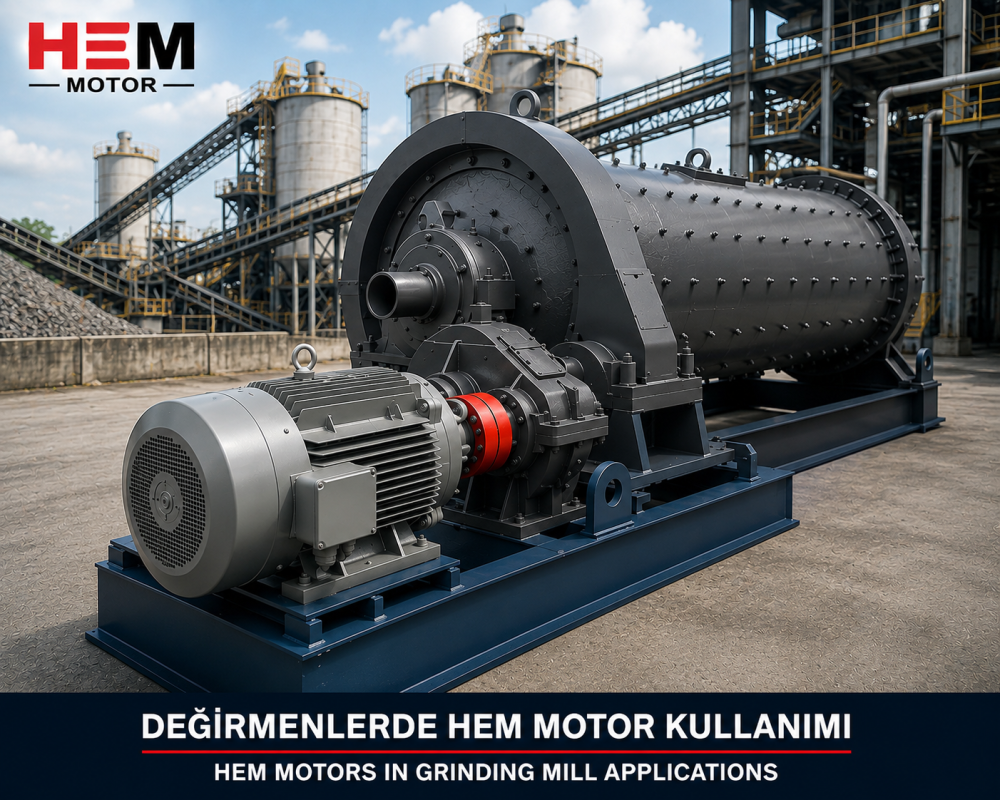
The ball mill motor sub-page explains how a drum filled with steel balls and ore is turned via a pinion and girth gear or a gearbox. Starting a loaded drum is hard for the motor; as the drum begins to turn, the charge piles up on one side and the starting torque demand is high.
The rotary kiln drive motor page covers the main drive of the long, inclined and very slowly turning kiln shell and the auxiliary drive that turns the kiln slowly during maintenance. Because the shell can bend if the kiln stops while hot, the auxiliary drive also has a safety role here.
What these two machines share is a high-inertia load. Slip-ring rotor or DC motors are not included in HEM Motor's 2026 catalogue; with the squirrel-cage motors we offer, a soft starter or frequency converter is used to accelerate the large mass without strain. Which method suits is decided by the machine builder's starting condition and the plant's transformer capacity. For geared arrangements, the connection information on the electric motors for reducers page is helpful.
Cement and asphalt plants: many drives under one roof
The cement plant motors sub-page lists the motors of a cement works: raw and raw meal mills, clinker cooler fans, bucket elevators, air slides and the packing line. A plant of this kind may have hundreds of motors fed from the same switchgear, which is why spare and equivalent motor planning becomes important.
The asphalt plant motors page covers cold aggregate feed belts, the drying drum, the hot elevator, the vibrating screen, the mixer and the dust collection fan. An asphalt plant runs seasonally, makes many starts in a short time and has motors located near hot zones. General information on burner and exhaust fans is also on the fan and extractor motors page.
Dust, temperature, altitude: the motor in a mine environment
What wears a motor most in a mineral plant is fine dust combined with heat. Cement or ore dust packed between the fins cuts cooling, and the winding temperature rises slowly. Regular cleaning of the frame and fan cover, placing the motor away from hot surfaces such as kilns or dryers, and if necessary drawing air through a duct from a cooler spot are therefore basic items of the maintenance plan.
The motors we sell have IP55 frames and class F insulation; the reference ambient temperature in the catalogue is −15 to +40 °C, and installations above 1000 metres require power derating. Many mine sites are at high altitude or in hot climates; both pieces of information must be written in the order. Explosion-proof (Ex) motors are not included in our catalogue; areas such as underground coal mines need a separate motor according to the site's own specification.
A PTC or PT100 sensor to monitor winding temperature, and an anti-condensation heater for motors that stand for long periods, can be added as order options. Our cast iron motors of 75 kW and above come with a service factor of 1.15; this margin is there to absorb sudden load increases and is not added in when sizing the motor. Depending on the frame, B3, B5, B14, B34, B35 and vertical V1/V3/V5/V6/V15 mountings can be chosen; flange and shaft dimensions are confirmed in the order.
Speed control and the power line
On mills, kilns and large fans, drives are used more and more often to change speed according to operating needs. Our three-phase motors are well suited to being driven by a frequency converter. If the motor will run at low speed with full torque for long periods, its own shaft fan may not be enough, and an independent cooling fan is added; if the cable between drive and motor will be long, a filter may be needed, of the dv/dt or the sine type. If these two conditions are stated in the order, the motor is prepared accordingly. Details are on the inverter-compatible electric motors page.
On mine sites the power line is often long, and starting a large motor can affect other consumers on the same line. When choosing the starting method, transformer capacity, cable cross-section and the number of motors starting at the same time should be considered together.
Sample motor table by mineral plant machine
| Machine | How the load behaves | Point to watch | HEM sample model |
|---|---|---|---|
| Ball mill | Loaded drum, high-inertia continuous load | Starting torque, starting method | 160 kW 1000 rpm 355M1-6 |
| Rotary kiln main drive | Very slow, heavy and continuous rotation | Gearbox, start with drive | 90 kW 1000 rpm 315M-6 |
| Bucket elevator (cement) | Start with full buckets | Backstop, dust | 30 kW 1500 rpm 200L-4 |
| Dust collection fan | Inertial, speed-dependent power | Fan speed, hot gas | 37 kW 1500 rpm 225S-4 |
| Aggregate feed belt | Geared, start with loaded belt | Gearbox input speed | 7.5 kW 1500 rpm 132M-4 |
These examples are for guidance; the final choice depends on the machine's load, the required speed, the mounting and the operating conditions. The nameplate of the motor to be replaced is always the first place to look.
What to include when requesting a quote
When asking for a motor for a mineral plant, send the machine type and manufacturer, the required power and speed, the supply voltage (400 V or 690 V), the mounting type, the transmission, the starting method, the installation altitude and the quantity. If a replacement for an existing motor is needed, sending a nameplate photo is the fastest way.
High-power models are in the cast iron frame electric motors list, and all models with current prices are in our shop. For WhatsApp and phone, go to the contact page.
Frequently Asked Questions
What should be considered when choosing a motor for a high-altitude mine site?
Catalogue values apply up to 1000 metres; higher up the air is thinner, cooling weakens and power derating is needed. If you write the installation altitude and ambient temperature in the order, the motor is assessed for those conditions.
Is star-delta enough for a heavy-starting machine such as a ball mill?
Usually not, because in star the starting torque also drops and may not accelerate a loaded drum. A soft starter or frequency converter is more often chosen; the final decision follows the starting condition given by the mill manufacturer.
Can motors for an underground mine be selected from this series?
Areas with an explosive gas or dust risk require Ex motors, and these are not included in our 2026 catalogue. For mills, belts, fans and pumps in surface plants without such a risk, our standard series can be considered.
How does cement dust affect motor life?
Dust sticking to the fins and fan cover reduces heat dissipation, the winding runs hotter and insulation life shortens. Regular cleaning and temperature monitoring with PTC sensors largely limit this effect.