English
 Français
 Türkçe
 Español
 Русский
 العربية

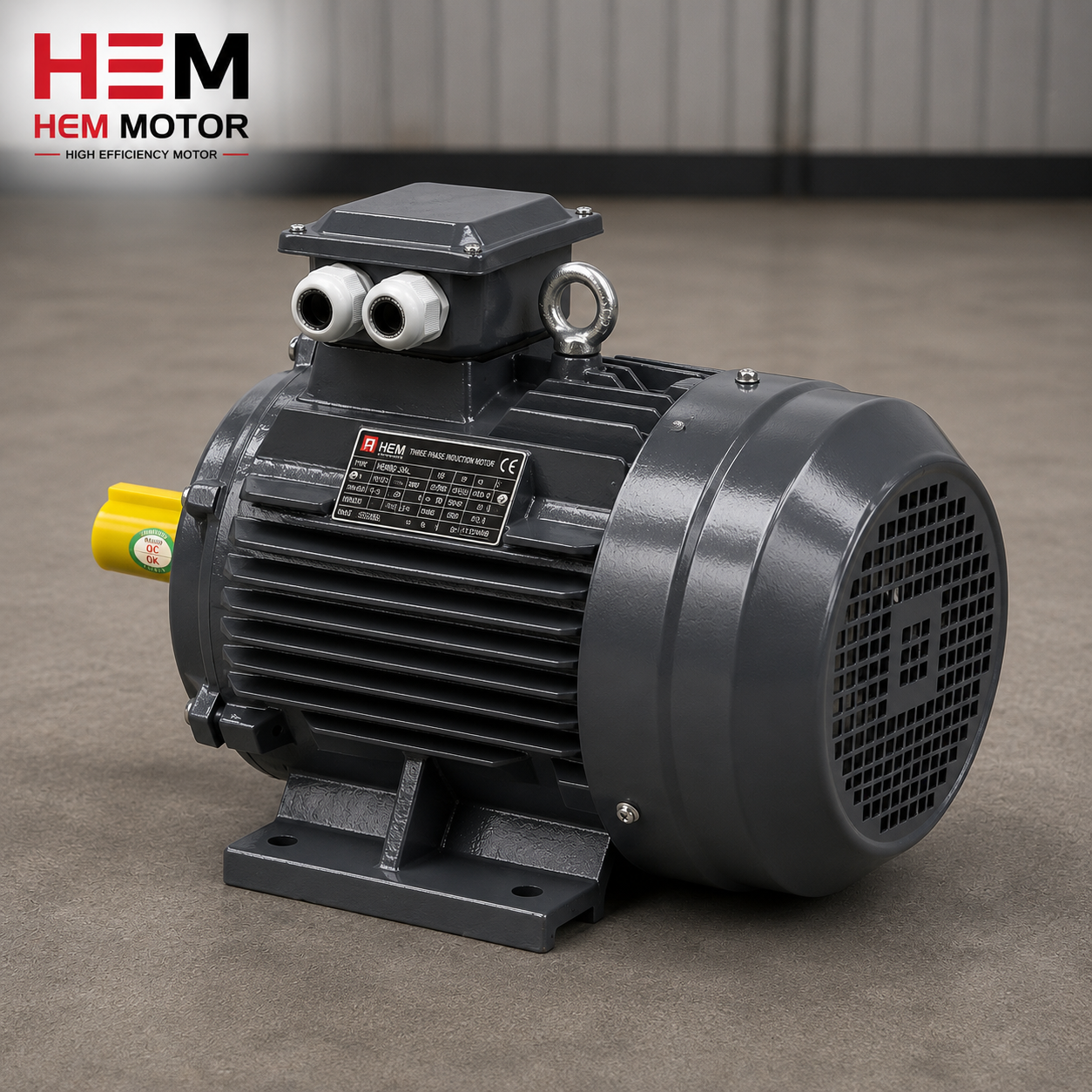
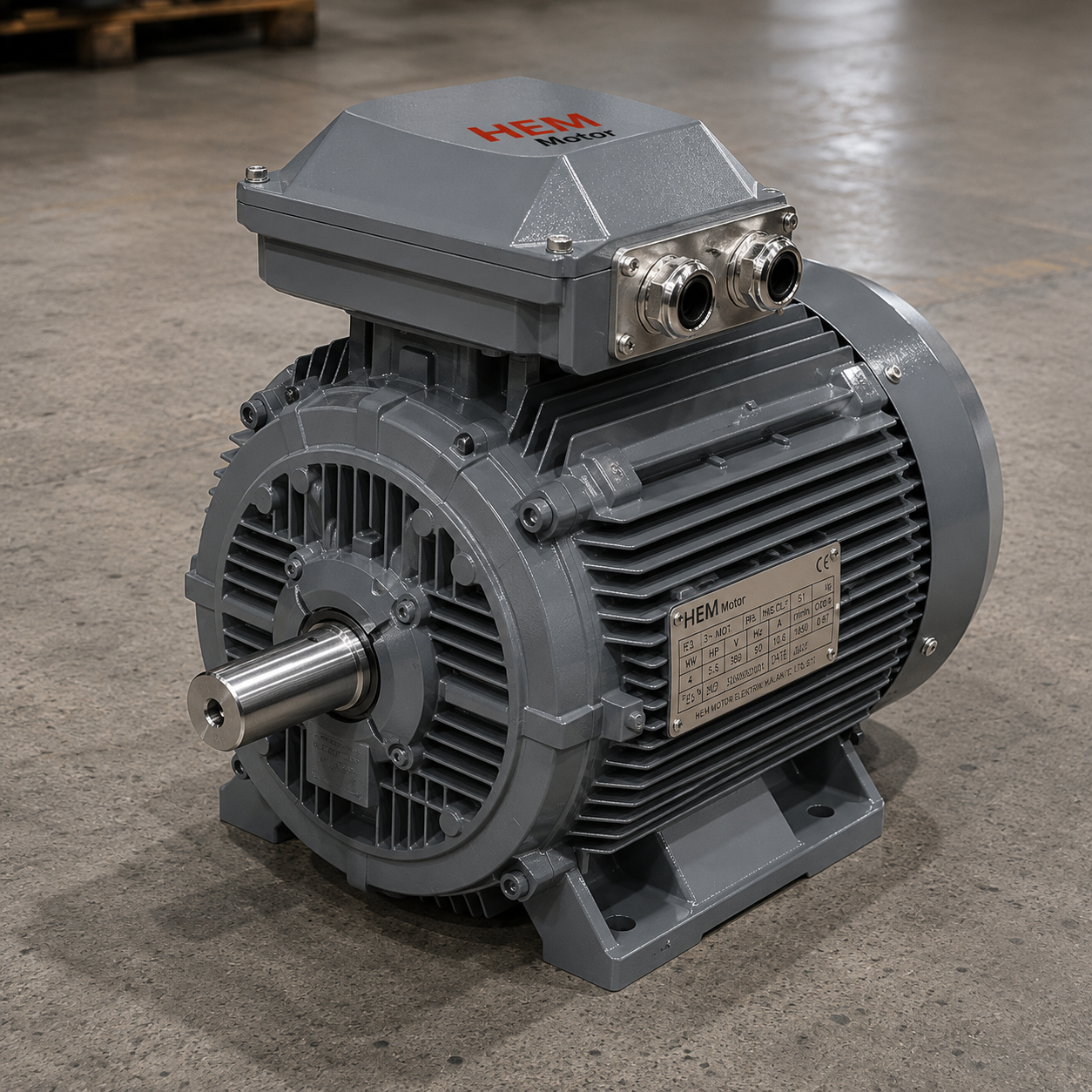
Commissioning a three-phase motor on the electrical side without trouble depends on three pieces of information matching: the line-to-line voltage at your site, the winding voltage on the nameplate and the way the motor will be started. If one of them does not fit, even a motor chosen with the right kW and speed will struggle at start-up or its winding will overheat. This page looks at HEM Motor's 0.25–355 kW three-phase range purely from the supply side.
Model codes, IEC frames and speed options are listed separately on the Three-Phase Electric Motors page.
The 400 V 50 Hz Supply in Turkey: What Does a "380 V Motor" Mean?
On site people still talk about a "380 V motor". Today's low-voltage supply, however, is rated 400 V phase-to-phase and 230 V phase-to-neutral; the older values were moved up to this level. A motor whose nameplate carries a 400 V rating also runs on a line that measures 380 V and stays within tolerance.
All 117 three-phase models HEM Motor has on sale are built for 50 Hz. If your plant is fed at 60 Hz or the line voltage differs from 400 V, state this before ordering.
Two Winding Voltages in the Range and the Boundary Between Them
The dual voltage on the nameplate tells you that the same winding suits two different supplies through two connection methods. The lower figure belongs to delta, the higher one to star. In HEM data the boundary lies between 3 kW and 4 kW. Between 0.25 and 3 kW, 42 models carry a 230/400 V winding; on a 400 V line they run in star. The 75 models from 4 to 355 kW have a 400/690 V winding; on the same line they run in delta, and on a 690 V supply they can be connected in star.
| Power range (HEM models) | Winding voltage | Connection at 400 V | Starting options |
|---|---|---|---|
| 0.25–3 kW (42 models) | 230/400 V | Star (Y) | Direct, soft starter, frequency inverter; star-delta not possible |
| 4–11 kW (24 models) | 400/690 V | Delta (Δ) | Direct, star-delta, soft starter, frequency inverter |
| 15–55 kW (21 models) | 400/690 V | Delta (Δ) | Star-delta, soft starter, drive; direct start depends on supply capacity |
| 75–355 kW (30 models, SF 1.15) | 400/690 V | Delta (Δ) | Star-delta, soft starter, drive; direct start depends on supply capacity |
The table is compiled from the models on sale; the right method is set by the starting behaviour of the load, the transformer capacity and the requirements of the distribution company.
Six Terminals and Link Bars in the Terminal Box
Both ends of each phase winding come to the terminal box, giving six connection points in total. The winding starts (U1, V1, W1) sit on top, the winding ends in shifted order (W2, U2, V2) below. The L1, L2 and L3 conductors are connected to the upper starts in both arrangements; the difference is made by the link bars.
- Star: the three winding ends at the bottom are joined at one point with two horizontal links. Models of 3 kW and below are connected like this at 400 V.
- Delta: the links are fitted vertically and each winding start is bridged to the terminal beneath it. This is the 400 V arrangement for models of 4 kW and above.
- Star-delta starting: the links are removed and each of the six ends is taken by a separate core to the contactors in the panel.
The protective earth (PE) conductor must be connected to the earthing screw in the box; a cable gland matched to the cable diameter and blanking plugs in unused entries keep IP55 protection in the terminal box as well. Before switching on, compare the link arrangement with the nameplate.
Which Models Allow Star-Delta Starting?
In star-delta starting the motor starts in star and each phase winding sees about 0.58 times the line voltage. Once speed has risen the connection is switched to delta and the winding receives full voltage. Starting current and starting torque fall to roughly one third compared with direct-on-line starting.
The condition is that the motor runs, in normal operation, at a delta voltage equal to the supply voltage. On a 400 V line this is provided by the 400/690 V winding; so in the HEM range every model from 4 kW upwards can be used with a star-delta starter. Small models with a 230/400 V winding already run in star at 400 V and cannot be switched to delta; they are started direct, with a soft starter or with a drive.
Because torque also drops to one third, the method suits fans that start unloaded, pumps with a throttled valve and saws. On machines that start under load, such as a full conveyor, a crusher or a mixer, a soft starter or frequency inverter is considered.
Phase Sequence, Direction of Rotation and Phase Loss
The phase sequence of the supply decides which way the motor turns. If the direction is wrong, two phase leads are swapped after the supply has been isolated and locked off; on pumps and fans, do a short direction check at the first start. Machines that reverse frequently use a forward-reverse contactor set or a drive.
If one phase is lost the motor keeps running on the remaining two, its current rises and the winding heats up quickly. Imbalance between phase voltages also unbalances the current, so all three phases should be measured individually during commissioning. The following protection chain is recommended in the panel:
- a motor protection circuit breaker (MPCB) or thermal overload relay set to the rated current,
- a phase monitoring relay that detects phase loss and wrong phase sequence,
- for frequent starts or critical duties, a PTC or PT100 winding sensor (order option) with its monitoring relay; an anti-condensation heater for motors standing in damp places.
Details are in the thermal relay, fuse and MPCB guide.
Rated Current in Cable and Switchgear Selection: Three HEM Examples
Every calculation in the panel starts with the 400 V rated current on the nameplate. Thermal protection is set to this value; cable cross-section is additionally determined by starting current, line length and acceptable voltage drop. Three examples from HEM's 1,500 rpm models:
- 3 kW, 100L2-4 (230/400 V, star): rated 1,450 rpm, rated current 6.02 A. The thermal setting is this value directly.
- 7.5 kW, 132M-4 (400/690 V, delta): 14.3 A at 400 V and 1,460 rpm. If the thermal relay in a star-delta panel sits in the winding branch, the setting is about 14.3 × 0.58 ≈ 8.3 A.
- 75 kW, 280S-4 (400/690 V, SF 1.15): rated 1,486 rpm, rated current 129 A. At this power the starting method directly governs cable and switchgear selection; in a star-delta circuit about 75 A flows through the winding branch.
These three models are examples only; the actual choice is set by the machine load, the required speed, the mounting arrangement and the operating environment. Currents for other ratings are in the current table, all models in the electric motor shop, and pre-energising checks in the commissioning list.
Drive Supply and Single-Phase Lines
If the motor is to be fed from a frequency inverter, speed control is possible with our range. If full load is drawn at low speed for long periods, the shaft-mounted fan may not be enough and a separate fan is added; if the cable between drive and motor is long, a dv/dt or sine filter is fitted at the output. Mention both conditions in your order; details are in the inverter question. Where only a 230 V single-phase line is available, our single-phase electric motor range or bringing a three-phase supply to the site is considered.
Your Supply and Machine Details for a Quotation
So that we can offer a motor with the right winding and connection, send us the machine the motor will drive, the required power (kW) and speed (rpm), the supply voltage and frequency at your site, the starting method you plan, the mounting type and the quantity. Which foot, flange and vertical versions are available for each frame is explained in the mounting arrangements question; we confirm flange and shaft dimensions together with you when ordering.
If you are replacing an old motor, simply send a photo of its nameplate; winding voltage and connection are read from it too. See the shop for models delivered from stock and the three-phase motor price page for list prices; for a quotation, write to us via our contact page.
Frequently Asked Questions
Can I use my old motor marked 380 V on a 400 V line?
Yes. Both values describe the same supply, one being the old and the other the current designation, and motors run without trouble within tolerance. What matters is that the terminal connection follows the 400 V entry on the nameplate.
Can I run my 5.5 kW motor with a star-delta starter?
Yes. Our 5.5 kW models have a 400/690 V winding, so on a 400 V line the motor is normally connected in delta and a star-delta starter can be used with it. The links are removed and the six ends are taken to the panel.
What happens if I connect a 2.2 kW motor in delta at 400 V?
Models of this rating have a 230/400 V winding. In delta each winding receives about 1.73 times its design voltage; current rises sharply and the winding is damaged within a short time. The correct connection at 400 V is star.
Does a phase monitoring relay replace the motor protection breaker?
No, the two watch for different faults. The phase relay catches a lost phase and wrong sequence; the MPCB or thermal relay trips on overload according to the rated current. On critical duties a PTC sensor adds a third layer.