 English
 Français
 Türkçe
 Español
 Русский
 العربية

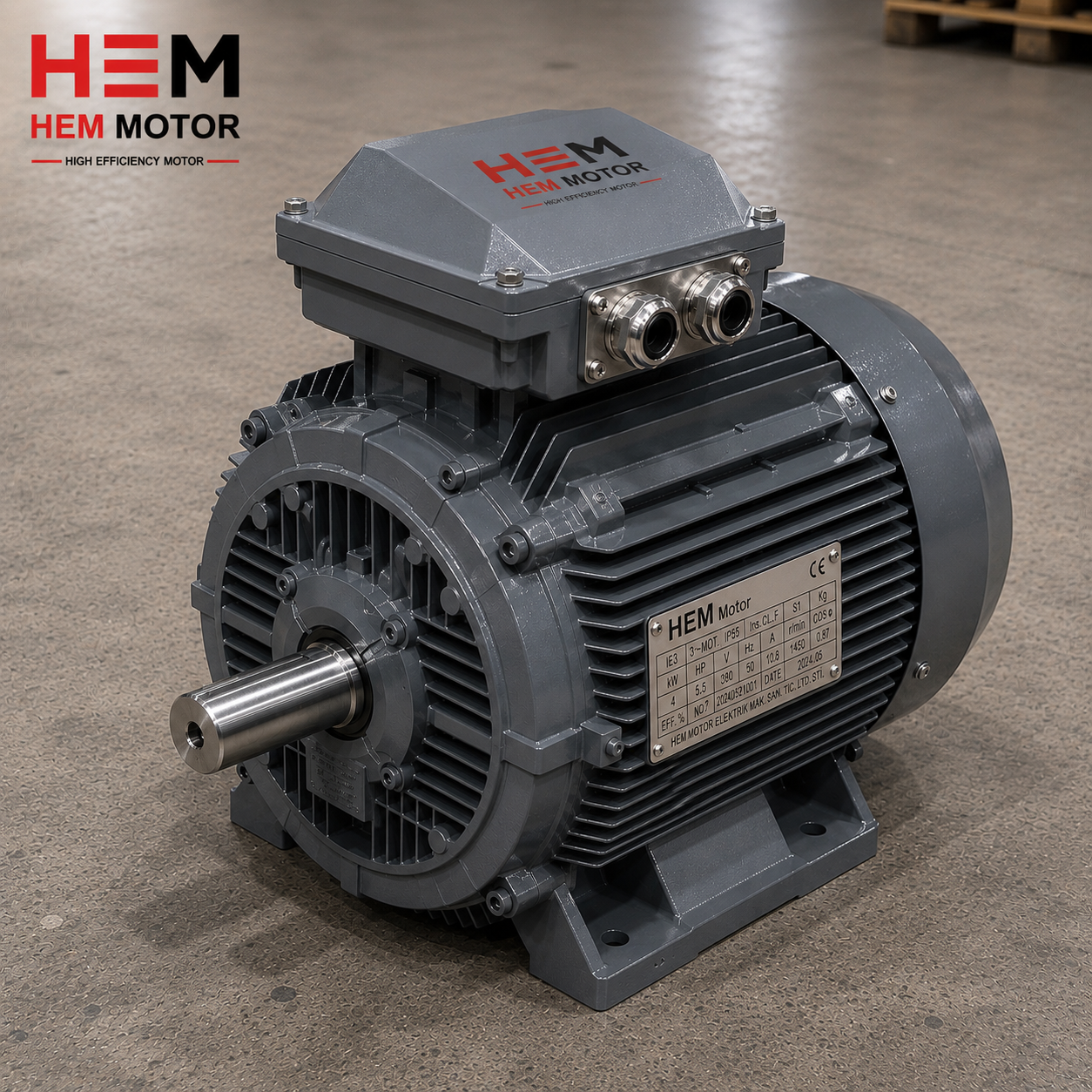
IE5 is the top efficiency class defined in IEC 60034-30-1, and the HEM Motor 2026 catalogue lists it as "Ultra Premium". This page does not describe IE5 in general terms. It works from what the IE5 model tables in the catalogue actually say: which power ratings and pole numbers are covered, where the tables match IE4 and where they differ, how to treat IE5 together with a drive, and what has to be confirmed when an IE5 motor replaces the motor on an existing machine.
For the general framework of the IE4 class, see the IE4 High Efficiency Electric Motors page; this page covers only the points specific to IE5.
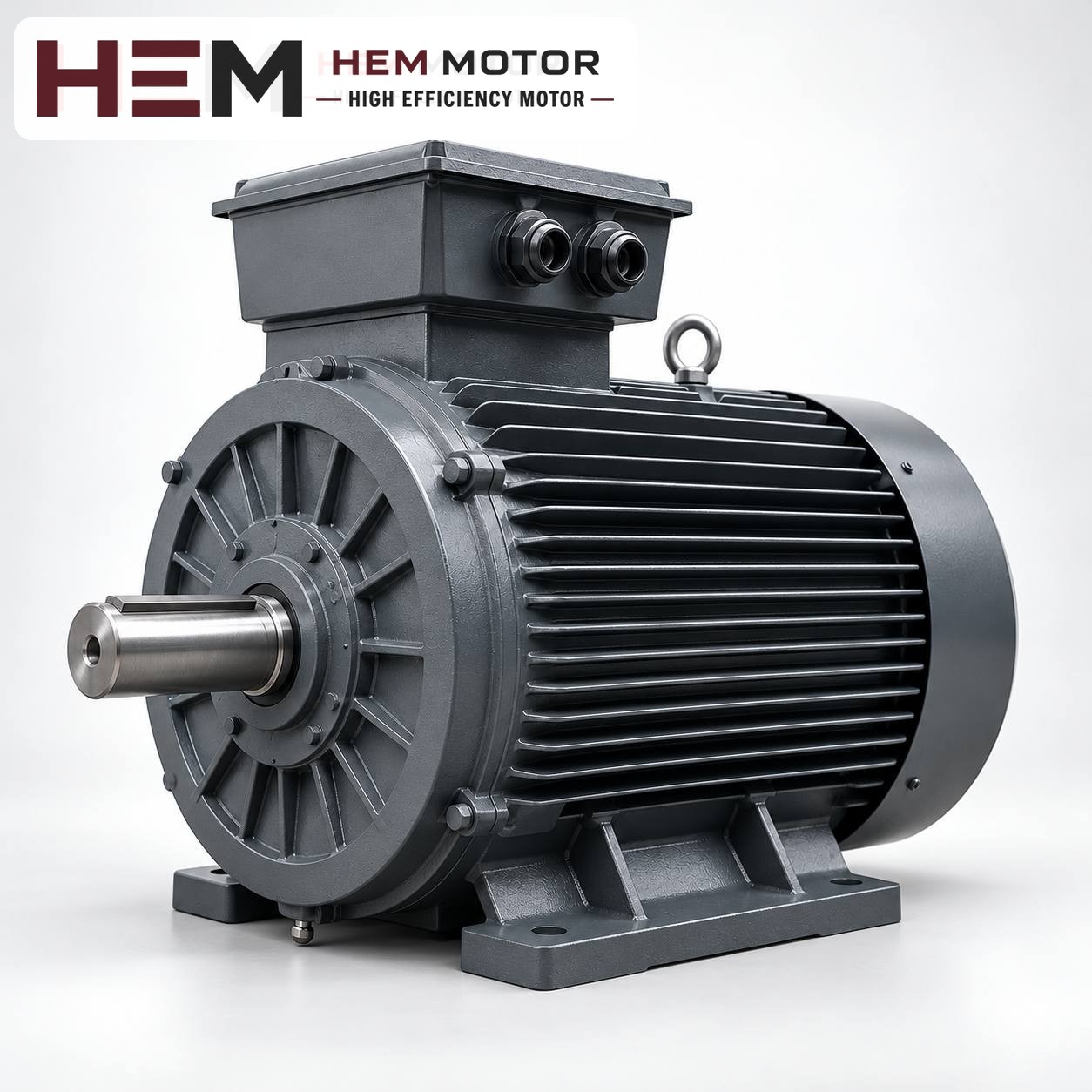
Where IE5 Sits in the IEC 60034-30-1 Classification
IEC 60034-30-1 divides the permitted losses of motors with the same power and pole number into levels. In the catalogue these levels appear as IE3 Premium, IE4 Super Premium and IE5 Ultra Premium; the higher the class, the smaller the loss allowance for a motor of the same power.
An IE class is a limit value, not a model; the motor's kW, speed, frame and supply are discussed separately. If you want the numerical limits of each class, the 50 Hz limit tables on page 14 are available through the HEM Motor Technical and Product Catalogue 2026.
The IE5 Family in the Catalogue: 80 Models, Three Pole Options
The IE5 model tables in the catalogue are split over three pages and contain 80 type codes in total:
- 2 poles, 3,000 rpm: 27 models, from IE5-632-2 to IE5-355L-2; 0.25–315 kW.
- 4 poles, 1,500 rpm: 27 models, from IE5-711-4 to IE5-355L-4; 0.25–315 kW.
- 6 poles, 1,000 rpm: 26 models, from IE5-712-6 to IE5-355L-6; 0.25–250 kW.
The tables are drawn up for a 50 Hz supply; currents are given separately for 380, 400 and 415 V line voltages, and the speed column shows the motor's actual speed under load. The IE3 section of the catalogue also has a 750 rpm (8-pole) table, whereas the IE5 tables are limited to 2, 4 and 6 poles. If you need an 8-pole motor, state it separately in your request.
In the common specifications of the series, the motor type is defined as squirrel-cage asynchronous (AC). The frame is GG20 cast iron, the shaft C45 carbon steel and the winding 100% electrolytic copper; protection is IP55 and insulation class F. The paint is electrostatic powder in RAL 7012 and RAL 7024, or a custom colour.
Noise and vibration reference
The catalogue gives roughly 58–75 dB(A) for the general series and a separate range for the IE5 1,500 rpm family: roughly 52–70 dB(A). The vibration reference is 1.8 mm/s or less under ISO 10816/20816 and IEC 60034-14. Values vary with power, fan and frame; the exact figure is in the test report of the model.
Side by Side with the IE4 Table: Same Frame Code, Higher Starting Current Ratio
Comparing the IE4 and IE5 tables row by row, at the same power and pole number the frame size in the type code, the rated speed, the rated torque and the starting torque ratio (Ts/Tn) are identical in both classes. The clear difference is the starting current ratio (Is/In): from 0.75 kW upwards this ratio is higher in the IE5 rows.
| Power and poles | Catalogue frame code (IE4 and IE5) | Rated torque | Is/In: IE4 → IE5 |
|---|---|---|---|
| 7.5 kW, 2 poles | 132S2 | 24.3 Nm | 7.9 → 9.5 |
| 7.5 kW, 4 poles | 132M | 48.7 Nm | 7.5 → 9.5 |
| 30 kW, 6 poles | 225M | 289.4 Nm | 6.9 → 8.3 |
| 55 kW, 4 poles | 250M | 353.7 Nm | 7.4 → 9.0 |
| 315 kW, 4 poles | 355L | 2,019 Nm | 7.1 → 8.5 |
Values are taken from the IE4 and IE5 model tables of the catalogue; the final choice depends on the machine load, the required speed, the mounting and the operating conditions.
In practice: if the motor is started direct on line (DOL), the current drawn at start-up is higher than for its IE4 counterpart. The switch, fuses and motor protection circuit breaker (MPCB) must be selected and set for this current; for details see our article on thermal relays, fuses and MPCBs. On a weak supply line, star-delta, a soft starter or a drive may be the easier way to start.
Treating IE5 Together with the Drive (Inverter)
IE5 usually comes up for machines that run long hours, such as pumps, fans and compressors, and in some of them the speed is set by a frequency converter. The motor and drive should then be thought of as one package. Our three-phase series are suitable for speed control with a frequency converter. The catalogue's notes on drive operation fall under four headings:
- The motor's rated current must be matched to the drive's rated current and carrier frequency.
- At low speed the shaft-mounted fan may not cool enough; if the motor runs for long periods at low speed with full torque, a separate fan may be needed.
- If the cable between motor and drive is long, a dv/dt or sine filter is considered.
- On large frames an insulated bearing or shaft grounding may be needed.
When requesting an IE5 for drive operation, it is enough to state the speed range (minimum and maximum frequency), the load type at low speed and the cable length; we then settle the options together. For a general Q&A there is also the page can I run the motors on a frequency inverter.
Switching to IE5 in an Existing Plant: Confirming Mechanical Fit
On a running machine the real question is whether the new motor will fit in place of the old one without problems. The order of checks:
1. Frame and shaft
Note the frame size (e.g. 132M, 250M) and shaft diameter from the old motor's nameplate. In the mounting and dimension pages of the catalogue, the IE4 and IE5 series share dimension tables for B3, B5 and B35 across H63–355; IE3 has a separate table. So if the old motor is IE3, the dimensions need to be compared one by one. You can view the dimension tables through the frame size table and the 2D technical drawings.
2. Mounting arrangement
Mounting options B3, B5, B14, B34, B35 and vertical V1/V3/V5/V6/V15 are offered according to the frame; flange and shaft dimensions are confirmed with the order. For details see the mounting arrangements page.
3. Bearings and coupling
The catalogue's bearing table contains IE3 and IE4 columns; the bearing arrangement for IE5 is settled separately with the order. If there is a belt pulley or gearbox connection, the shaft extension and key dimensions should be compared with the old arrangement.
4. Electrical side
The nameplate voltage and connection (star at 3 kW and below, delta at 4 kW and above) should be compared with your supply, and because of the starting current difference above, the protection settings should also be reviewed. PTC or PT100 winding sensors and an anti-condensation heater are order options.
What to Send Us with an IE5 Request
The IE class is not stated on the pages of the models in our shop. If you want IE5, write it clearly in your quote request; the catalogue contains the IE5 options listed above. If you want to look at ready models, you can browse the products listed by power, speed and frame in our electric motor shop.
For a clear quote, send the following in one message:
- The machine the motor will drive and its duty (continuous, intermittent, with a drive)
- Power (kW) and speed (rpm) or number of poles
- Supply voltage and connection
- Mounting type (B3, B5, B35, vertical, etc.) and frame size if known
- Speed range and cable length if a drive is used
- Quantity and options such as PTC/PT100 or an anti-condensation heater
If you are replacing an existing motor, the quickest way is to send a photo of its nameplate following the steps on the send your motor nameplate page. For questions, use the phone, WhatsApp and e-mail channels on our contact page, or go back to the shop for models in stock.
Frequently Asked Questions
Can an IE5 motor be fitted in the same place as an IE4 motor of the same power?
In the catalogue both classes use the same frame code and shared dimension tables at the same power and pole number. Flange, shaft and bearing arrangement are still confirmed with the order.
Why does the starting current of an IE5 motor look higher?
In the catalogue's IE5 tables the Is/In ratio is higher than in the IE4 rows from 0.75 kW upwards; for example 9.5 instead of 7.5 at 7.5 kW, 4 poles. If the motor is started direct on line, check the fuse and motor protection settings accordingly.
Can I order a motor from the shop as IE5?
The IE class is not stated on the product pages in the shop. State your IE5 requirement in a quote request together with power, speed and mounting; we will reply based on the IE5 options in the catalogue.
Can I run an IE5 motor on an inverter?
Yes; for long periods at low speed with full torque a separate fan, and with long cables a dv/dt or sine filter, may be needed. Write these conditions in your request.
Is there an 8-pole (750 rpm) model in the IE5 family?
The IE5 model tables in the catalogue are drawn up for 2, 4 and 6 poles; the 750 rpm table is in the IE3 section. If you need an 8-pole motor, state it separately in your request.