 English
 Français
 Türkçe
 Español
 Русский


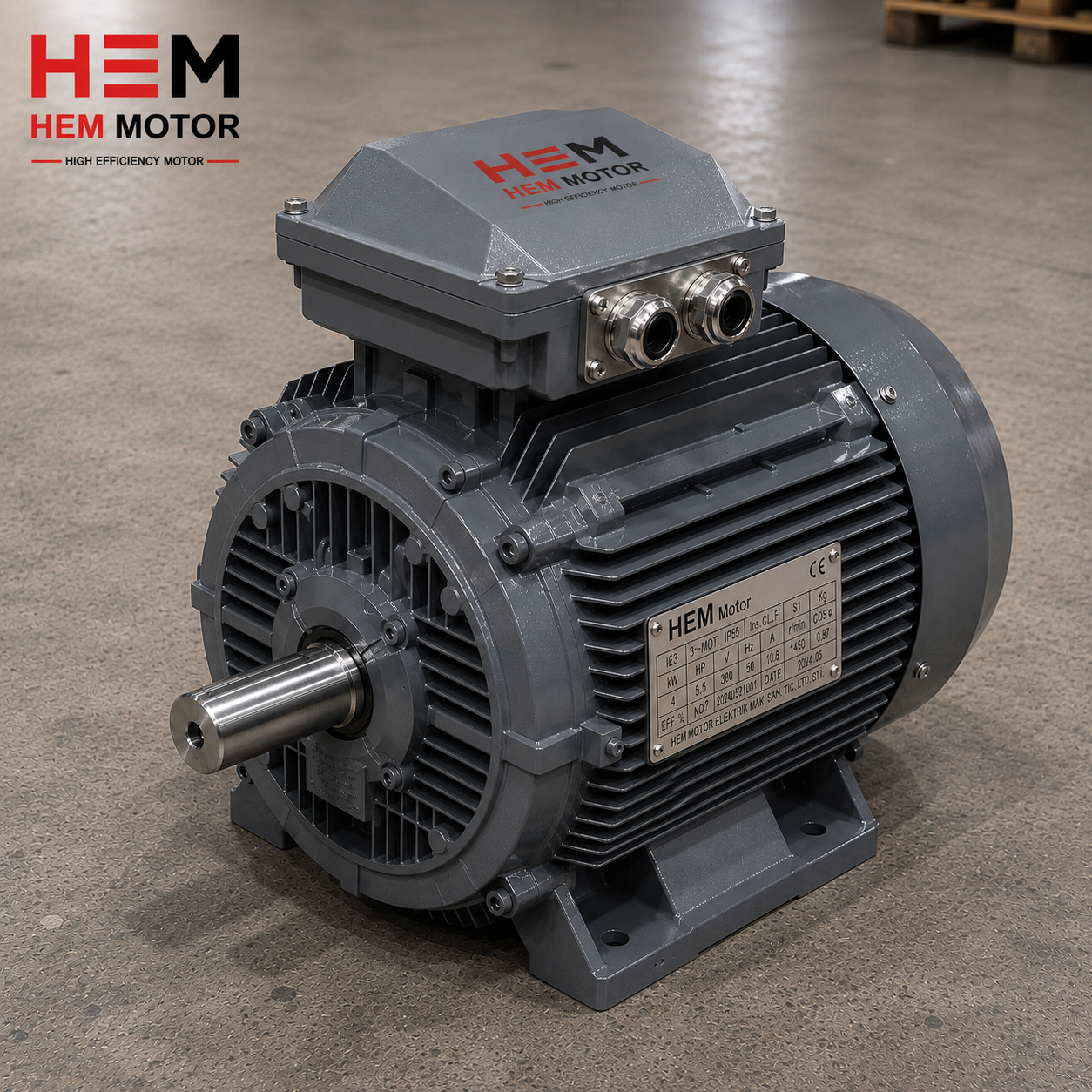
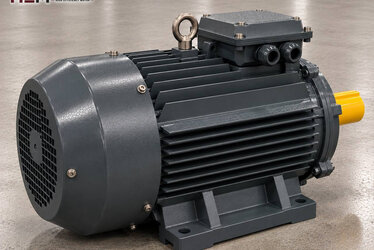
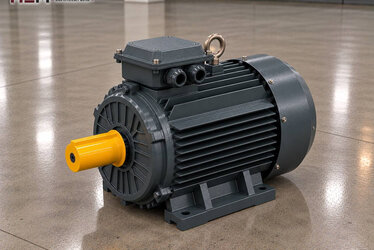
In a building's air-conditioning installation, electric motors work in places nobody sees: in the fan section of the rooftop air handling unit, in the circulation pumps of the basement boiler room, in the pump station next to the chiller and on top of the rooftop cooling tower. This page covers the three-phase asynchronous motors used to drive fans and pumps in HVAC installations. The focus is on the questions mechanical contractors and building operators face: how the load changes with the seasons, how belt-driven and direct-coupled arrangements differ, and what to check besides the nameplate when replacing a motor.

Where the Motor Works in an HVAC Installation
Air handling units and ventilation fans: Supply and exhaust fans are drives that run throughout the building's operating hours. In older units the motor turns the impeller by belt; in newer designs the impeller usually sits directly on the motor shaft.
Circulation and boiler pumps: Pumps that circulate heating and cooling water to the terminal units on each floor run for long hours. Pump-side details are described on the pump electric motors page, and types mounted straight into the pipeline on the inline pump motor page.
Around the chiller: The chiller's own compressor comes with the unit; the motors the contractor selects are the condenser water pump, the chilled water pump and the tower fan.
Cooling tower: The fan motor working on the roof, inside a warm and humid air stream, needs particular attention. The Cooling Tower Motor page covers vertical mounting, the humid environment and fan speed control in detail.
Seasonal Load and the Fan's Speed Behaviour
An HVAC system does not run at full capacity for most of the year; demand drops in spring and at night. On fans and centrifugal pumps the shaft torque rises with speed, while the absorbed power changes roughly with the cube of speed. This is an approximate rule that varies from system to system, yet it explains why lowering speed has become more common than throttling flow with a damper.
Our three-phase series can run with the frequency converter used for speed control. Since fan load becomes lighter at low speed, cooling is usually not a problem; still, if the motor will carry a high load at low speed for long periods, a separately powered fan may be needed. If the converter panel is in the plant room and the motor is on the roof, the cable gets long; in that case a dv/dt or sine filter should be considered. Simply pass these two points on with the order; the full explanation is on the inverter-compatible electric motors page.
The Motor in Belt-Driven and Direct-Coupled Fans
In belt-driven units the fan speed is set by the pulley ratio and the motor usually sits on a slide base. Too much tension strains the bearing on the pulley side; it is the part maintenance teams replace most often. Checking pulley alignment when renewing the belt extends motor life.
In direct-coupled fans the weight and imbalance of the impeller act directly on the motor shaft. This arrangement requires shaft diameter, shaft length and flange size to match the old motor exactly. Foot-mounted B3, flange B5 and B14 and the combined B34 and B35 designs are offered together with vertical V1, V3, V5, V6, V15 options depending on frame; dimensions are clarified at the order stage. For flanged designs see the flange-mounted electric motors page. Details by fan type are under fan and extractor motors.
Plant Room and Roof: Ambient Conditions
The boiler room is hot; if pipe insulation is poor, the ambient temperature stays high even in summer. Because the motor cools through its frame surface with its own fan, a pump motor squeezed into a corner with little air runs hotter. Rooftop motors, meanwhile, are exposed to sun, rain and the difference between day and night temperatures.
The enclosure is IP55 and the winding insulation is class F. Outdoor motors that stand idle for long periods and cool down at night may show condensation; an anti-condensation heater is an order option. For sites that want to monitor the winding, a PTC or PT100 sensor can also be added with the order. In applications that operate in a fire scenario and require documentation, such as smoke extraction fans, motor selection follows the project specification; please state any such need in the order.
Preliminary Motor Selection Table by HVAC Equipment
| Equipment | Motor load | Value to check | Example HEM model |
|---|---|---|---|
| Air handling unit supply / exhaust fan | Fan load rising with speed, long running hours | Fan speed, pulley ratio or direct-coupling dimensions | 5.5 kW 132S-4 (1,460 rpm) |
| Heating / cooling circulation pump | Continuous duty, variable flow | Pump speed, coupling or flange connection | 7.5 kW 132S2-2 (2,930 rpm) |
| Condenser water pump | Continuous load during the cooling season | Flow and head | 30 kW 200L-4 (1,475 rpm) |
| Cooling tower fan | Humid air stream, vertical mounting | Mounting orientation, condensation measures | 11 kW 160L-6 (970 rpm) |
The models given are examples; the final choice depends on the fan or pump load, the required speed, the connection type and the conditions of the installation. The nameplate of the motor being replaced is always the first place to look.
Motor Replacement and Starting
In an occupied building, motors are usually replaced at night or at the weekend, so it matters that the new motor fits without trouble when it arrives on site. Telling us in advance the old motor's frame size, shaft and flange dimensions and terminal box orientation shortens installation time. The frame size table article is useful for frame dimensions.
On large-diameter fans the inertia of the impeller lengthens the starting time. Our models of 4 kW and above have 400/690 V windings; since they are connected in delta on a 400 V supply, they lend themselves to star-delta starting. In converter-fed systems the starting ramp is set on the converter.
What to Send When Asking for a Quote
For a fast quote, please provide: machine or equipment type (AHU fan, circulation pump, tower fan, etc.), motor power (kW), speed (rpm), supply voltage, mounting arrangement and orientation, whether it will run on a converter, and the quantity. Taking and sharing a photo of the old motor's nameplate as shown in the send a motor nameplate article makes the job easier.
Current model prices are on the buy electric motors page. Our WhatsApp and phone details are on the contact page.
Frequently Asked Questions
Will replacing the AHU fan motor with a more powerful model increase airflow?
No. Airflow is determined by fan speed and the impeller; power only covers the load the fan demands at that speed. If more airflow is wanted, the fan side and the duct system need to be assessed.
Should a 2-pole or 4-pole motor be chosen for a circulation pump?
It depends on the pump's design speed; the speed on the pump nameplate or catalogue curve is the reference. A motor with a different speed changes the pump's operating point.
Why does the rooftop motor start with difficulty after standing idle in winter?
Condensation can form in the frame during long stops, and bearing grease thickens when cold. An anti-condensation heater is an order option; an insulation measurement before the first start is also recommended.
Is there a single-phase motor for a small ventilation unit?
In small buildings without a three-phase supply, our 220 V single-phase series can be used; its power range extends from 0.18 kW to 5.5 kW. Details are on the single-phase electric motor page.

