English
 Français
 Türkçe
 Español
 Русский

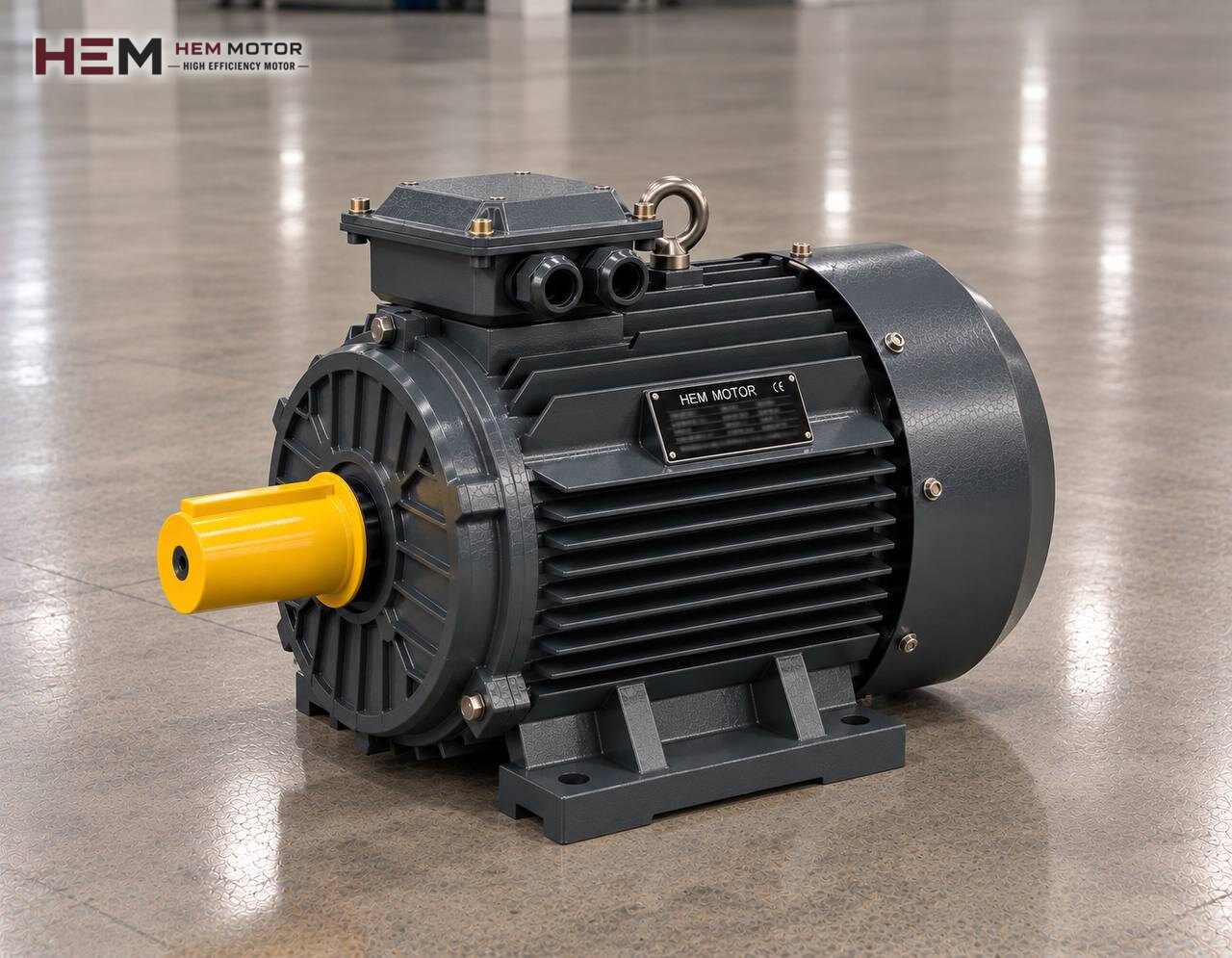
A cooling tower lets water that returns warm from an industrial process or a building's chiller flow down over fill material and meet the air passing through; part of the water evaporates and the rest cools and drops into the basin. Plastic injection shops, foundries and rolling mills, food plants and the water-cooled chillers of large buildings all use this arrangement. This article covers the electric motors that drive the tower fan and the water circuit; for the general picture of the sector, see our HVAC Sector Electric Motors page.

Where the Motor Sits Depends on the Tower Type
The most common layout is the induced draft tower, where the fan sits on top of the tower and draws air upward. In these towers a large-diameter axial propeller turns in a horizontal plane. In small packaged towers the propeller is mounted directly on the motor shaft and the motor stands vertically, often in or just below the airflow. In large field-erected towers the motor is placed on a platform outside the fan stack, sends power through a long drive shaft to a right-angle gearbox, and the gearbox turns the propeller at low speed.
The second group is the forced draft tower, where the fan sits beside or below the tower and blows air in. These designs often use centrifugal fans, and the motor is on the dry, inlet-air side. Keeping the motor away from the wet stack is a natural advantage here, although fan power is usually higher for the same air volume.
Humid Air, Mist and Motor Protection
The air leaving the tower is almost saturated and carries droplets. In direct-drive packaged towers the motor works in or near this air, so protection is central to the design. Our motors come with IP55 enclosure protection and class F insulation; IP55 protects against water jets and harmful amounts of dust, but it is not a motor specifically designed to run in a continuously wet, saturated airstream. If the motor will stay in this stream, state it clearly in your order; the protective measures recommended by the machine maker are then assessed separately.
When the tower stops, the motor cools and condensation can form inside the frame. On towers that run seasonally or stop at night, a condensation heater can be added as an order option. Positioning the terminal box so the cable entry faces down and keeping the glands sealed are simple but effective measures. At seaside plants, salt mist wears paint and fasteners faster; regular visual checks are useful.
Vertical Mounting, Drive Shaft and Gearbox
In a direct-drive packaged tower the motor runs vertically with the shaft facing up or down. In this position the bearings carry the propeller weight and thrust as axial load. The mounting form must be stated correctly in the order: depending on frame size, our three-phase range can be supplied in B3, B5, B14, B34, B35 as well as the vertical V1, V3, V5, V6 and V15 arrangements; flange and shaft dimensions are confirmed together at ordering. See the flange-mounted electric motors page for details.
In large towers with a gearbox, the motor usually stands horizontally on a base with a foot-mounted (B3) frame. The drive shaft is long and connected with flexible couplings; misalignment between motor and gearbox tires both coupling and motor bearing. Four- or six-pole motors, that is the 1,500 or 1,000 rpm class, are common in these towers; the right choice depends on the gearbox ratio and the propeller maker's speed limit.
Speed Control and Winter Operation
A cooling tower does not run at full capacity for most of the year. At night, in the cool season or at low process load, the outlet water temperature falls below target. In the past this was handled by switching the fan on and off or with a two-speed motor; today the common method is to adjust fan speed to water temperature with a frequency inverter. Since fan power falls roughly with the cube of speed, the motor runs noticeably lighter at part load; the exact difference depends on the system itself.
A few points need attention with inverter systems: on layouts with a long drive shaft, speeds that create mechanical resonance are skipped in the inverter; if the cable between motor and inverter is long, an output filter is considered, and this information is shared in the order. In some towers the fan is briefly run in reverse in winter to clear ice from the fill and air inlets; whether this is suitable for the gearbox and propeller is decided by the tower maker. The general conditions for inverter use are on the inverter-compatible motors page.
Pumps That Accompany the Tower
The tower also has a water side. The circulation pump sends cooled water from the basin to the process or condenser and carries warm water back to the tower's distribution system. Some plants also have a side-stream filtration pump and a chemical dosing pump. These pumps usually run continuously and are centrifugal; motor choice is based on the pump curve and operating point. For the pump side, the pump electric motors page gives guidance.
Example Motors for a Cooling Tower
| Application | Motor task | Value to check | Example HEM model |
|---|---|---|---|
| Small packaged tower, direct drive | Turning the propeller vertically | Mounting form, wet-air condition | 7.5 kW 160M-6 (970 rpm) |
| Medium tower, belt drive | Fan drive via pulleys | Pulley ratio, belt tension | 11 kW 160M-4 (1,465 rpm) |
| Field-erected tower with gearbox | Gearbox via drive shaft | Gear ratio, alignment | 22 kW 180L-4 (1,470 rpm) |
| Large six-pole fan | Low-speed propeller | Propeller speed limit, inverter | 15 kW 180L-6 (978 rpm) |
These models are for guidance; the right motor is determined jointly by the tower maker's fan data, the drive arrangement, the mounting position and the duty.
What We Need for a Motor Replacement
Photograph the nameplate of the existing motor and, if there is one, the gearbox label; the send your motor nameplate article explains how. Send us the tower or machine type, the motor power and speed, the supply voltage, the mounting form (vertical or foot), whether an inverter will be used, and the quantity. Current prices of the models are on the buy electric motors page; you can reach us by WhatsApp or phone via the numbers on the contact page.
Frequently Asked Questions
The motor of my packaged tower fails often; what could be the reason?
The most frequent causes are the motor taking in moisture while standing in the saturated airstream, propeller imbalance and a disturbed blade angle. Check the motor position, blade cleanliness and bearing noise; if the motor stays in the wet stream, state this in the new order.
Can a single-speed motor and inverter replace an old two-speed motor?
Yes, it is a common conversion. Instead of two fixed steps, the inverter adjusts fan speed continuously according to water temperature. The new motor's mounting dimensions and shaft connection must match the old one.
Why does motor speed matter on a tower with a gearbox?
Propeller speed is found by dividing motor speed by the gear ratio. If a motor with a different number of poles is fitted, propeller speed and therefore the power drawn by the fan change; this can strain both motor and propeller.
Is it a problem to stop the fan completely in winter?
Not for the motor, but condensation can form inside the frame during long stops. A condensation heater reduces this risk. Ice control on the tower is done according to the operating method recommended by the tower maker.