English
 Français
 Türkçe
 Español
 Русский
 العربية

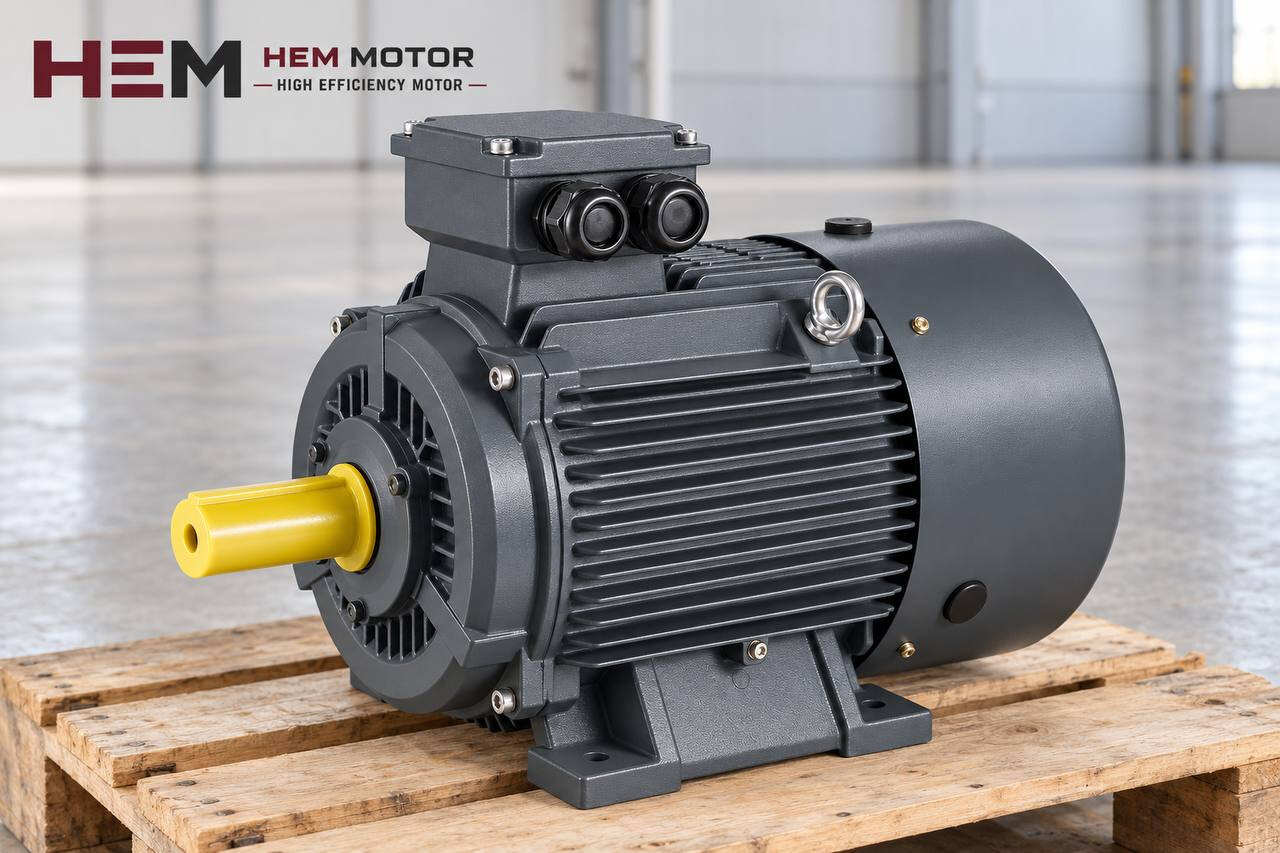
Our aluminium frame three-phase range consists of 36 models: twelve power steps between 0.25 kW and 11 kW, with one motor at 1000, 1500 and 3000 rpm synchronous speed in each step. Below we use our own model data to show the power–frame distribution, how torque changes with speed, the winding voltage limit and the point where the range hands over to cast iron.
The whole range is supplied with IP55 protection, class F insulation and 50 Hz ratings. The model code carries the frame and the number of poles: 90L-4 is a 4-pole motor in an IEC 90L frame.
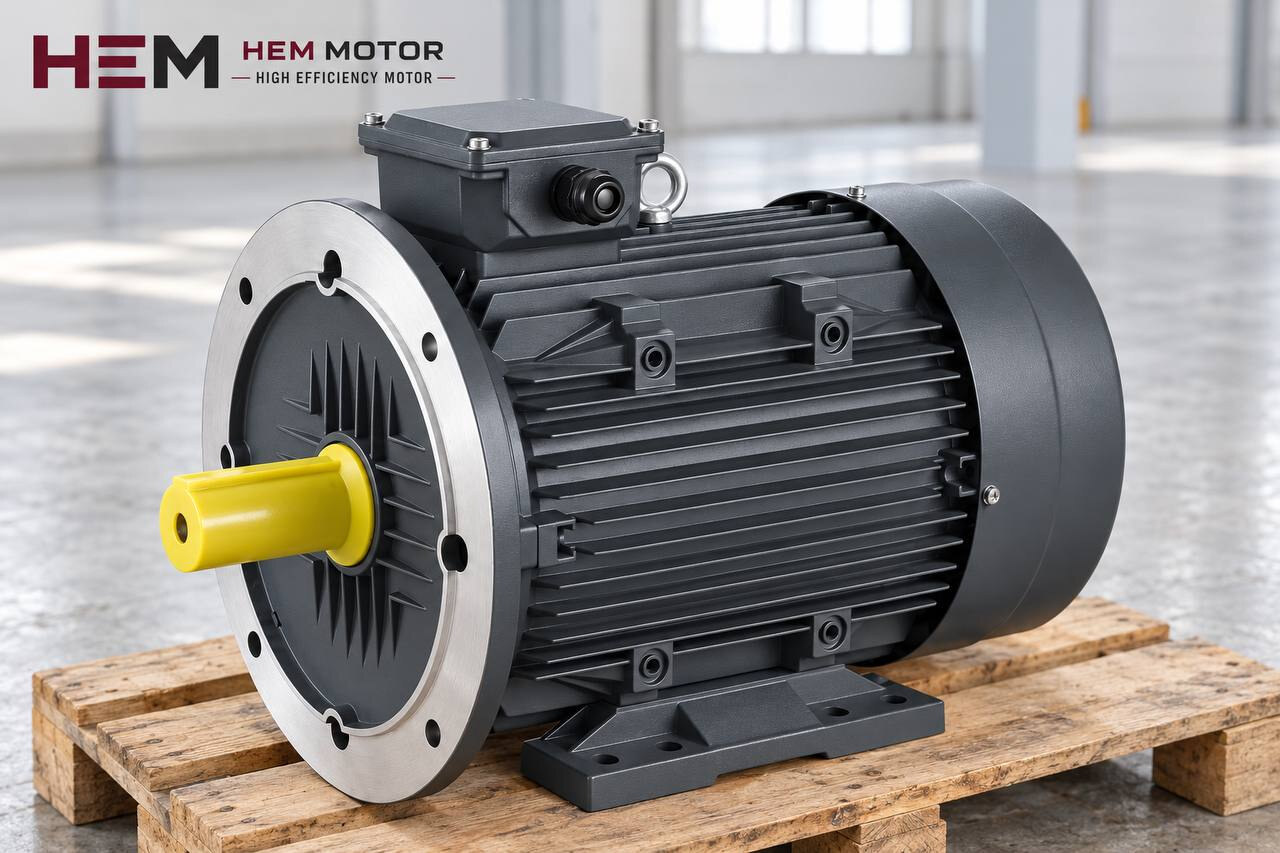
Power–Frame Map of the 36 Models: IEC 63M to 160L
Distribution of the models on sale across IEC frames (synchronous speed in brackets):
- 63M: only 0.25 kW (3000) — 63M2-2, the smallest motor in the range.
- 71M: 0.25 kW (1000 and 1500), 0.37 kW (1500 and 3000), 0.55 kW (3000).
- 80M: 0.37 and 0.55 kW (1000), 0.55 and 0.75 kW (1500), 0.75 and 1.1 kW (3000).
- 90S / 90L: 0.75–1.1 kW (1000), 1.1–1.5 kW (1500), 1.5–2.2 kW (3000).
- 100L: 1.5 kW (1000), 2.2 and 3 kW (1500), 3 kW (3000).
- 112M: 2.2 kW (1000), 4 kW (1500 and 3000).
- 132S / 132M: 3–5.5 kW (1000), 5.5–7.5 kW (1500), 5.5–7.5 kW (3000).
- 160M / 160L: 7.5 and 11 kW (1000), 11 kW (1500 and 3000).
The practical conclusion from the map: the same IEC frame can hold very different powers depending on speed. The 132S frame, for example, has 3 kW at 1000 rpm and 7.5 kW at 3000 rpm. So the frame size alone does not tell you the power; the kW and speed on the nameplate must be read together. For a detailed match by frame, see our IEC frame–power table.
Why the Frame Grows at Low Speed: the Torque Explanation
The main quantity that determines a motor's frame is the torque it delivers at the shaft. If power is held constant and speed is halved, torque roughly doubles; the rotor and winding that carry this torque need a larger frame. The 3 kW step in our own data shows this clearly:
- 100L-2 (3000 rpm, rated 2,895 rpm): 9.9 Nm, IEC 100L
- 100L2-4 (1500 rpm, rated 1,450 rpm): 19.8 Nm, IEC 100L
- 132S-6 (1000 rpm, rated 968 rpm): 29.6 Nm, IEC 132S
The 1000 rpm model produces about three times the torque of the 3000 rpm model and therefore sits two frame steps higher. The same ratio holds at 7.5 kW (from 24.4 Nm to 73.8 Nm) and at 11 kW (from 35.7 Nm to 108.3 Nm). For other powers, see our torque table page.
Winding Change After 3 kW: 230/400 V and 400/690 V
The 24 aluminium models between 0.25 and 3 kW come with a 230/400 V (Δ/Y) winding, and the 12 models between 4 and 11 kW with a 400/690 V (Δ/Y) winding. The limit is at the same step for all three speeds: it ends at 3 kW and starts at 4 kW.
On a 400 V supply this means, in short: motors up to 3 kW run with a star connection at the terminal box; motors from 4 kW run in delta at 400 V and are therefore suitable for star-delta starting. We have collected the details of supply type, phase sequence and starting methods on our 3-phase electric motors page.
The 11 kW Overlap and the Transition to the Cast Iron Range
The aluminium frame range ends at 11 kW. This step has three models: 160L-6 (108.3 Nm), 160M-4 (71.7 Nm) and 160M1-2 (35.7 Nm). The same three codes are also on sale with a cast iron frame; in our model data the speed, current and torque values are identical for both frame materials. So at 11 kW the decision is not electrical; it depends on the machine's environment and mounting preference.
The overlap actually starts at 0.55 kW: every aluminium code between 0.55 and 11 kW also has a cast iron counterpart, and you can see both versions side by side in our electric motor shop. The six models in the two smallest steps, however, are offered with an aluminium frame only. Above 11 kW the family hands over to cast iron; at 15 kW the 160M2-2, 160L-4 and 180L-6 have cast iron frames. For this range see our cast iron motor family page, and for the frame material decision the aluminium or cast iron question.
Model Matches by Machine Type
The aluminium range is used mostly on machines whose power does not exceed 11 kW and which do not impose impact or vibration loads on the frame. The following are examples; the final selection depends on the machine load, required speed, mounting and operating conditions.
- Fans and ventilation: 1500 and 3000 rpm models stand out; 80M1-2 (0.75 kW), 90L-4 (1.5 kW), 112M-4 (4 kW). See fan and extractor motors.
- Centrifugal pumps: 3000 rpm motors coupled to the pump; 90S-2 (1.5 kW, 4.95 Nm), 100L-2 (3 kW), 132S1-2 (5.5 kW). See pump electric motors.
- Packaging: small 1500 rpm motors working with a gearbox; 71M2-4 (0.37 kW), 80M2-4 (0.75 kW, 5.04 Nm). See packaging machinery motors.
- Conveyors: on geared belts the 90L-4, 100L2-4 (3 kW, 19.8 Nm) and 132M-4 (7.5 kW) are frequently used. See conveyor belt motors.
Five Steps from Nameplate Data to the Right Model
- Read the power: take the kW value on the nameplate; if only HP is given, check the HP equivalent on the product pages (e.g. 5.5 kW = 7.5 HP).
- Convert speed to poles: a rated speed between 2,700 and 2,950 rpm means 2 poles, between 1,340 and 1,465 rpm 4 poles, and between 855 and 970 rpm 6 poles (values from our range).
- Check the voltage pair: is it 230/400 V or 400/690 V?
- Compare frame and mounting: for dimensions see the technical drawings and the 2026 catalogue.
- Verify the current: the nameplate current should be close to the 400 V rated current of the selected model; a large difference points to an error in reading power or speed.
Order Options and Conditions to Specify
A PTC thermistor or PT100 sensor embedded in the winding, and an anti-condensation heater for motors that stand idle for long periods, can be added with the order. The mounting layout is chosen by frame: foot-mounted (B3), flanged (B5, B14), foot+flange (B34, B35) or vertical (V1/V3/V5/V6/V15); flange and shaft sizes are confirmed at the order stage (mounting arrangements).
If the motor will be driven by a frequency inverter, say so when requesting a quote: our three-phase ranges are suitable for speed control, but if full torque is needed at low speed for long periods a separate fan, and if the cable between motor and drive is long a sine or dv/dt filter, comes into consideration (use with an inverter).
Quotes and Orders from the Aluminium Range
All 36 models are listed in the aluminium frame models category, and both frame materials together in the shop. Prices are kept up to date on the model pages; aluminium models are delivered from stock and shipped from our warehouse in Türkiye.
So that we can quickly recommend the right aluminium model, please send us:
- the type of machine the motor will drive,
- the required power (kW) and speed (rpm),
- the supply voltage (e.g. 400 V) and mounting type (foot, flange or vertical),
- the quantity you need.
If you are replacing an old motor, send a photo of its nameplate and we will work out the matching code. For other questions, use the phone and WhatsApp line on our contact page.
Frequently Asked Questions
Do the 0.25 and 0.37 kW aluminium models have a cast iron counterpart?
In our 2026 sales list these two power steps are available with an aluminium frame only. The cast iron frame range starts at 0.55 kW.
Do aluminium and cast iron motors with the same code have different electrical values?
No. Between 0.55 and 11 kW, two models with the same code have the same rated speed, 400 V rated current, torque and voltage in our model data. The difference is the frame material.
Can I start a 4 kW aluminium motor star-delta on a 400 V supply?
Yes. From 4 kW the winding is 400/690 V, so the motor runs in delta on a 400 V supply and star-delta starting can be used. Models up to 3 kW are connected in star on this supply.
Is an aluminium frame model offered for 15 kW?
In the 2026 catalogue the aluminium frame ends at 11 kW. For 15 kW, look at the cast iron frame 160M2-2, 160L-4 and 180L-6 models.