English
 Français
 Türkçe
 Español
 Русский
 العربية

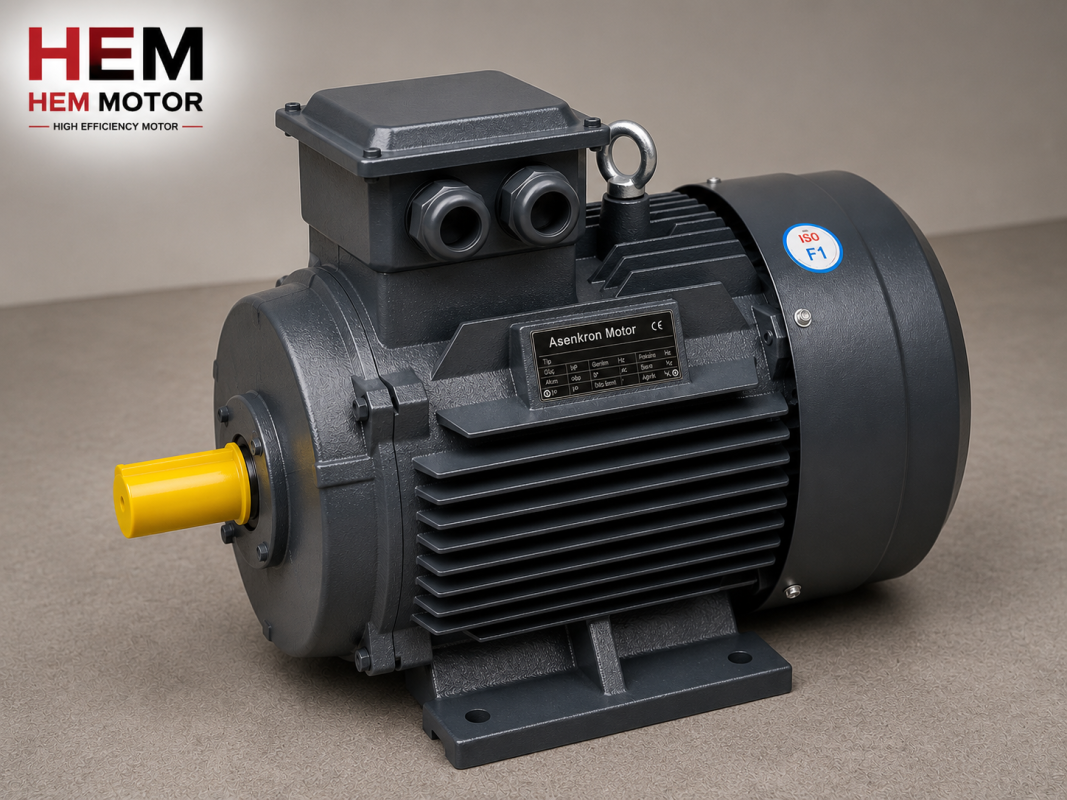
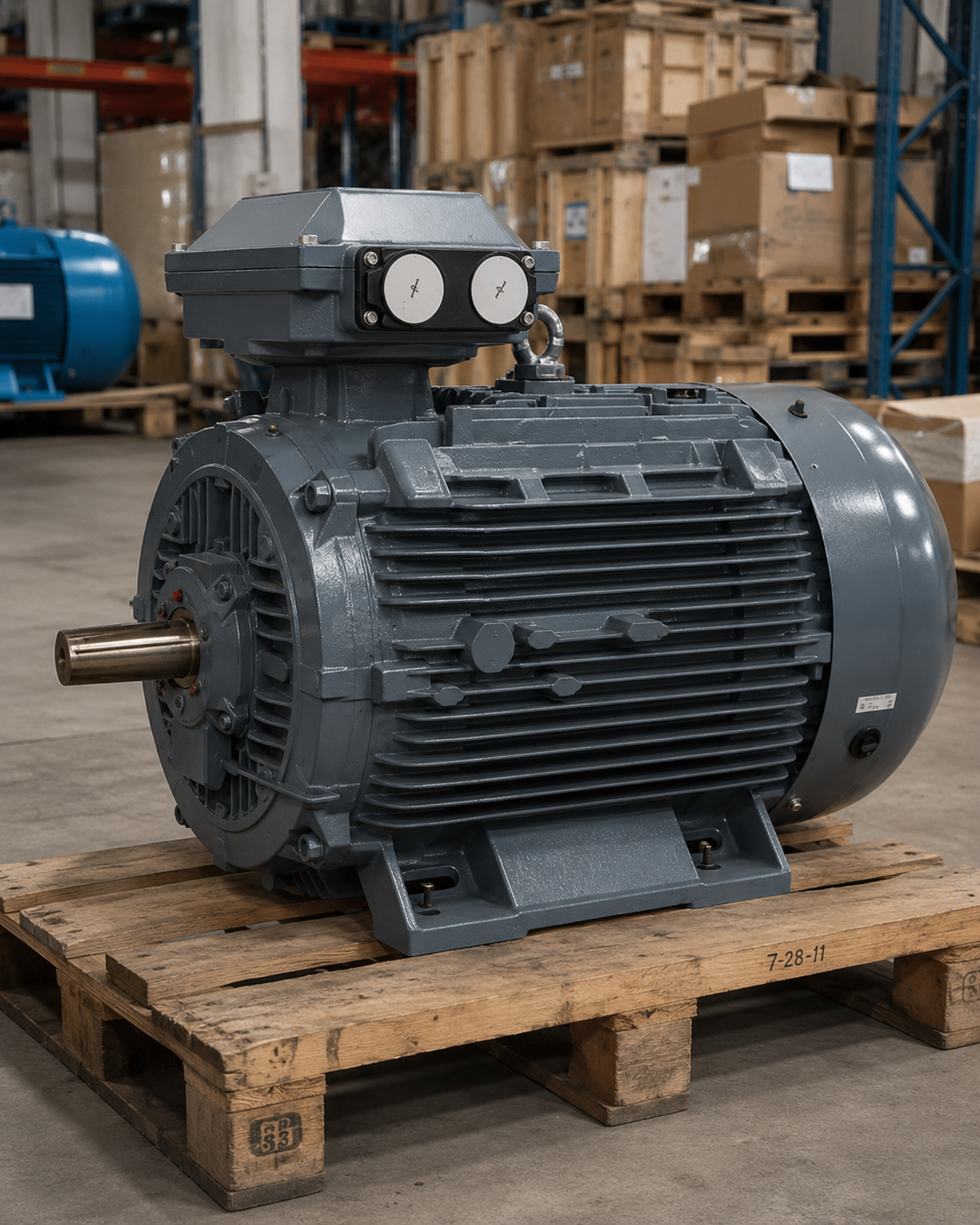
Most motors in a factory are not built for one specific machine. The motor turning a pump, an extractor fan, a belt drum or a gearbox input is an ordinary three-phase motor defined by its IEC frame number, and the same model can do the job on another line as well. HEM Motor's 117 models on sale follow this logic: 0.25–355 kW, three speed groups with 2, 4 and 6 poles (3000/1500/1000 rpm), 39 models in each group. This page gathers practical information that helps when you buy a new motor for the workshop or replace a burnt-out one.
Where a Motor Not Tied to One Machine Fits in the Plant
From the maintenance team's point of view, the value of a general purpose motor is that it can be swapped. The machine builder defines power, speed and mounting when choosing the motor; the motor itself is a standard part. That is why a motor that fails years later can be replaced by another manufacturer's motor with the same characteristics.
All models in the series are IP55, class F insulated and designed for 50 Hz. The frame material is aluminium from 0.25 to 11 kW and cast iron from 0.55 to 355 kW; the choice of frame material is covered separately on the cast iron frame motors and aluminium frame motors pages. If you are curious how the rotor turns, see the asynchronous motors page.
IEC Frame Number: Feet, Shaft and Flange Speak the Same Language
A code such as 90S, 132M or 160L on the nameplate shows the shaft height and frame length of the motor. The spacing of the foot holes, the diameter and length of the shaft end and the pitch circle of the flange all depend on this number. If the new motor carries the same frame number, that is the first piece of information for assessing whether it fits the old base, coupling half or pump bell housing; to confirm the fit, compare the mounting type, shaft diameter and length, foot hole spacing, flange dimensions if any, as well as power, speed and electrical data. The dimensions themselves are given in the frame size table article and in the 2D technical drawings.
The HEM list contains 25 different frame codes from 63M to 400L. For the 30 power–speed pairs between 0.55 and 11 kW, the aluminium and cast iron records carry the same model code and the same frame number; the material changes but the connection logic stays the same.
Same power, different frame
The frame number should not be considered separately from power. At 7.5 kW, the 3000 rpm model is in a 132S frame, the 1500 rpm model in 132M and the 1000 rpm model in 160M. So replacing a 6-pole motor with a 4-pole motor of the same kW changes both the machine speed and the foot and shaft dimensions. The reverse also holds: the 315L frame code appears in eight different power–speed combinations in the list, so the frame number alone does not tell you the power.
From the Failed Motor's Nameplate to the Right Model
The most common mistake in a replacement order is reading only the kW value from the nameplate. When the lines below are read together, the right model becomes clear:
| Nameplate line | What it tells you when replacing | Example from HEM data |
|---|---|---|
| Power (kW) | The value that carries the load; never reduced | 7.5 kW exists in all three speed groups |
| Rated speed (rpm) | Shows the number of poles and the speed group | 1,460 rpm → 1500 rpm group (132M-4) |
| Frame code (IEC) | Foot, shaft end and flange match | Model 132M-4 is in a 132M frame |
| Voltage (Δ/Y) | Terminal connection and supply match | 230/400 V up to 3 kW, 400/690 V from 4 kW |
| Rated current | Thermal overload setting | 132M-4: 14.3 A (400 V) |
| Mounting (IM) | Foot, flange or vertical connection | B3, B5, B35 and others |
The models in the table are examples; the final choice depends on the machine load, the required speed, mounting and operating conditions. The current table and the torque table help when comparing current and torque values. If the nameplate is unreadable, you can send a photo via the send motor nameplate page.
A Spare Motor Plan for the Workshop
Keeping a spare for every motor ties up unnecessary capital. A more efficient way is to group the motors in the plant by frame number, speed and mounting type. If one group contains many motors, a single spare protects several machines.
HEM data helps with this grouping. One third of the 117 models in the list (39 models) belong to the 1500 rpm group and cover 29 power steps between 0.25 and 355 kW. 75 of the models are 22 kW or below; in the 1500 rpm group there are 25 models under this limit (12 aluminium, 13 cast iron). Because 4-pole motors are common on conveyors, mixers and gearbox inputs, this group stands out in most spare lists; still, build your list by looking at the nameplates of the motors in your plant.
- Critical machine: one spare with the same frame and mounting for the motor of a machine whose stoppage halts the whole line.
- Recurring frames: a shared spare for a frame number used on five or six machines.
- Large ratings: cast iron models of 75 kW and above have a service factor of 1.15; in this class the spare decision is made together with the production plan.
For moisture and bearing care of a motor waiting on the shelf, see the storing a spare motor article. You can filter models that fit your spare list by frame and speed among all models in the shop.
When a General Purpose Motor Is Not Enough
A standard motor runs comfortably under continuous, steady load. Under the following conditions, extra information in the order or a sector-specific assessment is needed:
- Shock loads and heavy starting: crushers, mills and vibrating screens are a different case; see stone crushing plant motors.
- Hydraulic unit: the motor drives the pump, selection is based on flow and pressure; hydraulic pump motors.
- Long periods at low speed with full torque: in this kind of operation with a speed controller an external fan may be needed; details on the inverter FAQ page.
- Submersion, pressure washing, food contact or explosive atmospheres: a standard IP55 motor is not designed for these conditions; protection by the machine builder or a special motor is required, so state it in the order.
- Single-phase supply: there is a separate single-phase series from 0.18 to 5.5 kW.
All sector-specific pages are collected under electric motors for industries.
What to Send Us for a Replacement or a New Order
To match the right model quickly, just tell us the type of machine the motor will drive, the required power (kW), speed (rpm), supply voltage, mounting type (foot, flange, vertical) and quantity. If the old motor is still there, a photo of the nameplate answers most questions at once. Products are shipped from our warehouse in Türkiye.
You can send the details through the contact page and see current prices in the electric motor shop.
Frequently Asked Questions
The motor nameplate cannot be read; how do I find a replacement?
Measure the shaft height, shaft end diameter and foot hole spacing and compare them with the frame size table. Once the frame number is clear, we confirm the machine speed and power together; you can send a photo of the motor through the contact page.
Can I replace a 1000 rpm motor with a 4-pole motor of equal kW?
Not directly. At 7.5 kW, the 6-pole model 160M-6 gives 73.8 Nm and the 4-pole model 132M-4 gives 49.1 Nm rated torque, and their frames differ too (160M and 132M). The machine runs faster and the connection dimensions change.
Can I replace an aluminium frame motor with a cast iron one?
Between 0.55 and 11 kW both materials are listed with the same model code and IEC frame number; this is a good starting point for matching the connection, but it is not enough on its own. We confirm the flange and shaft dimensions together when you order. To decide, see the aluminium or cast iron page.
Which mounting arrangements are available?
B3, B5, B14, B34, B35 and vertical V1/V3/V5/V6/V15 are offered depending on the frame; flange and shaft dimensions are confirmed with the order. Details on the mounting arrangements page.
Can I start a spare motor that has been on the shelf for a long time right away?
First the winding insulation and bearings must be checked. The steps are listed in the motor commissioning article.