English
 Français
 Türkçe
 Español
 Русский


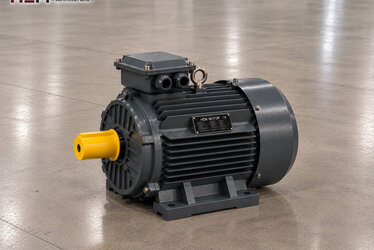
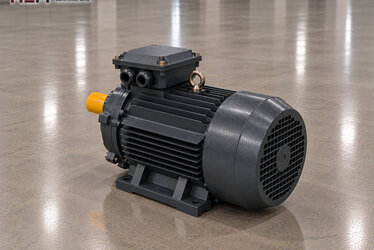
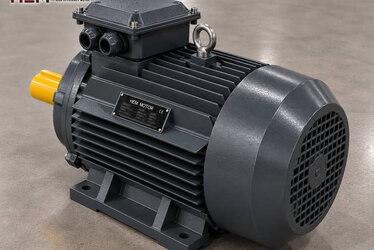
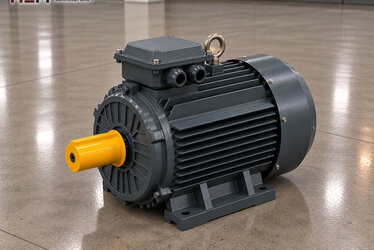
In most plants, moving material from one point to another is left to a conveyor: crushed stone leaving the quarry, cartons entering a warehouse, wheat rising to a silo or bricks leaving a kiln. On almost all of these carriers the motion comes from a three-phase asynchronous motor connected to a drum, a screw or a chain sprocket through a gear reducer. This page covers the motor side of the conveyor family as a whole; each carrier type is described in detail on its own sub-page.

A Short Look at Carrier Types
Belt conveyors are the most common group. A rubber or PVC belt is tensioned between the drive drum and the tail drum and carries bulk material or unit goods. As length, slope and belt width increase, the resistance the motor has to overcome grows too. Drums, take-ups and starting on long belts are covered on our Belt Conveyor Motor page.
Screw conveyors push powder and granules with a helical screw turning inside a closed trough or tube. They are preferred for cement, flour, bran and feed. Restarting a screw that stopped full is the hardest moment for the motor; this is discussed on the Screw Conveyor Motor page.
Bucket elevators carry material vertically upwards. The motor sits at the head station and most of the load is lifting work; the belt must not run back when it stops with full buckets. Details are on the Bucket Elevator Motor page.
Roller and chain conveyors handle single items such as pallets, cartons, crates and hot products. Accumulation, stop-start operation and zone-by-zone drives are typical of these lines; the Roller and Chain Conveyor Motor page explains these layouts.
Belts in concrete plants, quarries and agricultural facilities work on the same logic; conditions specific to those plants are on the related sector pages.
What Load Does a Conveyor Motor Work Against?
The motor of a carrier overcomes three things: friction of the moving parts (bearings, rollers, belt or chain), the force needed to drag the material horizontally and, if there is a slope, the work spent raising the material. On level, light lines the first two dominate; on inclined belts and elevators the lifting share becomes decisive.
Unlike a fan or a centrifugal pump, this load does not fall with speed. Even if the carrier slows down, roughly the same torque is needed to bring the same material to the same height. Conveyors are therefore treated as constant-torque loads, and this directly affects motor selection both at start-up and when speed is adjusted.
The belt or chain manufacturer's method is the basis for the power calculation. If you already have a working line, the power and speed on the existing motor's nameplate are the most reliable starting point; if capacity is to be increased, this value must be recalculated for the new load.
Starting a Full Line
Starting an empty conveyor is easy; the difficult part is getting a line full of material moving again after a fault or a power cut. At that moment the motor must overcome both the inertia of the stationary material and static friction. Material packed around the screw, full buckets on an elevator and belt stretch on a long conveyor all make the start heavier.
Direct-on-line starting gives high starting torque but sends a hard shock to the belt and couplings. With star-delta starting the torque drops along with the current and may be insufficient on a loaded line. A soft starter or a frequency inverter makes the acceleration adjustable and is preferred on long belts to reduce belt slip on the drum. Which method to use is decided from the machine builder's starting data.
Reducer, Speed and Connection
A conveyor drum or screw usually turns at a few tens of revolutions per minute, while the motor is in the 1,500 or 1,000 rpm class on a 50 Hz supply. The gap is closed by a gear reducer, sometimes with an extra chain or belt stage. Four-pole motors are the choice that most often matches reducer input speed; on very slow, heavy drives six poles are also used.
When the motor is mounted directly on the reducer, the flange type (B5 or B14) and shaft diameter must match the reducer exactly. For a base-mounted layout with a coupling, foot-mounted B3 is chosen, and B34 or B35 where both are required; vertical positions such as V1 come up on vertical-shaft drives. These arrangements are offered according to frame size, and we confirm the exact flange and shaft dimensions together at the order stage. For the reducer side, see our electric motors for gear reducers page.
If line speed has to follow the product flow, a drive is used, and the three-phase motors in our series are suitable for this. However, if a constant-torque load keeps the motor turning slowly for long periods, cooling from its own shaft fan weakens and a separate fan may be needed. If the cable from the drive to the motor is long, an output filter is considered. Simply mention these two points at the quotation stage; the topic is covered in depth on the inverter-compatible electric motors page.
Dust, Outdoor Use and Maintenance
Conveyor motors often stand at the dustiest spot, next to the transfer chutes. IP55 protection is designed for ordinary dust and rain splashes; however, a layer of material building up on the motor body spoils cooling, so the fins and fan cover should be cleaned regularly. On open sites with large day-night temperature swings an anti-condensation heater, and on lines that stop and start often or start hard a PTC or PT100 winding sensor, can be added with the order.
Washdown on a food line, the humidity of a cold store or corrosive vapour fall outside the design conditions of a standard motor; if such an environment exists, state it clearly in the order. On heavy-starting, vibrating lines cast iron frame motors are preferred, while aluminium frame models suit light parcel lines.
Preliminary Selection by Carrier Type
| Carrier | Nature of the load | Value to check | Example HEM model |
|---|---|---|---|
| Light roller / parcel line | Low power, frequent stop-start | Number of zones, positioning | 0.75 kW 80M2-4 (1,420 rpm) |
| Screw conveyor | Full start, risk of clogging | Screw diameter, fill ratio | 5.5 kW 132S-4 (1,460 rpm) |
| Bucket elevator | Lifting load, run-back | Height, hourly capacity | 15 kW 160L-4 (1,465 rpm) |
| Long or inclined belt | Inertia, belt stretch | Length, slope, starting method | 37 kW 225S-4 (1,485 rpm) |
The models in the table are examples; the final choice depends on the machine load, required speed, mounting arrangement and operating conditions.
Send Us the Following for a Quote
To recommend the right motor quickly, this information is enough: the machine type (belt, screw, elevator, roller line), the required power (kW) and speed (rpm), the supply voltage, the mounting arrangement or the flange of the reducer it will fit, the line's environment and the quantity. If you are replacing an old motor, sending a photo of the motor nameplate is usually sufficient.
You can see the models and list prices in our buy electric motors shop and use our contact page for WhatsApp and phone. The handling systems electric motors page, which looks at carriers as a whole, can also help.
Frequently Asked Questions
Should a conveyor use a 4-pole or a 6-pole motor?
Most carriers use a four-pole motor in the 1,500 rpm class together with a reducer. On very slow, heavy drives a six-pole motor in the 1,000 rpm class can be chosen to reduce the gear ratio; the decision is made together with the reducer manufacturer.
Is it a problem to slow a conveyor motor down with a drive?
A conveyor load does not get lighter as it slows. If the motor will run at low speed with full torque for long periods, its own cooling may be insufficient and a separate fan is considered. State the operating mode in the order.
Is it enough to buy the same power to replace an existing conveyor motor?
If power and speed are the same it usually is; however, the flange type, shaft diameter and frame size must also fit the reducer or base. A nameplate photo makes this matching easier.
What can be done about an inclined belt that runs back when it stops?
The element that prevents run-back is usually a backstop in the reducer or on the drum. If a brake is wanted on the motor side, specify it in the order.
Does a conveyor motor installed outdoors need extra measures?
An IP55 frame suits rain and dust. Where there is direct sun, icing or a risk of condensation, an anti-condensation heater and a simple sheet-metal canopy over the motor can be considered.