English
 Français
 Türkçe
 Español
 Русский

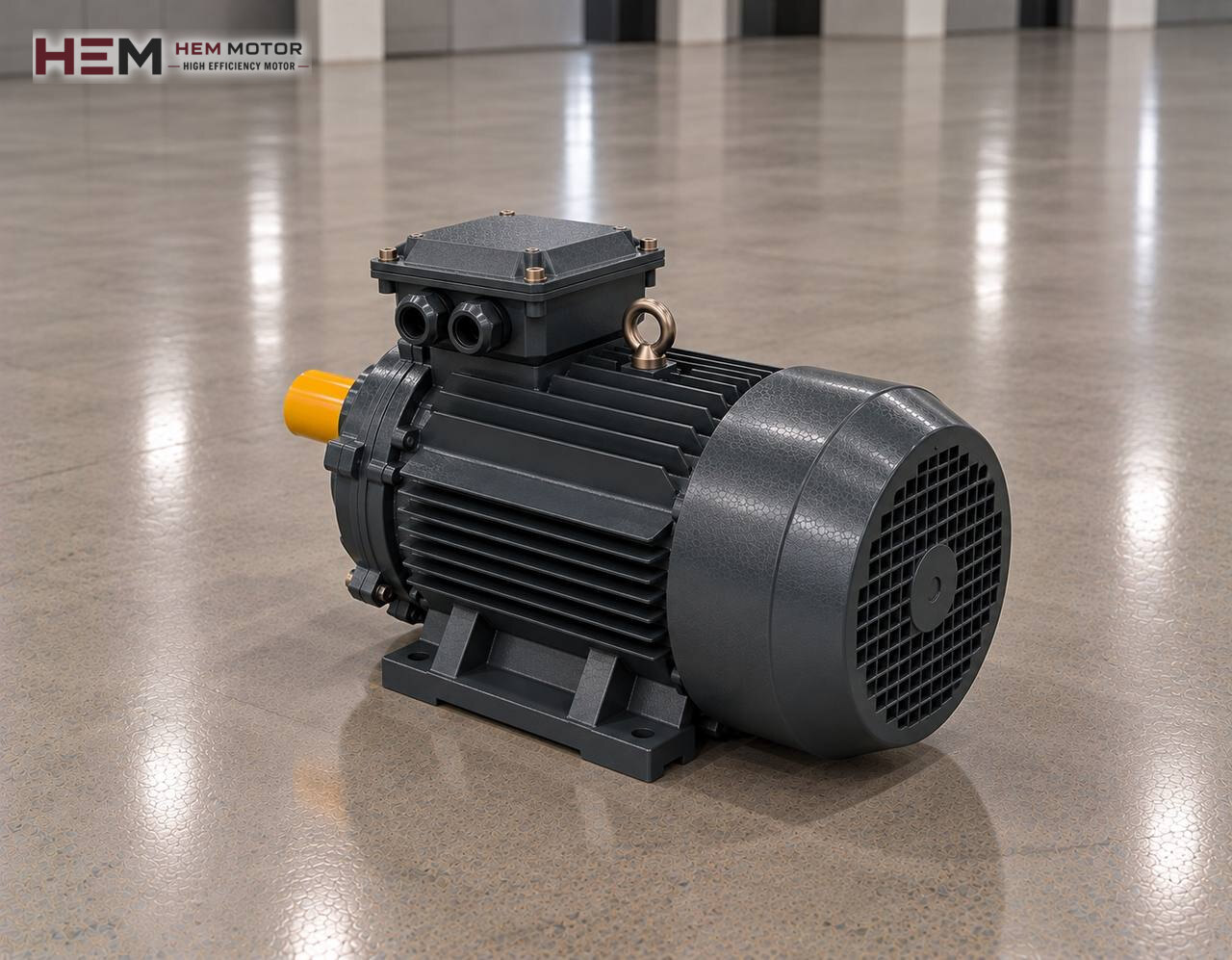
A screw conveyor pushes powder, granules and fine-grained material with a helical screw turning inside a closed trough or tube. It does not carry the material on top like a belt; the flights drag the material along the casing wall. This is why the motor load resembles a mixer more than a belt conveyor. This page explains the motor that turns the screw; for all conveying equipment see the conveyor belt electric motors page.

How the screw pushes material and what the motor works against
As the screw turns, material between the flights slides forward. The material does not rotate with the screw thanks to its weight and its friction with the trough wall. So in a screw conveyor, power is spent mainly on friction within the material and against the casing; the quantity conveyed, the fill ratio and the flowability of the material determine the motor load.
At the same screw diameter and speed, flour, cement and wet sand need very different power. Free-flowing, light powders create a low load, while abrasive, sticky or damp materials markedly increase resistance. The screw designer takes this difference into account by lowering the fill ratio or using a material factor. If the material on an old screw is going to change, the motor should be re-evaluated.
The difference between horizontal, inclined and vertical screws
- Horizontal screw: The lowest load is in this layout; material moves in the lower half of the trough.
- Inclined screw: As the incline increases, material falls back, conveying capacity drops and more speed or power is needed for the same flow.
- Vertical screw: Material is lifted inside a tube; the screw has to turn at high speed, because without the centrifugal effect pressing the material against the wall there is no lift. The motor usually sits vertically at the top end.
On vertical screws the motor is placed on top of the gearbox with the shaft pointing down. HEM motors are also offered in V1, V3, V5, V6 and V15 vertical designs depending on frame; in a vertical position, the need for bearings and a rain cover should be stated in the order. Details are in the V1/V5 vertical mounting article.
Blockage, loaded start and sudden torque rise
The most frequent failure of a screw conveyor is blockage. If the outlet closes, damp material forms lumps or a foreign object gets caught, the screw jams and motor torque rises at once. On a belt conveyor, the belt limits the load to some extent by slipping; a screw has no such flexibility, and the torque goes straight to the gearbox and motor.
This is why correct setting of motor protection matters on a screw. Setting the thermal relay or motor protection breaker to the nameplate current and, if needed, stopping the line on overload with a current monitoring relay protects the winding. Some plants fit a shear pin or torque limiter at the gearbox output; these are part of the machine. For choosing protection, the thermal relay and fuse selection article is a useful starting point.
A loaded start is another difficulty. Cement or feed left in the screw overnight can absorb moisture and harden; at the first turn in the morning, the motor has to break this mass loose. Emptying the screw before stopping is the simplest measure. If the start needs to be softened, a soft starter or inverter is considered; ramp time and starting torque should be set together with the screw manufacturer.
Speed, gearbox and dosing
Horizontal and inclined screws turn at tens of revolutions per minute; there is almost always a gearbox between motor and screw. The most practical solution is to fit a flange motor to a gearbox attached to the screw's end plate, so no alignment is needed. A 4-pole motor is the most used type in this layout; screw speed is set by the gearbox ratio. For gearbox-motor matching see the electric motors for gearboxes page.
A screw is also often used as a dosing element: in a concrete plant cement, and in a feed mill additives, are sent to the weigher by screw rotation. In this case an inverter is used to adjust the screw speed. Our three-phase series can be driven by an inverter; however, if the screw will run loaded at low speed for long periods, the motor's own fan may not provide enough cooling and a separate fan may be needed. State this operating mode and the inverter cable length in your order.
Dust, temperature and maintenance
Because the screw is enclosed, material usually stays inside, but heavy dust forms at the inlet and outlet. Cement and flour dust sticks to the fins of the motor frame and weakens cooling. Our models are IP55 protected with class F insulation; regular cleaning of the frame and keeping the fan cover clear are sufficient measures. Motors for explosive dust atmospheres (ATEX) are not included in HEM Motor's 2026 catalogue; if there is such a zone, tell us in your order.
In the maintenance plan, gearbox oil, motor bearing grease and the bearing at the screw end are dealt with together. A PTC or PT100 sensor is an order option for those who want to monitor winding temperature.
Example HEM models and selection table
On a small feeder screw, the 4 kW cast iron 112M-4 delivers 26.3 Nm at 1,450 rpm. On a medium-sized cement screw, the 5.5 kW cast iron 132S-4 produces 36 Nm at 1,460 rpm. On a long screw running full, a frame such as the 11 kW cast iron 160M-4 comes into question. On heavy screws where a lower gearbox input speed is wanted, the 6-pole 5.5 kW 132M2-6 delivers 54.3 Nm at 968 rpm.
| Screw type | Load characteristic | What to watch | Example HEM model |
|---|---|---|---|
| Short feeder screw | Light, free-flowing powder | Flange motor, gearbox ratio | 112M-4, 4 kW |
| Cement and dosing screw | Frequent stop-start, speed control | Inverter, cooling | 132S-4, 5.5 kW |
| Long and inclined screw | High friction, loaded start | Starting method, protection | 160M-4, 11 kW |
| Heavy material, low speed | High torque, blockage risk | Gearbox input speed, torque limiter | 132M2-6, 5.5 kW |
These pairings are examples; the exact motor is determined by the real material and capacity of the screw, screw speed, connection type and ambient conditions.
Send us before ordering
Write which machine or plant the screw works in, the material it carries, its length and incline. Then add the motor power (kW), speed (rpm), supply voltage, mounting type (horizontal flange or vertical), gearbox type and quantity. If you are replacing an existing motor, send a photo of its nameplate.
You can find prices on the buy electric motors page and WhatsApp and phone details on the contact page.
Frequently Asked Questions
Why does the screw conveyor motor trip its thermal relay often?
The most common causes are a blocked outlet, damp or lumpy material and overfilling. First measure the current and compare it with the nameplate; if the problem persists, check the feed rate, the condition of the screw and the thermal setting.
Should the motor be at the top or the bottom of a vertical screw?
Usually at the top, at the discharge end, with the shaft pointing down. In this case the motor is ordered in a vertical design such as V1; the vertical position should be clearly stated in the order.
Is an inverter essential for a dosing screw?
Not essential; dosing can also be done with a fixed-speed screw and a weighing system. However, if precise and variable dosing is needed, speed control with an inverter is a practical solution.
Will the same motor be enough if the material changes?
Not always. Heavier, abrasive or damp material needs more power in the same screw. Re-evaluate the screw capacity and motor power with the manufacturer for the new material.