 English
 Français
 Türkçe
 Español
 Русский
 العربية


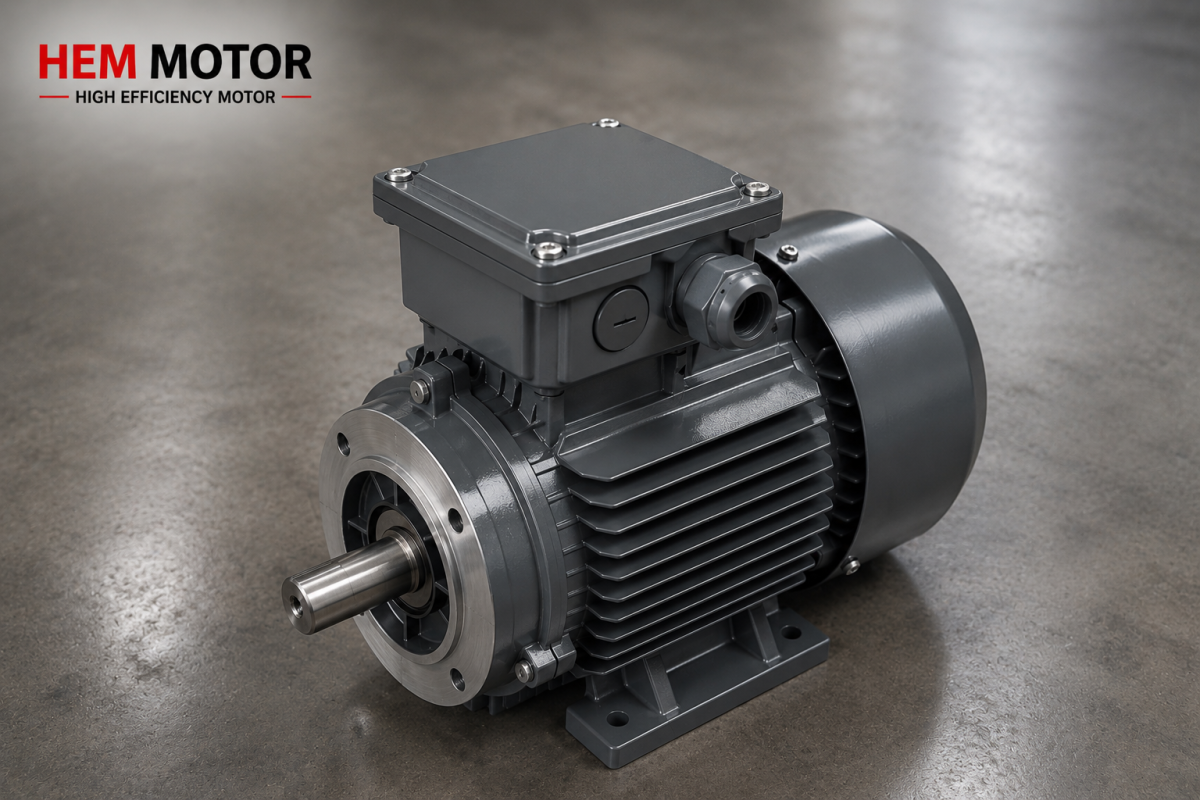
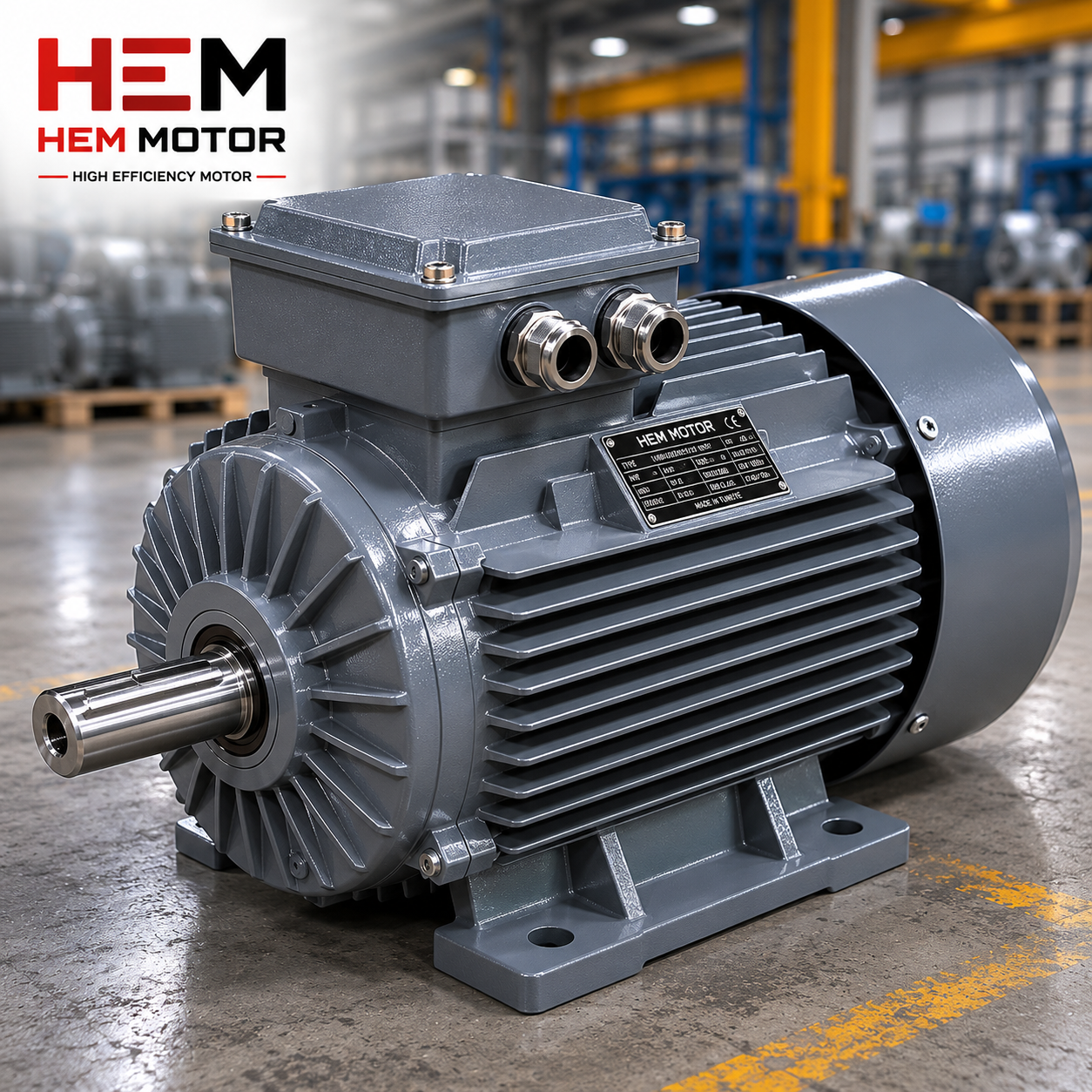
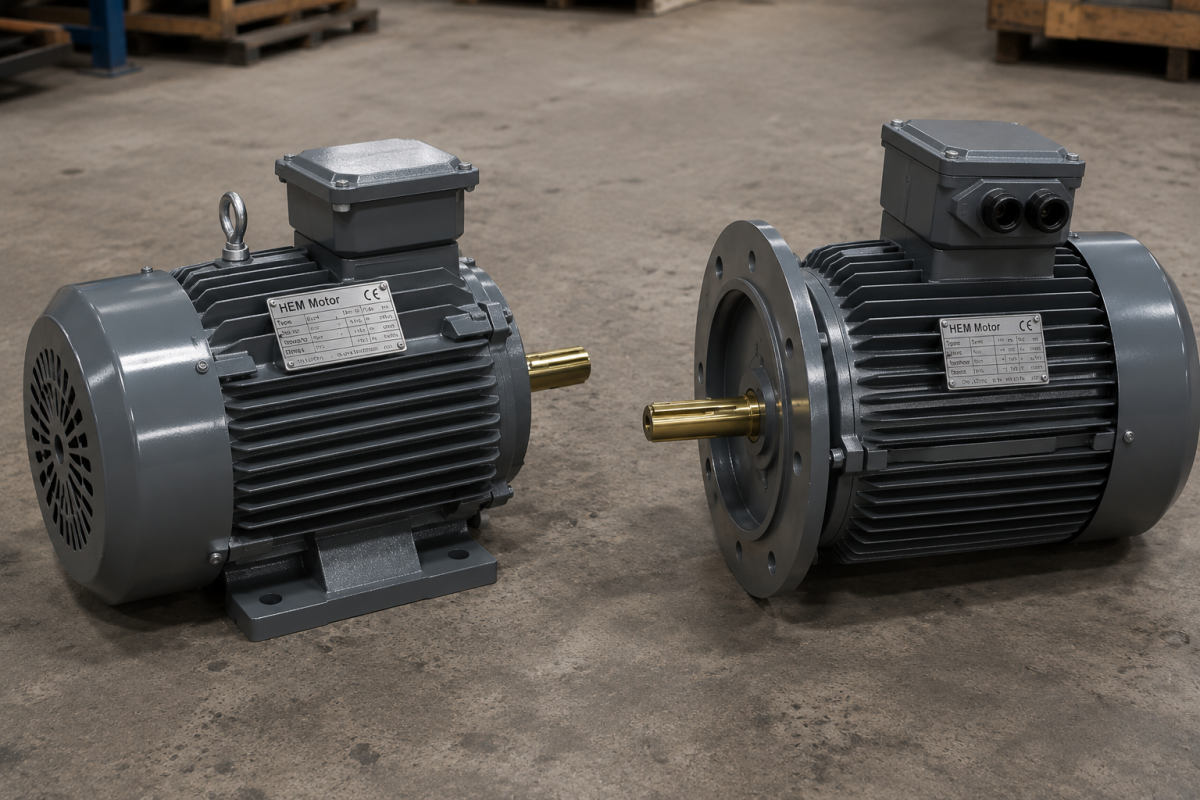
IE4 is the name of the "Super Premium" efficiency class defined in IEC 60034-30-1. In the HEM Motor 2026 technical catalogue, three-phase asynchronous motors are described in three efficiency levels: Premium (IE3), Super Premium (IE4) and Ultra Premium (IE5). This page explains where IE4 actually makes sense in a plant, what to check when it replaces an existing IE3 motor, and how to state an IE4 request clearly.
What the Super Premium Class Defines — and What It Does Not
An IE class is an international classification based on how much of the power drawn from the supply a motor delivers to its shaft. The higher the level, the smaller the permitted losses for a motor of the same output; those losses appear in the motor as heat.
The IE4 label does not change the motor's torque, speed or degree of protection. As with the other three-phase motors in the catalogue, IE4 types are listed with IP55 protection, class F insulation and S1 (continuous) duty. In other words, IE4 is not a "stronger motor" but a motor designed to do the same work with lower losses.
The rated values of each IE4 model are published in the catalogue's model tables. On this page we rely on the class name and the standard; for model-specific technical values, see the 2026 technical and product catalogue.
Which Operating Profiles Make IE4 Worthwhile
What an efficiency class difference is worth depends on how many hours a year the motor runs and at what load. On a motor that starts only a few times a day for short periods, the effect stays limited. On a motor that runs without stopping through shift after shift, however, most of its lifetime cost is electricity rather than purchase price.
Situations where IE4 deserves a look
- Pump motors that supply the plant's water and stay on all day.
- Fan and extractor motors running continuously for ventilation and process air.
- Compressor motors producing compressed air throughout production.
- Conveyor and process lines whose load stays close to nominal for long periods.
Check the power rating first
A general engineering note in the catalogue matters here: a motor running permanently at low load stays in an inefficient zone. Replacing an oversized motor with an IE4 unit is no substitute for choosing the right power. Power should be set according to the machine's real operating point.
IE4 Model Range in the Catalogue
The 2026 catalogue gives separate model tables for the IE4 Super Premium series in 2, 4 and 6 poles. The type code starts with the "IE4-" prefix, followed by the IEC frame size and the number of poles.
| Poles / synchronous speed (50 Hz) | IE4 power range in the catalogue | Number of types in the table | IEC frame range |
|---|---|---|---|
| 2 poles / 3,000 rpm | 0.25–315 kW | 27 | 63–355 |
| 4 poles / 1,500 rpm | 0.25–315 kW | 27 | 71–355 |
| 6 poles / 1,000 rpm | 0.25–250 kW | 26 | 71–355 |
The ranges in the table were counted from the catalogue's IE4 model list. If you need a different speed such as 750 rpm, state it separately when requesting a quote.
The pages of the 117 models on sale in our shop do not state an IE class. So if you want an IE4 motor, write it clearly in your order; IE4 options are listed in the catalogue and the matching type is given in your quotation. Standard models and prices are available in the electric motor shop.
Mechanical Fit When Replacing an IE3 Motor with IE4
In the catalogue's model tables, IE3 and IE4 types of the same power and number of poles share the same frame designation. For example, the 7.5 kW 4-pole motor is listed with a 132M frame in both series. This means the replacement can usually be planned on the same base and coupling arrangement.
Even so, the catalogue gives the mounting and dimension tables for the IE4 and IE5 series on separate pages from IE3. The bearing table also has separate IE3 and IE4 columns; for 2-pole IE4 models from frame 160 upwards, the bearing selection is stated separately. Plants that keep spare bearings in stock should take this difference into account.
Foot-mounted B3, flange-mounted B5 and B14, combined B34 and B35, or vertical positions (V1, V3, V5, V6, V15) can be supplied depending on frame size. The flange and shaft end of the new motor are confirmed against the existing machine before the order is approved. See the mounting arrangements FAQ for options and the frame size table for frame–power matching.
Running an IE4 Motor on a Frequency Inverter
Speed in the three-phase series, IE4 types included, can be adjusted with a frequency inverter. If the motor will run at low speed and full load for long hours, its own fan may be insufficient; a separately powered fan is then considered. If the cable between drive and motor is long, the need for a dv/dt or sine filter is examined separately. Simply mention these two conditions in your request.
On pumps and fans with varying flow, speed control can replace adjustment by throttling valve or damper. The IE4 class and a drive are not alternatives to each other but two separate decisions taken together. For details see the inverter operation FAQ. A PTC or PT100 temperature sensor fitted in the winding and an anti-condensation heater for standstill periods can be added to the order on request.
The Difference Between IE4 and IE5
IE5 Ultra Premium is the next efficiency level up in the same standard and is defined in the catalogue within the same frame system as IE4; details are on the IE5 electric motors page.
What to Send Us for an IE4 Quotation
For a fast and accurate answer to an IE4 request, send the following in a single message:
- The machine the motor will drive and how it operates (continuous or intermittent, daily running time).
- Required power (kW) and speed (rpm).
- Supply voltage and whether it runs direct-on-line or on a drive.
- Mounting type; if it replaces an existing motor, its frame and flange details.
- Required quantity and your request for the "IE4 Super Premium" class.
If you are replacing an existing motor, sending a photo of its nameplate is the fastest route. Our article on information needed for a quote helps when preparing a request. You can send your details via the contact page and review standard models in the shop.
Frequently Asked Questions
Can I order a model from the shop as IE4?
The model pages in the shop do not state an IE class. If you want IE4, write it at the quotation stage together with power, speed and mounting details; the matching type from the catalogue's IE4 options will be given to you.
Will an IE4 motor fit the base of my old IE3 motor?
In the catalogue, IE3 and IE4 types of the same power and poles share the same frame designation. However, flange and shaft dimensions are confirmed with the order; sending the existing motor's nameplate and mounting type is enough.
Is IE4 worth it on a machine that runs only briefly?
The value of the class difference depends on running hours and load. On a machine that runs little each day the effect stays limited; on continuously running pumps, fans and compressors it is more noticeable. We recommend deciding on the basis of the machine's operating profile.
Can an IE4 motor be used with an inverter?
Yes, our three-phase series are suitable for speed control with a frequency inverter. If long periods at low speed and full load or a long drive cable are involved, state this in your request; fan and filter needs are assessed accordingly.
Are the protection and insulation classes different on an IE4 motor?
No. In the catalogue, IE4 types are also IP55-protected with class F insulation. The efficiency class concerns the motor's losses; it does not change the degree of protection.