English
 Français
 Türkçe
 Español
 Русский


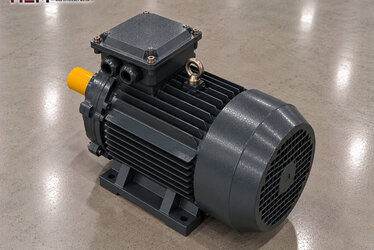
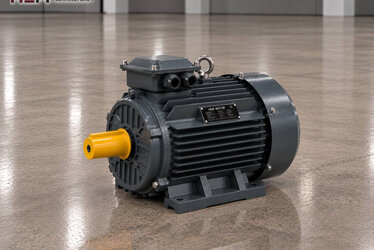
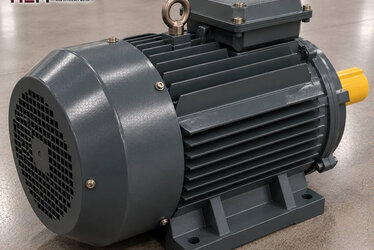
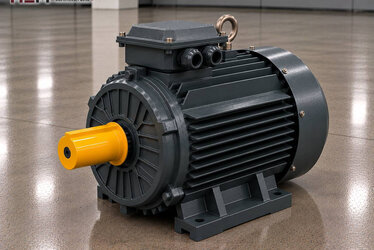
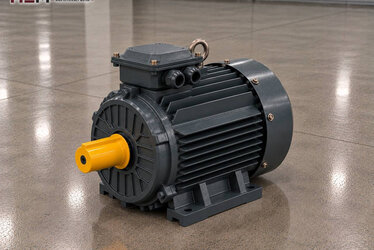
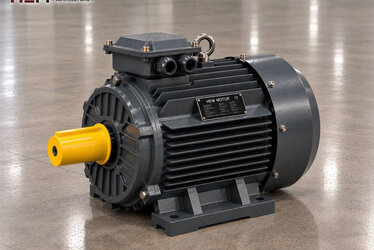
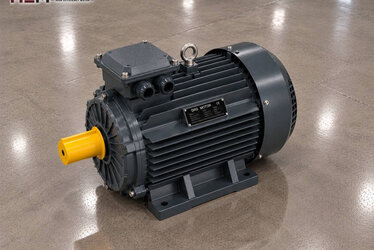
A plastics plant houses loads that have almost nothing in common under one roof: the extruder screw turns against a steady torque all day, the granulator rotor takes a blow with every piece, the injection moulding machine motor does nothing but drive a hydraulic pump, and a rubber mixer has to start with a full chamber. This page covers the three-phase asynchronous motors that drive the machines of plastics and rubber lines. It does not describe the machines themselves; it explains how the motor is loaded in each of them and which information is needed for an order.

Four Different Loads the Motor Sees on a Plastics and Rubber Line
Constant-torque continuous load: On extrusion and pelletising lines the screw pushes the melt towards the die. Torque hardly changes with speed and the line often runs for weeks without stopping; what matters is the motor's thermal balance and its match with the gearbox.
Shock load: In granulators and shredders the shaft torque jumps every time a blade bites into a piece. The inertia of the rotor and flywheel smooths these peaks, but it also lengthens the start.
Pressure-dependent load: In a hydraulic injection moulding machine the motor turns the pump; clamping and injection force come from the hydraulic system. The power drawn by the motor changes through the cycle together with pump flow and system pressure. This relationship is explained on the hydraulic pump electric motors page.
Heavy-start load: Rubber internal mixers, open mills and calenders may have to restart loaded with material. That calls for care with starting torque and the starting method.
Pages Dedicated to the Machines of This Sector
Each machine is covered in detail on its own sub-page; here you will find only a short guide.
- The Plastic Extruder and Pelletising Motor page deals with the constant torque of the screw drive, the gearbox connection and speed adjustment.
- The Plastic Injection Hydraulic Unit Motor page describes how the load of the motor turning the pump varies within the cycle.
- The Plastic Granulator Motor page covers the inertia of the bladed rotor, the belt drive and the effect of a clogged screen on the motor.
- The Plastic Shredder Motor page looks at low-speed, geared shredders that reverse when they jam.
- The Plastic Washing Line Motor page is about motors in wet zones such as friction washers, float tanks and dryers.
- The Rubber Processing Machine Motor page explains the heavy start of internal mixers, mills and calenders.
- The Cable Production Line Motor page covers speed matching between the coating extruder, the capstan and the winder.
Auxiliary Equipment: the Overlooked Motors of the Line
Many small and medium motors work around the main machines: pumps circulating mould cooling water, chiller and cooling tower fans, blowers of vacuum loaders carrying granules from the silo to the machine, mixers, dosing screws and belt conveyors. Each of them looks minor, yet when one stops the line stops too. When a spare motor list is drawn up, this group deserves the same attention as the main drive. For the pump side see pump electric motors, and for granule conveying and drying air see ventilation electric motors.
Screw, Rotor and Roll Speed: Gearbox and Speed Control
Extruder screws, shredder rotors and calender rolls turn much more slowly than the motor; the gap is bridged by a gearbox or a belt and pulley. Gear ratio and output torque come from the machine builder's data; on the motor side 4-pole models in the 1,500 rpm class are usually preferred. For geared arrangements the electric motors for reducers page is a good guide.
Because output in extrusion is set through screw speed, a frequency converter is a normal part of these lines, and our three-phase series can be driven by one. If the screw will turn at low speed with full torque for long periods, the shaft-mounted fan of the motor is not enough and a separately powered cooling fan may be needed. If the cable between panel and motor is long, a dv/dt or sine filter is considered. Simply add these two details to the order note; the topic is covered more broadly on the inverter-compatible electric motors page.
Heat, Granule Dust and Water: How the Surroundings Affect the Motor
Extruder heater bands and dies warm up the area around the machine, and the motor tries to cool itself with that hot air. Placing the motor where it can draw clean air, rather than right next to the melt zone, extends its life. Fine plastic dust collecting around a granulator covers the fan cowl and the frame fins; a motor that is not cleaned regularly runs hot.
The enclosure is IP55 and the winding insulation is class F. Where the motor is washed down with pressurised water or is constantly splashed, as on washing lines, a standard IP55 motor is not designed for that condition; a protective measure by the machine builder or a special motor is required, please state this in the order. For drives with frequent starts or in hot zones, a PTC or PT100 winding sensor can be added as an order option, and an anti-condensation heater for damp areas that cool down at night.
Preliminary Motor Selection Table by Plastics and Rubber Machine
| Machine | Motor load | Value to check | Example HEM model |
|---|---|---|---|
| Extruder / pelletiser main drive | Constant torque, continuous duty | Screw speed range, gear ratio, converter | 37 kW 225S-4 (1,485 rpm) |
| Hydraulic injection pump | Pressure varying through the cycle | Pump flow and working pressure | 22 kW 180L-4 (1,470 rpm) |
| Plastic granulator | Shock load, large inertia | Pulley ratio, starting time | 18.5 kW 180M-4 (1,470 rpm) |
| Rubber internal mixer / calender | Heavy start with a full chamber | Starting torque, starting method | 90 kW 280M-4 (1,486 rpm, SF 1.15) |
| Cooling water pump, vacuum loader | Continuous, medium load | Pump or blower speed | 4 kW 112M-2 (2,905 rpm) |
The models in the table are examples; the final choice depends on the machine load, required speed, mounting and operating conditions. The nameplate values of your existing motor are the most reliable starting point.
Starting and Connection Details
On high-inertia machines such as granulators and rubber mixers, direct-on-line starting puts a hard current surge on the supply. Our models from 4 kW upwards have 400/690 V windings, so they are connected in delta on a 400 V supply and allow star-delta starting. Because torque drops markedly in star, a soft starter or a converter can be the safer choice for machines that start with a full chamber. The 230/400 V models of 3 kW and below already run in star on a 400 V supply.
On extruders and geared drives the motor usually sits on the gearbox by its flange; on granulators a foot-mounted motor stands on a slide rail and the belt is tensioned by moving the motor. Foot-mounted B3, flange B5 and B14, the combined B34 and B35, and vertical V1, V3, V5, V6, V15 designs are possible depending on frame size; flange and shaft dimensions are confirmed at the order stage. If you need a robust frame for heavy drives, see the cast iron frame motors page.
Information Needed for a Quote
So that we can identify the right motor quickly, please send: machine type (extruder, granulator, injection moulding machine, mixer, etc.), power (kW), speed (rpm), supply voltage, mounting arrangement, connection type (gearbox, belt or coupling), whether a converter will be used, and the quantity you need. A photo of the old motor's nameplate answers most questions on its own; how to send it is described in the send a motor nameplate article.
Current model prices are shown on the buy electric motors page. For WhatsApp and phone, use our contact page.
Frequently Asked Questions
Which motor speed should be chosen for an extruder?
Since the screw turns slowly there is a gearbox in between, and on the motor side the 1,500 rpm class is generally preferred. The exact ratio and torque come from the machine builder's data; the existing motor's nameplate is a good starting point.
Why does the plastic granulator motor trip during starting?
The heavy rotor and flywheel take a long time to reach speed, and the starting current stays high throughout. Starting with a full hopper, a loose belt and a clogged screen lengthen this time even further. The starting method and the overload setting should be reviewed together.
What determines the motor power of an injection moulding machine?
Since the motor turns the hydraulic pump, power depends on pump flow and working pressure. The machine builder's pump data and the existing motor's nameplate are the basis.
Are the motors on a washing line water-resistant?
Our motors are IP55; that is not sufficient for pressure washing or a constant water jet. If such a zone exists, a protective measure or a special motor is needed, please state it in the order.
Can a single-phase motor be used on a small granule machine?
If there is no three-phase supply, our single-phase electric motor series in the 0.18–5.5 kW range can be considered. Higher powers require a three-phase supply.