English
 Français
 Türkçe
 Español
 Русский

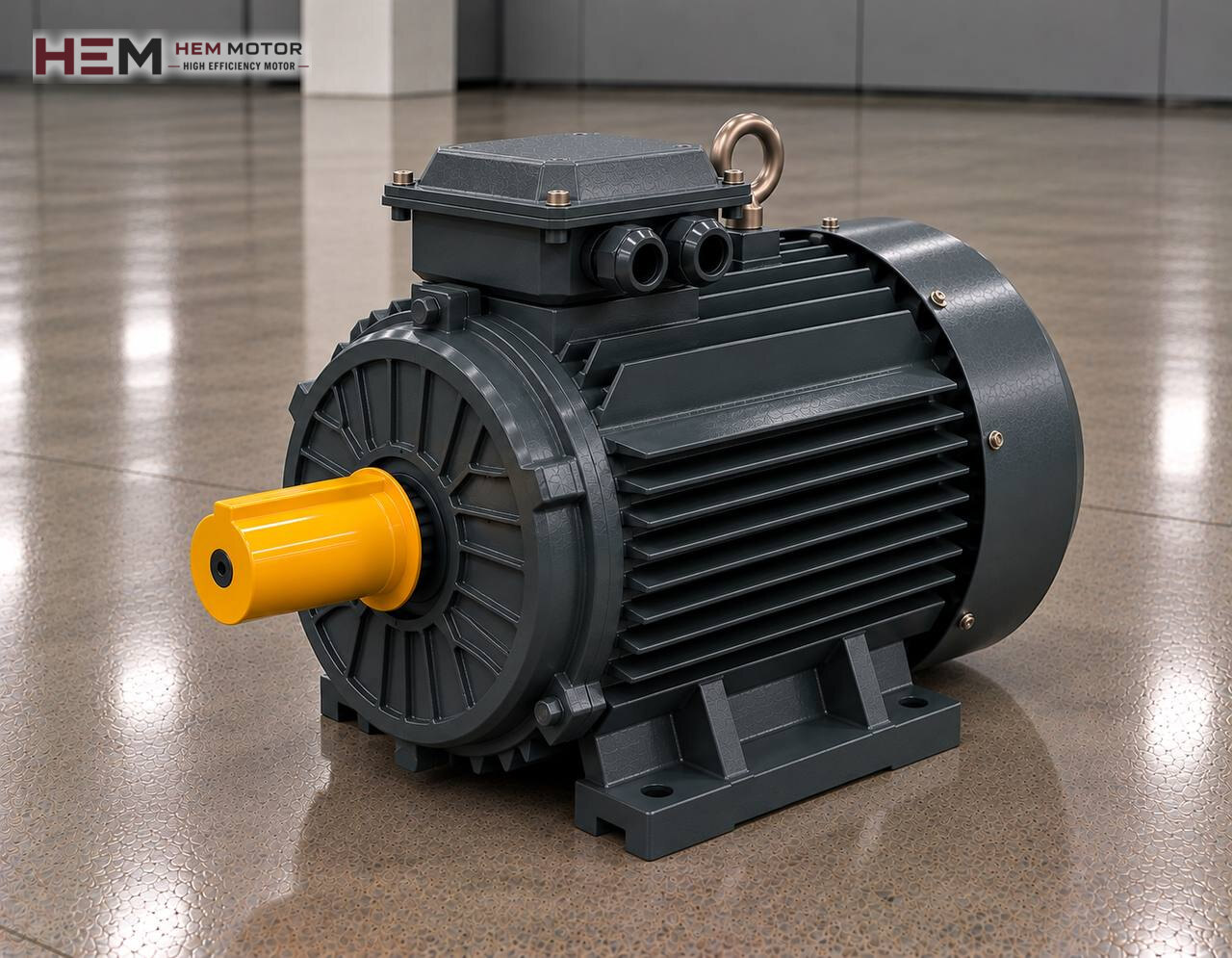
A plastic granulator breaks injection runners, rejected parts, pipe and profile offcuts, and bulky scrap such as bottles and crates into small pieces that can be processed again. The overall picture, together with the other machines in the sector, is on the plastic and rubber processing motors page. Here we explain what kind of load the motor driving the granulator rotor faces, how it starts and which information is used to select it.

Rotor, bed knife and screen: what the motor works against
At the heart of a granulator is a rotor carrying several rows of rotating knives. As the rotating knives pass the bed knives fixed to the housing, they cut the plastic like scissors; the pieces stay in the cutting chamber until they are small enough to pass through the holes of the screen below.
Three things set the load on the motor shaft: the thickness and hardness of the material being cut, the gap between rotating and bed knives, and the hole diameter of the screen. A blunt knife or a widened gap makes the same amount of material break at a higher current. That is why a current that slowly rises over time usually points to knife maintenance before it points to the motor.
The rotor design also changes the load. An open rotor makes it easier to ventilate the chamber with thin-walled, bulky parts. A closed (solid) rotor gives more mass and cutting force for thick runners and block-shaped parts. On rotors with angled or staggered knives, cutting is spread over time, so current peaks are softer.
Fast rotor, large inertia and long start-up
A granulator rotor turns much faster than shredder shafts and is usually connected to the motor by belts and pulleys. On many machines the large pulley also acts as a flywheel: when the rotating mass hits a thick part, it finishes the cut without losing all its speed. The price is paid at start-up. While bringing the total inertia of rotor and flywheel up to operating speed, the motor draws high current for longer than it would on a fan or a pump.
So start-up time and thermal protection setting are considered together. With star-delta starting the motor torque drops noticeably; with an empty chamber this is no problem, but with a full chamber the rotor may not reach the required speed in star. On large machines with heavy flywheels a soft starter or a frequency inverter is preferred. On the control side, the simplest measure is that the infeed conveyor does not run until the start is complete.
Plants that want to vary rotor speed with the material can drive the motor from an inverter; our three-phase series are suitable for this. If heavy load is carried at low speed for long periods, a separate cooling fan comes into question; if the cable between panel and motor is long, a dv/dt or sine filter does too. It is enough to mention these points when you ask for a quote. The topic is explained on the inverter compatible electric motors page.
Changing the pulley diameter also changes the knife tip speed. When the motor is replaced, keep the same speed class (often 4-pole, 1,500 rpm) and check belt tension and pulley alignment; an over-tightened belt wears the front bearing of the motor.
Feeding method and jamming moments
The granulator load depends on feeding. Small, slow-speed granulators standing next to an injection machine take runners one by one from a robot or a conveyor and run at an almost constant load. Central granulators, on the other hand, are filled by emptying full crates; if a lot of material enters the hopper at once, the rotor slows down and current rises. Purge lumps and thick pipe pieces are the most demanding materials.
If current stays high for a long time during a jam, the motor protection trips. On newer granulators the control monitors current and slows or stops feeding; this logic belongs to the machine control system. What can be done on the motor side is to order a PTC or PT100 sensor that measures winding temperature directly, so the protection looks not only at current but at actual temperature as well.
Knife change, run-down time and maintenance
Before the cover is opened for knife maintenance, the rotor must come to a complete stop. A heavy rotor keeps coasting for a long time after the power is cut. The cover interlock and standstill detection are the machine's safety circuit. If the rotor should stop sooner, options such as inverter braking are discussed with the machine builder; if a brake motor is needed, state it in your order.
Plastic dust and fines collect around the granulator. When the cooling fins and fan cover of the motor are covered in dust, cooling weakens; regular cleaning is a simple but effective measure. Granulator vibration can loosen the motor foot bolts over time, so add a bolt check to the maintenance list.
The regrind conveying fan and other auxiliaries
The ground pieces are usually carried from under the screen to a cyclone by a suction fan. This fan changes load slightly with material flow but runs continuously and is generally driven by a small 2-pole motor. Large granulators also have an infeed conveyor, a rotating-arm feeder or pull-in rollers for film; these are low-power drives, often with a gearbox.
The main motor sitting on the granulator frame is mostly foot-mounted (B3). HEM frames are also available in B5, B14, B34 and B35 flange versions and in V1, V3, V5, V6 and V15 vertical arrangements; we confirm the flange and shaft dimensions together with you at the order stage. For flange-mounted auxiliary drives see the flange-mounted electric motors page.
Example motors by granulator size
| Granulator type | Load on the motor | What to check | Example HEM model |
|---|---|---|---|
| Slow beside-the-press granulator | Low capacity, almost constant | Runner length, feeding method | 4 kW 112M-4 (1,450 rpm) |
| Medium granulator | Belt-driven, flywheel, fluctuating | Start-up time, screen size | 15 kW 160L-4 (1,465 rpm) |
| Central granulator, pipe and profile granulator | Heavy flywheel, impacts from thick parts | Starting method, rotor type | 37 kW 225S-4 (1,485 rpm) |
| Regrind suction fan | Continuous, direct-coupled | Conveying line length, cyclone | 4 kW 112M-2 aluminium (2,905 rpm) |
The models in the table are for guidance only. The actual power and speed are fixed once rotor diameter, number of knives, material type, pulley ratio and operating time are known. The nameplate of the existing motor is the most reliable starting point.
Information to send for a quote
Include in your message: machine type (beside-the-press granulator, granulator, pipe granulator), motor power (kW) and speed (rpm), the plant voltage, mounting type, whether it is belt or coupling driven, the starting method and the quantity needed. If the old motor's nameplate is readable, you can send a photo using the method on the send a motor nameplate page.
Models with a listed price are in the buy electric motors shop, and WhatsApp and phone details are on the contact page.
Frequently Asked Questions
If the granulator motor trips the overload at every start, is the motor too small?
Not always. A flywheel rotor takes a long time to start; if the thermal setting does not match this time, the protection trips early. First check the start-up time, whether the chamber is empty and the starting method, then look at the power.
Will a higher-speed motor increase granulator capacity?
Knife tip speed is a value set by the machine builder. Raising speed can increase heating, noise and bearing load; for capacity, first look at the screen and knife condition. If the pulley ratio is not changed, choose the same speed as the old motor.
Can a single-phase motor be used on a small granulator beside the press?
It is possible if only 220 V is available in the workshop and the machine power is suitable. HEM's single-phase electric motor series covers 0.18–5.5 kW; the starting need of the granulator should be assessed together with the machine builder.
Is a belt or a coupling better for a granulator motor?
Belts are common on granulators because they let you set the speed through the pulley ratio and absorb part of the shocks. Direct coupling is seen more on slow-speed and gearbox-driven granulators; the choice depends on the machine design.