English
 Français
 Türkçe
 Español
 Русский

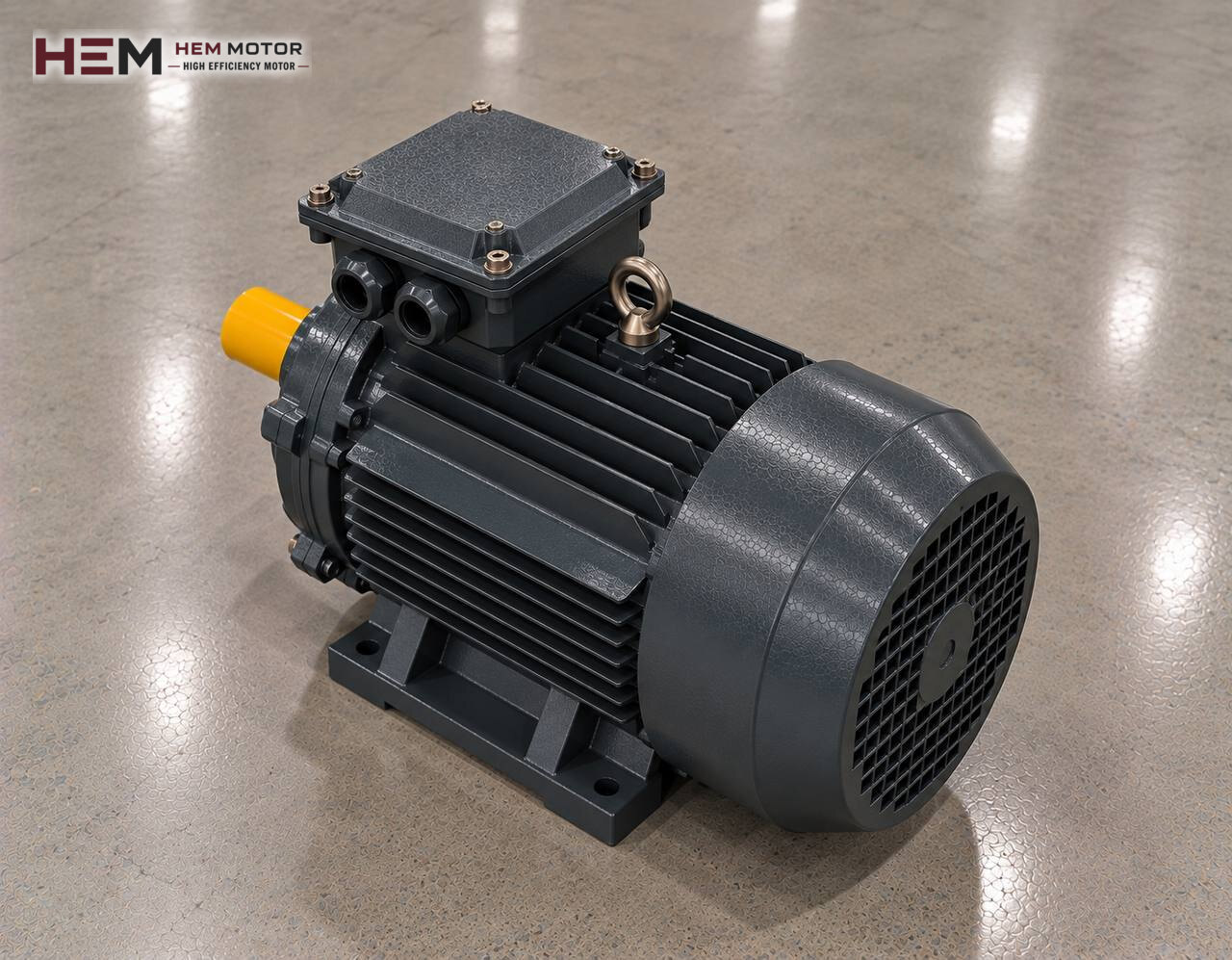
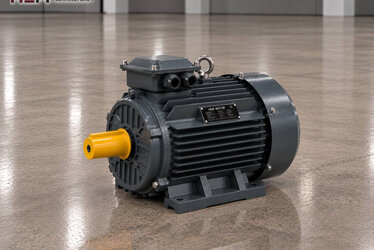
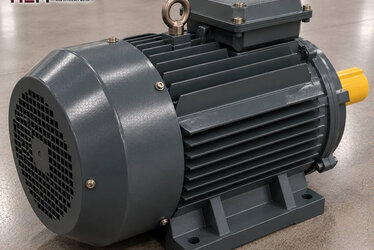
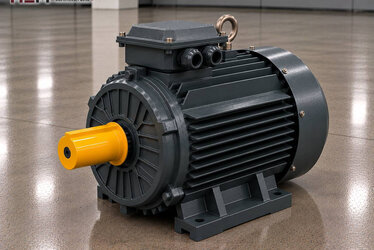
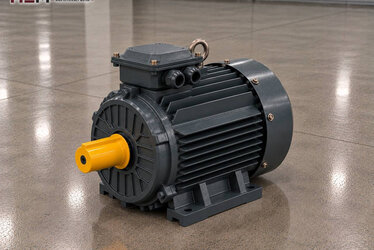
A plastic extruder melts granules or regrind with a screw turning inside a heated barrel, mixes it and pushes it continuously out through a die; a pelletising line turns this melt back into granules. This page is part of plastic and rubber processing motors and focuses on the motors that turn the screw, the cutter, the haul-off and the fans on an extrusion line.

Screw drive: a load that needs constant torque
The extruder screw turns at low speed; typical screw speeds range from a few tens to a few hundred revolutions per minute. There is therefore always a gearbox between motor and screw; the large axial force that the screw pushes backwards is carried not by the motor but by the thrust bearing inside the gearbox. The motor is connected to the gearbox either directly by flange or through a belt and pulleys.
Screw torque stays largely the same even when speed changes: as long as melt viscosity and die pressure do not change, the screw meets a similar resistance on every revolution. The extruder is therefore a typical constant-torque load, and motor power rises roughly in proportion to speed. Since line output is set by speed, the screw motor is almost always driven by a frequency inverter. On older lines DC motors did this job; DC motors are not included in HEM Motor's 2026 catalogue, and in retrofits a three-phase asynchronous motor with an inverter is the common solution.
Cold barrel, start-up and commissioning sequence
The extruder screw is never run in a cold barrel. First the heater bands bring the barrel to set temperature, the die and adaptor heat up too, and then the screw is started at low speed. The control system protects this sequence with interlocks. Even so, if solidified material is left in one zone of the barrel, torque on the first turn is higher than expected; the inverter's current limit and the motor's starting torque matter at this moment.
A screw motor driven by an inverter can run for long periods at low speed and full torque. Its own shaft fan is weak at that speed; cooling by an independent fan may then be required. If the cable between panel and motor is long, a dv/dt or sine filter is considered at the output. It is enough to state these two details in the order; the general framework is explained on the inverter compatible electric motors page.
A PTC or PT100 sensor can be ordered to monitor winding temperature; on an extruder the inverter can evaluate this signal directly.
Barrel cooling fans and heat management
The barrel is both heated and cooled in each zone: excess heat from screw friction is removed by small radial fans under the heater bands. These fans switch on and off at short intervals and are generally small. Our small aluminium-frame motors can be used on such fans; the detailed framework is on the fan and extractor motors page.
The main screw motor sits at the rear end of the barrel, near the feed hopper. Heat radiating from the barrel and granule dust around the hopper affect the motor's cooling air; the area in front of the fan cover must be kept open and the motor should not be placed too close to the heat source.
Pelletising: strand, hot-face and underwater cutters
On a pelletising line the melt leaves a perforated die and is cut. Three arrangements stand out:
- Strand pelletising: the melt passes as strands through a water bath, cools, and a pull roll feeds them into a rotor cutter. The cutter motor runs at high speed and continuously; its load grows with the number of strands and the speed.
- Hot die-face cutting: the knives turn directly on the die face; the cutter motor is adjusted to line speed and pellet size is set by this speed.
- Underwater cutting: the knife turns in a water-filled chamber; the cutter motor stays outside the chamber, and shaft sealing is the machine's job.
In all three arrangements, after the cutter there is a centrifugal dryer separating pellets from water, a pneumatic transfer fan carrying pellets to silos and a water circulation pump. These auxiliary drives are continuously running loads turned by standard three-phase motors; for pumps, the pump electric motors page is a guide.
Haul-off and winder on profile, pipe and film lines
On lines producing profile, pipe or film instead of pellets, a haul-off after the die pulls the product at constant speed; product dimensions depend on the ratio of this speed to screw speed. The haul-off motor runs at low speed with fine speed adjustment; on pipe lines a cutting saw follows, on film lines a winder. Cable coating lines also use extrusion, but because the line structure is different they are covered under a separate heading.
On the mounting side, the screw motor is usually connected to the gearbox in B3 foot or B35 foot-and-flange arrangement. Depending on frame size, B3, B5, B14, B34, B35 and vertical V1/V3/V5/V6/V15 arrangements are offered; flange and shaft dimensions are finalised in the order. For gearbox matching see the electric motors for reducers page.
Example motors for an extrusion line
| Drive | Load type | What to check | Example HEM model |
|---|---|---|---|
| Main screw (with gearbox) | Constant torque, speed set by inverter | Screw diameter, cooling at lowest operating speed | 45 kW 225M-4 (1,485 rpm) |
| Small laboratory or recycling screw | Constant torque, low output | Gearbox flange, current limit | 18.5 kW 180M-4 (1,470 rpm) |
| Strand pelletiser cutter | Continuous, tied to line speed | Number of strands, cutter speed | 7.5 kW 132M-4 (1,460 rpm) |
| Pellet transfer fan | Continuous, direct coupled | Line length, fan speed | 3 kW 100L-2 (2,895 rpm) |
The models are for illustration; exact power and speed are determined once screw diameter, material, target output and line layout are known. The nameplate of the motor currently on the line is the best starting point.
Information to send with your order
Write the machine type (extruder, pelletising line, profile or pipe line), the drive the motor is on, power (kW), speed (rpm), voltage, mounting arrangement, gearbox flange details, inverter use and quantity. If the screw motor is being replaced, you can send a photo of the old motor's nameplate via the send a motor nameplate page.
Current model prices are on the buy electric motors page; use the contact page for WhatsApp and phone details.
Frequently Asked Questions
Why does power drop when I lower the speed of the extruder screw motor?
The screw is a constant-torque load; when torque stays the same, the power delivered by the motor falls together with speed. So when output decreases, the motor also draws less power, but cooling at low speed must be assessed separately.
Is it possible to replace an old DC screw motor with an asynchronous motor?
Yes, many lines have been renewed this way. The required speed range, torque at low speed and gearbox connection dimensions are examined together, and a suitable inverter is chosen along with the motor.
At what speed should I choose the motor for a pelletiser cutter?
The cutter rotor speed is the value given by the machine builder; motor speed is matched to it by belt ratio or inverter. Use the speed on the existing motor's nameplate as the basis.
The screw motor is close to the barrel; is any extra measure needed?
Heat radiating from the barrel and granule dust can make cooling the motor harder. Keep the space in front of the fan cover clear, clean off dust regularly, and you can ask for a motor with a PTC sensor to monitor winding temperature.