English
 Français
 Türkçe
 Español
 Русский

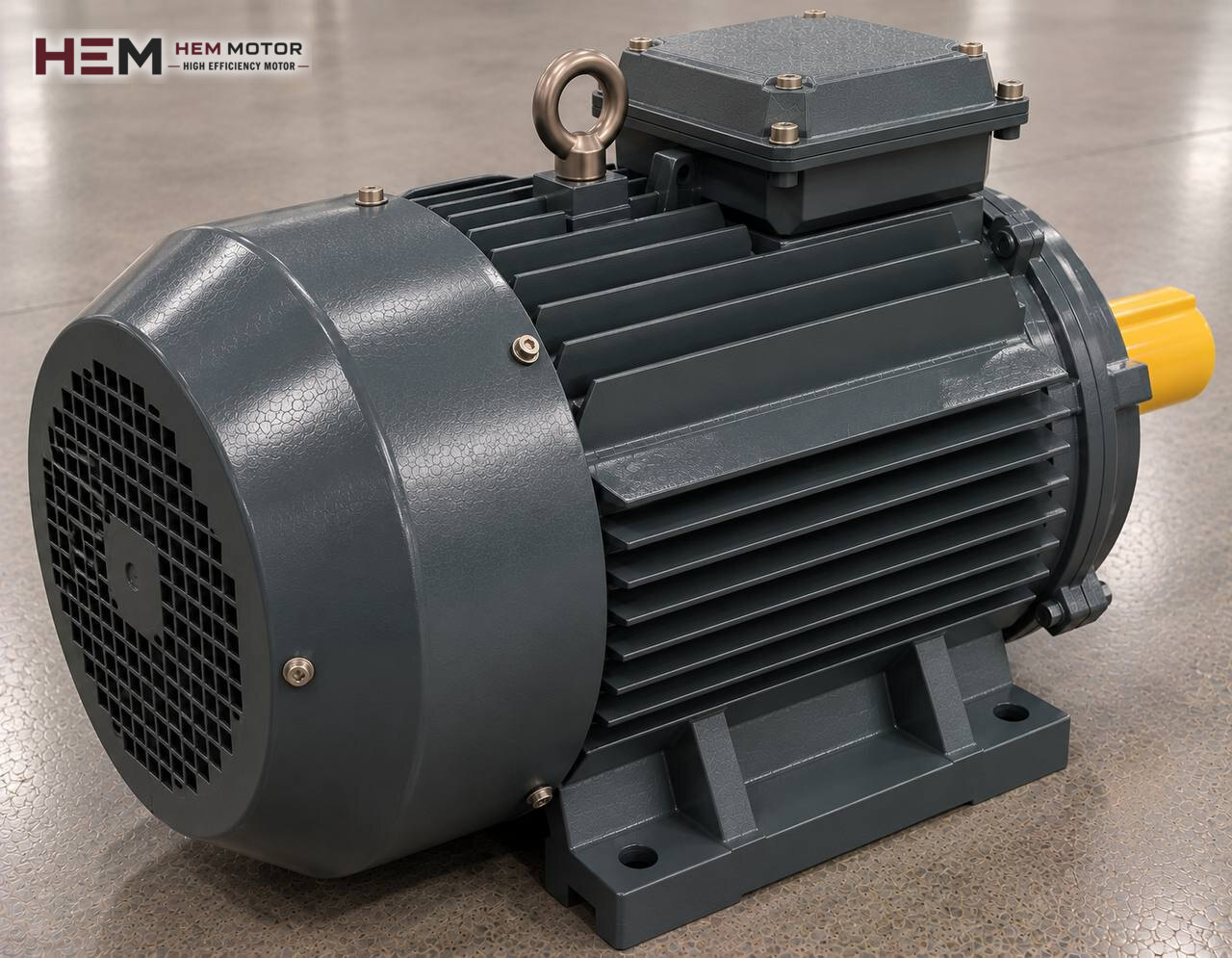
Cable manufacturing starts by reducing copper or aluminium rod, continues with stranding and insulating the conductor, and ends when the finished cable is wound onto a reel. Insulation and sheath extrusion is a branch of plastics processing; for the other machines in that sector see plastic and rubber processing motors. This page explains where, and under what load, a standard three-phase asynchronous motor works in the stations that make up a cable line.

Stations along the line and their motors
A typical power cable plant consists of several separate machines. The wire drawing machine pulls thick rod through successive dies to turn it into fine wire. An annealer then softens the wire. The bunching or stranding machine combines many fine wires into one flexible conductor. On the insulation line an extruder applies PVC, PE or XLPE over the conductor; a cooling trough, a haul-off (caterpillar) and a take-up follow.
The motor faces a different situation at each station. Some need high power and long continuous load, others need precise speed matching. That is why there is no single "cable motor"; you have to think station by station.
Wire drawing: high power and die resistance
In wire drawing the motor turns the capstan drums that force the wire through the dies. The load depends on the reduction ratio of the cross-section, the number of dies and the quality of lubrication. On rod breakdown machines this drive is the most powerful motor on the line, and a 4-pole motor is usually coupled to the drums through a gearbox or gear unit.
When the machine starts with full dies, the wire is under tension and the motor needs high torque at the first moment. The line stops and restarts often when a new rod coil is joined or when the wire breaks. This starting frequency affects motor heating and is always asked during selection. For the gearbox side, electric motors for reducers will help.
Extruder: constant torque, adjustable speed
The screw of an insulation extruder needs almost constant torque while it melts the granules and pushes them into the die. Because output is set by screw speed, the main motor is usually driven by a frequency converter and coupled to the screw through a gearbox. Coating thickness depends on the balance between conductor line speed and screw speed; the line's control system sets this balance.
The motor does not start against high-viscosity melt while the heater zones are hot; but if a start with a cold screw is attempted, the motor is heavily stressed. This is a process rule, not a motor rule, and belongs in the operator instructions. Extruder details are covered on a separate sub-page of this sector.
Haul-off, take-up and auxiliaries
The caterpillar haul-off pulls the cable forward between two tracks at constant speed. The take-up carries a load whose diameter grows as the reel fills; to keep line speed constant, its speed must keep falling. Speed matching is critical at these two stations. On many modern lines this task is given to servo drives; servo motors are not included in HEM Motor's 2026 catalogue. On simpler lines a standard motor can be used with a vector-controlled drive; the decision belongs to the line builder.
The line also has motors you rarely notice but that never stop: the pump feeding water to the cooling trough, the annealer's cooling circuit, the granule dryer fan and the air cooling fans on the extruder zones. These are relatively small drives running for long hours at fixed speed.
Example motors by station
| Station | Motor load | Asked during selection | Example HEM model |
|---|---|---|---|
| Rod breakdown drawing | High, continuous torque against die resistance | Drawing speed, number of dies, starts per hour | 225S-4 cast iron — 37 kW, 1,485 rpm |
| Insulation extruder | Constant torque, drive-adjusted speed | Screw diameter, gear ratio, speed range | 180L-4 cast iron — 22 kW, 1,470 rpm |
| Caterpillar / take-up (simple line) | Variable speed, speed matching | Control method, reel weight | 112M-4 cast iron — 4 kW, 1,450 rpm |
| Cooling trough pump | Long running at fixed speed | Flow, head | 90L-2 cast iron — 2.2 kW, 2,895 rpm |
The models in the table are only for orientation. Actual power and speed are confirmed from the line builder's data, the station's transmission layout and the plant's operating regime.
Drive, mounting and plant environment
Most motors on cable lines run behind a drive. HEM's three-phase series are suitable for speed control with a drive. At stations such as the extruder that need full torque at low speed as well, the motor's own fan may be insufficient, so a separate cooling fan should be considered. If the cable between the drive panel and the motor is long, a filter limiting the voltage rise rate (dv/dt or sine) may be needed at the output. Share these details with your order; a general explanation is on the inverter-compatible electric motors page.
As motors attach to a gearbox or to the machine frame, foot, flange and combined foot-flange designs are used. B5 or B35 is common on wire drawing and extruder gearboxes; alongside them HEM series offer B3, B14, B34 and vertical V1, V3, V5, V6 and V15 arrangements depending on frame size, and flange and shaft fit are checked at ordering. The drawing section has drawing-oil vapour, the extrusion section hot air and granule dust. Clean the fan cover regularly so it does not clog with oily dust; anyone wishing to monitor winding temperature can request a PTC or PT100 sensor as an order option.
What information is needed for a quote?
When looking for a motor for a cable line, send us: the machine and station where the motor will be fitted (drawing, extruder, haul-off, take-up or pump), the power (kW) and speed (rpm) on the nameplate, your plant voltage, the mounting type (foot or flange), whether it will run on a drive and how many units you need. If the motor sits on a gearbox, adding flange and shaft diameter makes matching easier.
If the old motor's nameplate is readable, a clear photo answers most questions; the method is in our article on finding an equivalent motor from the nameplate. For models listed with prices go to the shop, and for our WhatsApp line and phone numbers see the contact page.
Frequently Asked Questions
Why does the wire drawing machine motor overheat so often?
The most common causes are worn dies, insufficient drawing oil and a higher number of starts caused by wire breaks. Compare the operating current with the nameplate current and clean oily dust from the fan cover.
Can the extruder motor run without a drive?
Technically yes, but screw speed must change to adjust coating thickness. That is why on insulation extruders the motor is almost always driven by a frequency converter.
Can I fit a standard motor in place of the servo motor on the take-up?
This depends on the line's control structure. A control program written for a servo may not give the same precision with a standard motor. The decision should be made together with the line builder.
What speed suits the cooling water pump?
Most centrifugal water pumps run with a 2-pole motor of around 3,000 rpm. The exact information is on the pump's nameplate or in the manufacturer's data.