English
 Français
 Türkçe
 Español
 Русский
 العربية

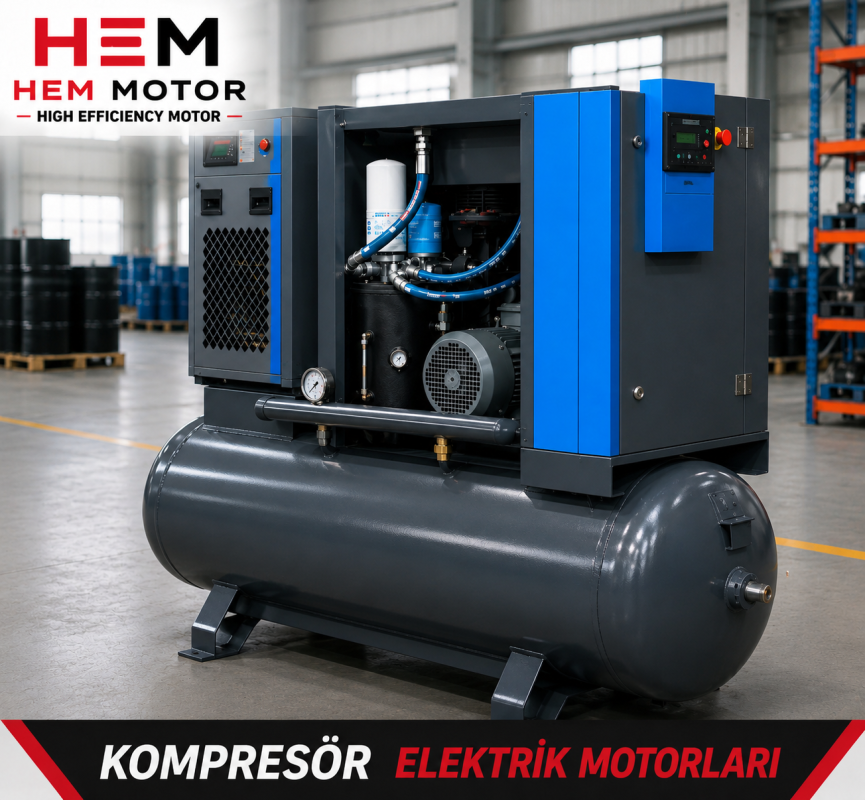
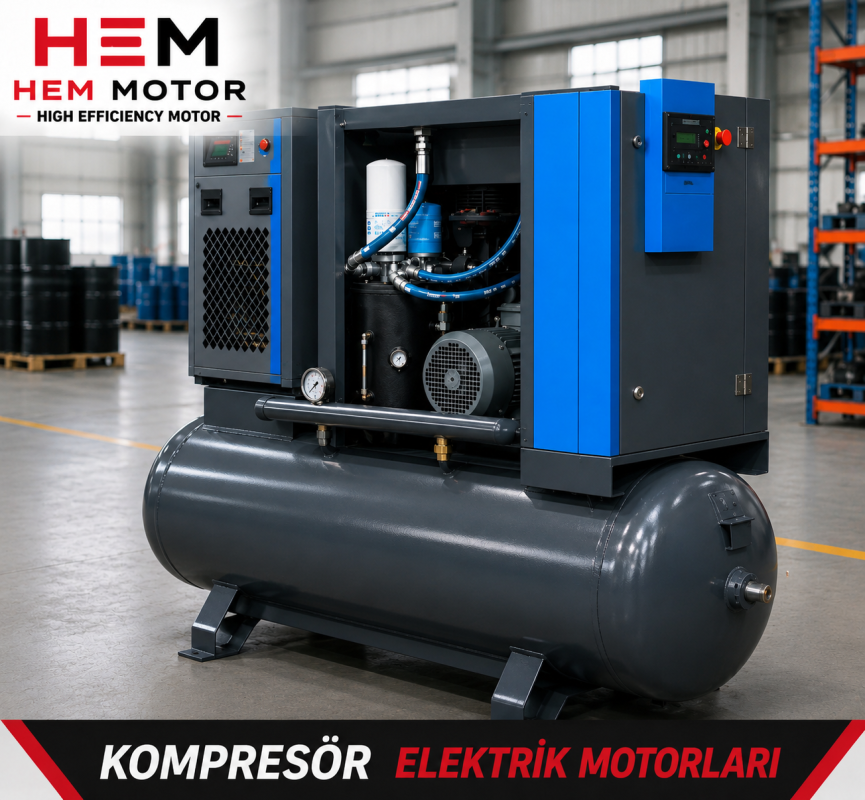
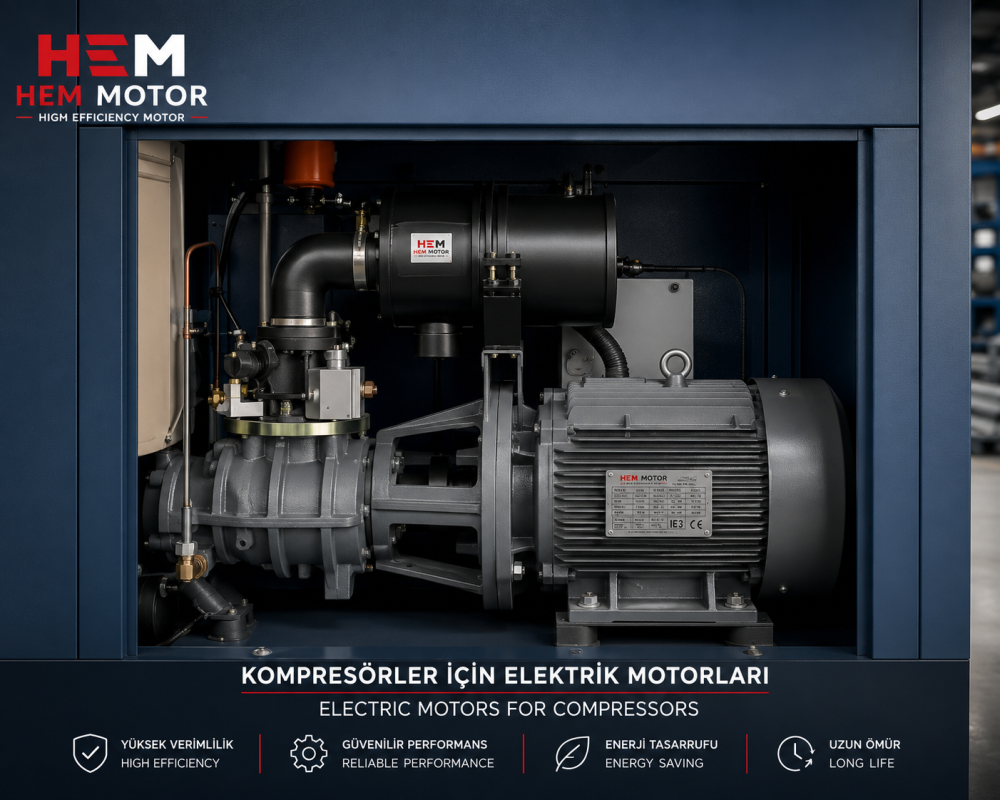
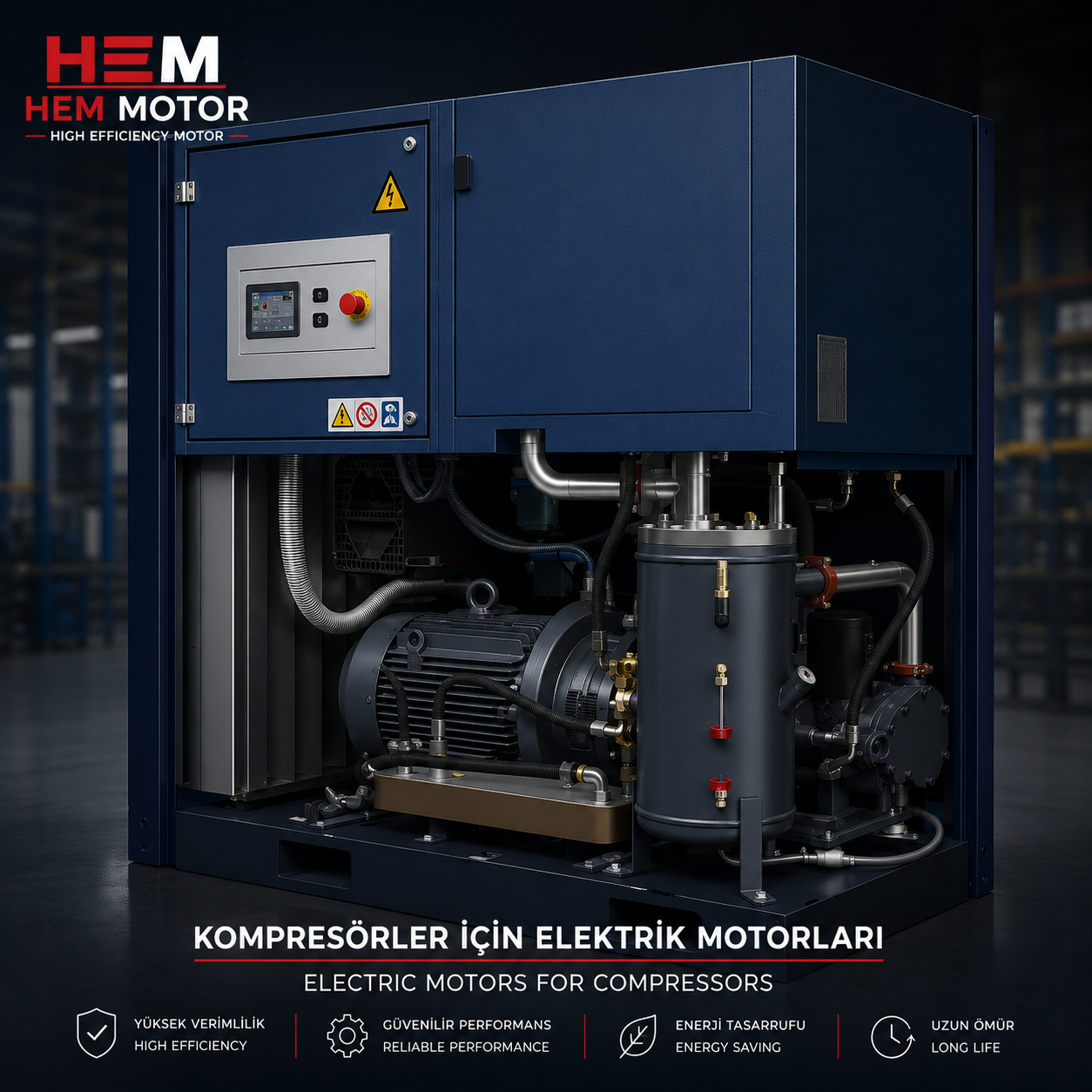
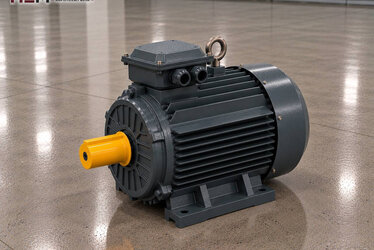
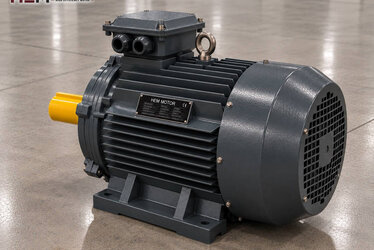
A compressor turns the energy it takes from the mains into compression work through the motor shaft; from the tank-mounted piston unit in a workshop to the screw package in a factory, the first link in that chain is a three-phase asynchronous motor. This page is about the motor that drives the compressor, not the compressor itself: how the motor is loaded in each compressor type, what to check at start-up, how the heat and oily air of a compressor room affect the motor, and what information an order needs.

The Load the Motor Sees in Piston, Screw and Turbo Compressors
In a piston compressor the crankshaft drives the pistons back and forth. Shaft torque rises and falls with every compression stroke, so the motor sees a pulsating load. Most of this pulsation is smoothed by the heavy pulley on the compressor side, which also acts as a flywheel. In small workshop units the motor and the compressor head usually sit side by side on top of the tank, linked by a belt.
In a screw compressor two meshing helical rotors compress the air continuously, so the torque ripple is small. Because the machine is positive-displacement, shaft torque depends more on discharge pressure than on speed: the higher the pressure setting, the more current the motor draws. Before raising line pressure above the design value, measure how close the motor current comes to the nameplate figure.
In a turbo (centrifugal) compressor an impeller spinning at high speed compresses the air; a gearbox raises the motor speed considerably and powers are large. Here start-up is governed by the inertia of the impeller and gear set.
For domestic and small workshop compressors where no three-phase supply is available, our single-phase electric motor range can be considered.
This page sets out a general framework for the compressor family; the details of each machine are on its own sub-page. The Screw Compressor Motor page covers the load/unload cycle and coupled units in detail, the Piston Air Compressor Motor page covers stop-start by pressure switch and the belt-driven tank-mounted layout, and the Vacuum Pump Motor page covers the motors of pumps that draw air out rather than push it.
How Does the Load/Unload Cycle Affect the Motor?
Most screw units run on two-step control. When line pressure drops to the lower limit the inlet valve opens and the machine runs loaded; when it reaches the upper limit the valve closes and the motor keeps turning but draws far less power. If the unloaded period goes on too long, the unit stops itself. This arrangement protects the motor from frequent stop-start.
In piston types, by contrast, the pressure switch stops and starts the motor directly. The main factor in motor heating is therefore the number of starts per hour: the high inrush current heats the winding a little more each time. In a workshop with fluctuating air demand, a small tank means frequent starts; a larger tank or a wider pressure band eases the load on the motor. For operation with frequent starts, a PTC or PT100 winding sensor can be added as an order option.
A piston compressor has a small head unloading valve that vents the discharge line when the unit stops. If this valve fails, the motor tries to start against the pressure left in the cylinder, current stays high for a long time and the overload trips. Check that this valve works before replacing the motor.
Pulley, Coupling and Gearbox: Motor Details by Drive Type
In a belt drive, the ratio of the pulley diameters sets the compressor speed. Belt tension applies a side force to the motor shaft; the motor usually sits on slide rails and tension is adjusted by moving it. The smaller the motor pulley, the higher the tension needed to transmit the same power, and the more load on the drive-end bearing.
In direct-coupled screw units, the motor and the airend are joined on one axis through a coupling or a flanged bell housing. Misalignment wears the coupling and the bearings on both sides. Some compressor builders use motors made to their own drawings; if standard IEC dimensions do not fit, state this in your order.
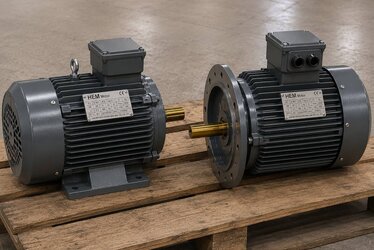
Mounting arrangements B3, B5, B14, B34, B35 and vertical V1/V3/V5/V6/V15 are offered according to frame size; flange and shaft dimensions are confirmed with the order. For the arrangement common on coupled units, see foot-and-flange B34/B35 motors.
How Is the Starting Method Chosen for a Compressor?
A screw compressor starts with its inlet valve closed, so the initial load is low; that is why star-delta is the arrangement most often found in the field. Torque is reduced in star; if the changeover to delta comes before the motor approaches speed, a current surge results, so the changeover time is set accordingly.
Check the winding voltage in the catalogue: from 4 kW upwards our models are rated 400/690 V (Δ/Y) and, running in delta on a 400 V supply, are suitable for star-delta starting. Models up to 3 kW are rated 230/400 V; since they are already star-connected on a 400 V supply, this starting method cannot be used with them.
A piston compressor starts hard if pressure is left in the cylinder; small sizes are usually started direct-on-line. In variable-speed screw compressors, a frequency inverter matches air output to demand. Our three-phase ranges are suitable for speed control with a frequency inverter; for long periods at low speed with full torque an external fan may be needed, a dv/dt or sine filter is considered for long cables, and these conditions should be stated in the order. Details: inverter-compatible electric motors.
The Motor in the Compressor Room: Heat, Oil Mist and Dust
The heat of compressed air spreads into the room; in a poorly ventilated compressor room the temperature climbs quickly. The motor cools itself with its own shaft fan over the frame fins, so a hot room also eats into the motor's cooling margin. It is worth stating the room's summer temperature in your order.
When oil mist mixes with dust, a sticky layer forms on the fan cowl and fins and stops heat from escaping. Regular cleaning has a direct effect on motor life. Enclosure protection is IP55 and insulation is class F. In outdoor enclosures where condensation forms on a frame that cools overnight, an anti-condensation heater is available as an order option. In belt drives, rising noise or vibration at the pulley-end bearing is an early warning that maintenance is due.
Motor Pre-Selection Table by Compressor Type
| Compressor type | Motor load | Value to check | Example HEM model |
|---|---|---|---|
| Piston, tank-mounted workshop type | Pulsating torque, frequent stop-start | Starts per hour, head unloading valve | 2.2 kW 100L1-4 (1,450 rpm) |
| Screw, belt-driven | Torque rising with pressure, continuous duty | Working pressure, pulley ratio | 15 kW 160L-4 (1,465 rpm) |
| Screw, direct-coupled | Load/unload cycle | Airend speed, flange and shaft size | 22 kW 180M-2 (2,955 rpm) |
| Large screw or turbo unit | High inertia, high power | Starting method, supply capacity | 75 kW 280S-4 (1,486 rpm, SF 1.15) |
The models in the table are examples; the final choice depends on the compressor load, required speed, mounting and operating conditions. The most reliable starting point is the power and speed on the existing motor's nameplate.
What to Send Us With a Motor Request
For a quick and accurate quotation, tell us: the machine type (piston, screw or turbo compressor), motor power (kW), speed (rpm), supply voltage, mounting arrangement, drive type (belt or coupling), starting method and the quantity required. A photo of the old motor's nameplate answers most questions on its own; how to take it is explained in our send your motor nameplate article.
Current prices for all models are shown on the buy electric motors page. WhatsApp and phone details are on our contact page. If you need a large volume of low-pressure air rather than compressed air, our ventilation electric motors page covers blower and fan drives.
Frequently Asked Questions
Will the motor be strained if I raise the pressure setting on a screw compressor?
Yes. In a screw machine, shaft torque rises with discharge pressure, so motor current rises as pressure increases. Before changing the setting, measure the current under load and compare it with the nameplate value.
Why does a piston compressor motor keep tripping its overload?
The most common causes are too many starts per hour, a faulty head unloading valve and a belt that is slack or over-tensioned. Check these three before replacing the motor.
Can I use star-delta starting on a 3 kW compressor motor?
Not on a 400 V supply. Our models in this size are rated 230/400 V and already run in star at 400 V; star-delta requires the motor to be connected in delta at 400 V.
Can I use a compressor motor on a single-phase supply?
For small sizes, yes; our single-phase range from 0.18 to 5.5 kW is a separate option for this. Larger compressors need a three-phase supply.