English
 Français
 Türkçe
 Español
 Русский
 العربية

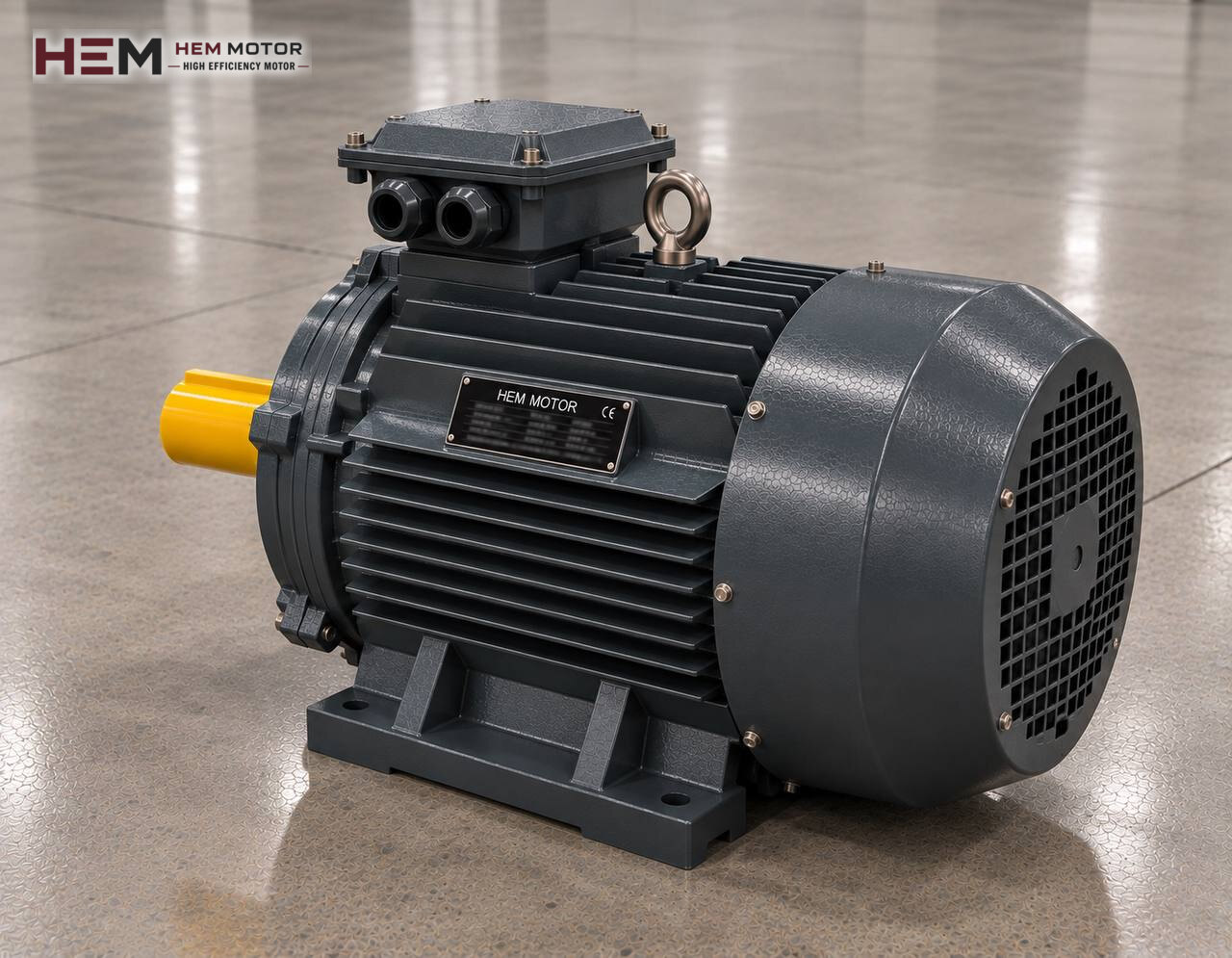
A vacuum pump removes gas from a closed volume and creates a pressure below atmospheric there. Typical examples are drawing air out of bags on packaging machines, holding panels on a CNC table, pulling sheet onto the mould in vacuum forming, and removing vapour in drying and degassing processes. This page covers the electric motor that turns the pump rotor; for machines on the compressed-air side, see the compressor electric motors page.

Pump types and how the motor is connected
The type most often seen in industry is the oil-lubricated or dry-running rotary vane pump. Vanes in the slots of an eccentrically placed rotor slide against the housing wall and form cells; the cells draw in as they grow and discharge as they shrink. On these pumps the motor is usually flange-mounted to the pump housing and the shaft turns the rotor directly through a coupling; there is no separate baseplate.
In a liquid ring pump an eccentrically mounted bladed impeller throws the water inside against the casing by centrifugal force, and the resulting water ring works like a compression chamber without pistons. Because it handles wet and vapour-laden gas easily, it is common in paper, chemical and food plants. Motor and pump usually sit on a common frame with a flexible coupling between them.
Dry claw and screw pumps are used where oil-free vacuum is needed; the rotors turn without touching and speeds are high. Some of them have a gearbox or belt between motor and pump. In large systems a roots-type booster placed ahead of the main pump also runs on its own motor.
The link between vacuum level and motor load
The power drawn by a vacuum pump motor is not constant; it changes with suction pressure. When the inlet is close to atmospheric, the gas mass moved per revolution is large and shaft torque is high. As the tank or line empties, less gas is moved and the load falls. So the motor usually faces its hardest moment at the start of the cycle, while the volume is still full of air.
The picture is a little different for a liquid ring pump: the power spent turning the water forms a constant base load independent of vacuum, and the power curve peaks in the medium vacuum range. The highest value on the pump manufacturer's power curve is used for motor selection; the rated power on the nameplate must cover this peak. Excess or warm sealing water also increases motor current.
Cold oil, a flooded casing and starting
Starting an oil-lubricated vane pump in a cold workshop in winter is hard on the motor. Thickened oil resists vane movement and the motor delivers higher torque than normal in the first seconds. Using oil of the viscosity recommended by the pump manufacturer and not keeping the room too cold reduce this load.
A liquid ring pump starts heavily if its casing has stayed full of water; the water mass must be accelerated at once. Manufacturers therefore ask for the water to be drained to a certain level before starting. The starting method is chosen accordingly: direct-on-line is common for small ratings, while soft starters or frequency inverters are preferred on large units. Our models from 4 kW up carry a 400/690 V label, so they also suit star-delta on a 400 V supply; however, the low torque in star may not be enough for a flooded-casing start.
Direction of rotation and the risk of running back
Reverse rotation is harmful on vane pumps: vanes can jam in their slots and the oil circuit does not work. On first connection the motor should be run briefly and the direction compared with the arrow on the pump housing; if necessary, two phase leads are swapped. When the pump stops, the evacuated volume can suck gas back and turn the rotor backwards; a non-return valve at the inlet prevents this and belongs to the pump side. What matters on the motor side is never to restart a shaft that is turning backwards.
Speed control, heat and vapour
In central systems where vacuum demand fluctuates during the day, pump speed is adjusted by a frequency inverter to hold the required vacuum level. Our three-phase ranges suit this use. If the pump turns slowly for hours yet still demands high torque, the shaft fan delivers less air and a separately powered cooling fan is added; if the drive is far from the panel, a dv/dt or sine filter is fitted against voltage spikes at the motor terminals. The minimum and maximum speeds allowed by the pump manufacturer must not be exceeded; details on the inverter-compatible electric motors page.
The housing of an oil-lubricated pump gets noticeably hot in operation and a flange-mounted motor takes part of this heat. If oil mist escaping from the exhaust sticks to the motor fins, cooling weakens; maintaining the exhaust filter protects the motor too. Our motors have an IP55 enclosure and class F insulation. If the extracted gas contains flammable solvent vapour, a standard motor is not designed for that environment; explosion-protected motors are not included in HEM Motor's 2026 catalogue, and this condition must be stated in the order.
Sample motor selection
| Pump layout | Motor load | Value to check | Sample HEM model |
|---|---|---|---|
| Small oil-lubricated vane pump, flange-mounted | High torque at cycle start, cold oil | Flange and shaft size, direction | 2.2 kW 100L1-4 |
| Medium vane or claw pump | Continuous duty, hot housing | Ambient temperature, exhaust vapour | 5.5 kW 132S-4 |
| Liquid ring pump, coupled | Base load of the water ring | Peak of the power curve | 11 kW 160M-4 |
| Central vacuum system with inverter | Variable speed, variable vacuum | Speed range, separate fan | 18.5 kW 180M-4 |
These rows are for guidance only; which motor fits is decided by looking at the pump's power curve, the required speed, the connection type and site conditions together. For reference: the 160M-4 delivers 71.7 Nm at 1,465 rpm and the 180M-4 120.2 Nm at 1,470 rpm rated torque. Flange options are summarised on the B5 and B14 flange motors page.
What information is needed for a quote?
Send the pump brand and machine type (vane, liquid ring, claw), the required power and speed, the voltage at your site, the mounting arrangement (flange B5/B14 or foot-and-flange B35), shaft and flange sizes, inverter use and quantity. A photo of the existing motor's nameplate makes selection much easier. For small single-phase vacuum units our single-phase motor range is also an option.
Prices are listed in our electric motor shop; our WhatsApp and phone numbers are on the contact page.
Frequently Asked Questions
Why does a vacuum pump motor draw more current at the start of the cycle?
While suction pressure is close to atmospheric, the pump moves more gas per revolution and shaft torque rises. As the volume empties, less gas is moved and current falls.
Why does a vane pump motor struggle to start in winter?
Cold oil becomes more viscous and resists vane movement. Using the oil recommended by the pump manufacturer and not leaving the pump in a very cold room make starting easier.
Can a frequency inverter be fitted to a vacuum pump motor?
Yes, our three-phase motors can be inverter-driven. The pump manufacturer's speed limits must be respected; if the motor will turn slowly for long periods, state the need for an extra cooling fan in the order.
Can a standard motor be used on a pump that extracts solvent vapour?
A standard IP55 motor is not suitable for an environment with flammable vapour. This condition must be reported in the order and a suitable motor determined according to the plant's explosion risk assessment.