English
 Français
 Türkçe
 Español
 Русский
 العربية

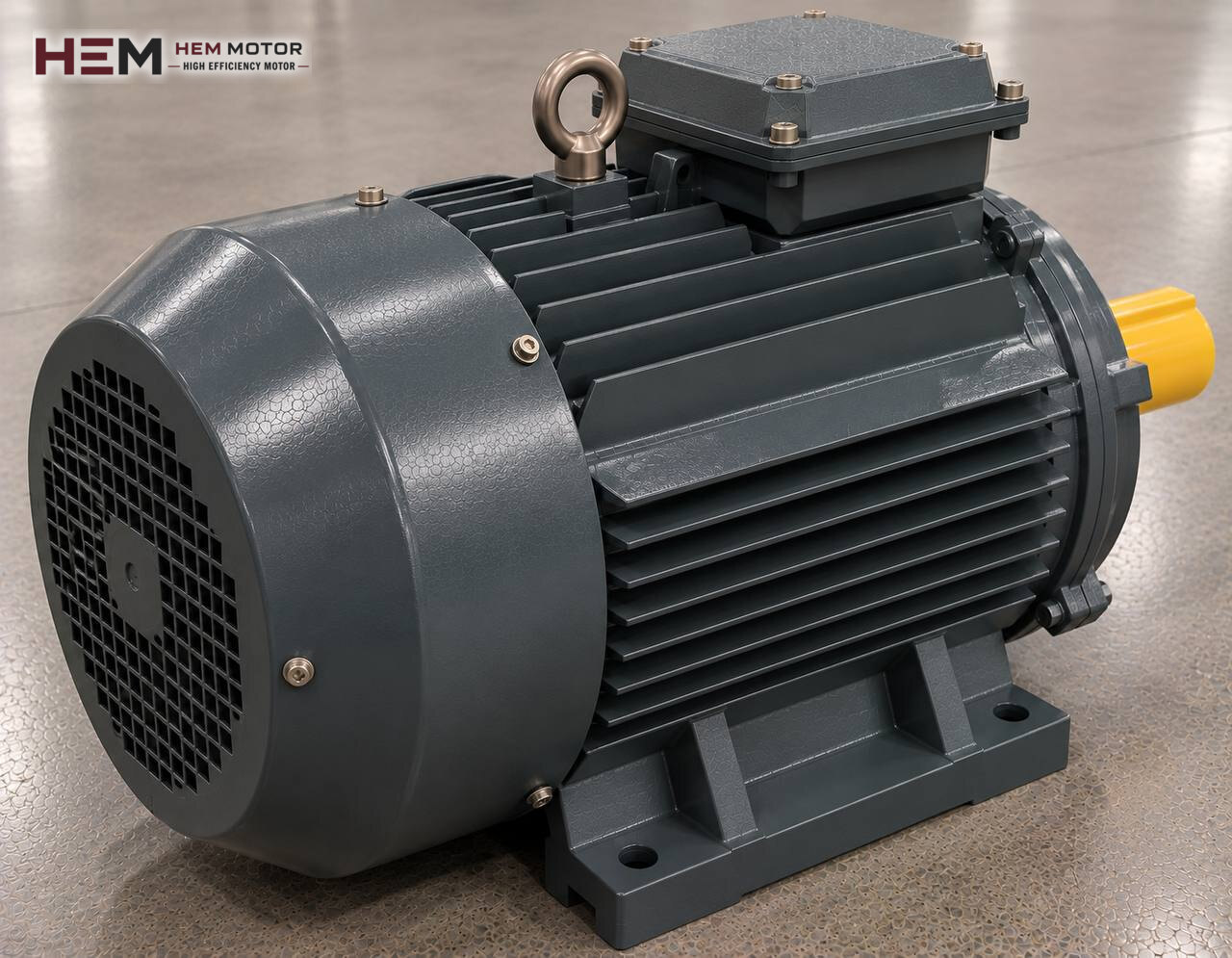
A screw compressor is a machine in which two intermeshing helical rotors compress air continuously; from workshops to large factories, it is the main source of compressed air. The three-phase asynchronous motor that turns the rotors inside the canopy is the machine's largest single consumer. This page covers only that motor: the speed the screw element needs, the different demands belt, gear and direct drive make on the motor, cooling inside a sound-insulated canopy, the difference between fixed and variable speed, and what to watch when replacing the motor. For a comparison with piston and turbo types, see the parent page Compressor Electric Motors.

What Speed Does the Screw Element Need?
The rotor tip speed at which a screw element works efficiently depends on the element maker's design. If the same element is turned at a different speed, both air delivery and power drawn change. That is why in a screw compressor the motor speed alone means little; what matters is the speed at the element's input shaft. The transmission between motor and element matches these two speeds.
In these machines, most of which are oil-injected, oil is sprayed onto the rotors during compression; the oil both seals and carries heat away. In the first minutes when the oil is cold, the element turns more heavily. Oil-free (dry) screw elements, on the other hand, need a much higher rotor speed and are usually driven through a gearbox.
Belt, Gear and Direct Drive: What Do They Ask of the Motor?
In a belt drive the motor sits on a tensioning plate and the pulley ratio sets the element speed. Manufacturers often change only the pulleys within the same canopy for different pressure classes: the high-pressure version is turned slower, the low-pressure version faster. When replacing the motor, the pulley ratio is kept by choosing a motor with the same rated speed as the old one. Belt tension puts a side load on the motor shaft end; the bearing near the shaft end carries this force.
In a gear drive there is a fixed-ratio gear set between motor and element, often integrated into the element housing. In this arrangement the motor is usually flange-mounted to the gearbox; flange and shaft end dimensions are critical.
In a direct drive motor and element turn at the same speed; the flexible coupling between them is aligned, or motor and element are joined axially by an adapter bell. Here the motor speed must equal the element speed, which is why two-pole motors are common.
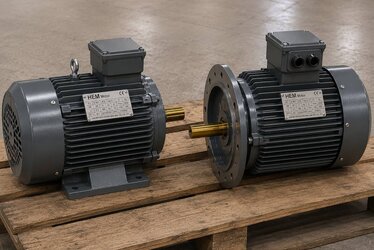
Belt-driven units typically use foot-mounted B3, while geared and bell-housing connections favour flange B5 or foot-and-flange B35; B14, B34 and vertical arrangements are also offered depending on the frame. We verify flange diameter and shaft end together in the order. Some compressor makers use non-standard shafts or flanges; in that case send us the dimensions of the old motor.
Cooling Inside a Sound-Insulated Canopy
Most screw compressors sit inside a sound-insulated canopy. While the canopy keeps noise in, it also keeps heat in: the motor, the oil cooler and the aftercooler work in the same enclosed volume. Airflow inside the canopy is usually designed around the pattern created by the cooler fan; the motor's own fan is part of this flow. When canopy filters clog or the compressor room is poorly ventilated, the motor is one of the first parts to heat up.
The frame is protection class IP55 and the winding has class F insulation. For those who want to monitor winding temperature in a hot canopy, a PTC thermistor or PT100 element fitted in the winding is an order option; many compressor controllers have an input for this sensor. The layer that oil vapour and dust leave on the fan cover should be cleaned during routine maintenance.
Fixed Speed or Variable Speed?
A fixed-speed screw compressor meets air demand by opening and closing the inlet valve; the motor runs either loaded or unloaded, but always at the same speed. In plants where consumption fluctuates widely during the day, unloaded time grows and the motor draws energy without producing work.
In a variable speed (VSD) compressor, the frequency inverter adjusts motor speed to air demand and line pressure is held within a narrow band. The screw element needs constant torque even at low speed; the motor therefore runs at low speed with a load close to full torque, which is exactly where cooling from the shaft-mounted fan drops. Our three-phase series can be used with a frequency inverter. If the compressor runs for hours at low frequency during the night shift, adding a separately powered cooling fan to the motor comes into question, and if the inverter sits in a panel far from the motor, a dv/dt or sine filter at the output; state these two points in your order. See inverter compatible electric motors. Take the minimum and maximum operating frequency of an inverter-driven compressor from the compressor maker's data.
Points to Watch When Replacing the Motor
In a screw compressor the motor is usually replaced after a winding burn-out or bearing failure. When choosing the new motor, first look at the power, rated speed and winding voltage on the old motor's nameplate. Star-delta starting, common on fixed-speed units, requires the motor to run in delta at 400 V: in our catalogue this condition is met by the 400/690 V rated models from 4 kW upwards.
If bearing failures keep recurring, check belt tension, pulley alignment and coupling alignment before replacing the motor. On a direct-drive unit, vibration that starts on the element side can also wear the motor bearing. If you are going to keep a spare motor in storage for a long time, the steps in our article keeping a spare motor on the shelf will help.
Example Motors by Screw Compressor Layout
| Compressor layout | Situation for the motor | Value to check when selecting | Example HEM model |
|---|---|---|---|
| Small workshop unit, belt-driven | Tensioning plate, side belt load | Pulley ratio, rated speed | 7.5 kW cast iron, 132S2-2 |
| Mid-size, direct coupled | Same speed as the element | Shaft and flange size, alignment | 18.5 kW cast iron, 160L-2 |
| Variable speed (VSD) unit | Constant torque at low speed | Frequency range, separate fan | 30 kW cast iron, 200L-4 |
| Large factory compressor, gear-driven | High power, long running hours | Starting method, supply capacity | 90 kW cast iron, 280M-4 (SF 1.15) |
These models are examples only; which motor fits is decided by looking at the compressor load, element speed, connection type and canopy conditions together. The nameplate of the motor being replaced is the soundest starting point.
Information for a Screw Compressor Motor Request
Send us the machine details (compressor make and type), motor power (kW), rated speed (rpm), supply voltage, mounting arrangement, transmission type (belt, gear or coupling), starting method (star-delta, soft starter, inverter) and quantity. Photographing and sending the old motor's nameplate solves most of the job: send the motor nameplate.
You can see models in stock and their current prices on the buy electric motors page, and reach us by WhatsApp or phone via the numbers on the contact page.
Frequently Asked Questions
Can I replace the motor in my screw compressor with one of a different speed?
On a belt-driven unit it is possible if the pulley ratio is recalculated; on a direct-drive unit the motor speed must equal the element speed, so a motor with the same speed is needed.
Can I retrofit an inverter to a fixed-speed compressor?
On the motor side our three-phase series are suitable for inverters; however, the compressor maker's approval should be obtained regarding the element's minimum permitted speed, lubrication and the compressor control software.
Why does the compressor motor overheat in summer?
Canopy temperature and compressor room ventilation are decisive. Clean the canopy filters, cooler fins and fan cover; if the room temperature is high, improve ventilation.
Is the motor different in an oil-free screw compressor?
The motor itself is a standard three-phase asynchronous motor; the difference is the gearbox inserted for the high rotor speed and the related flange size. State the connection dimensions on the gearbox side in your order.