This category covers four-pole (4-pole) three-phase asynchronous motors that turn their magnetic field at 1500 rpm when fed from 50 Hz mains. Most general-purpose industrial machines run in this speed group: a four-pole winding sits in a balanced middle ground between the high speed of a two-pole motor and the high torque of a six-pole motor. On this page you will find the technical logic of the group, real speed and torque values taken from the four-pole models HEM Motor currently sells, and the points to check when choosing a motor.
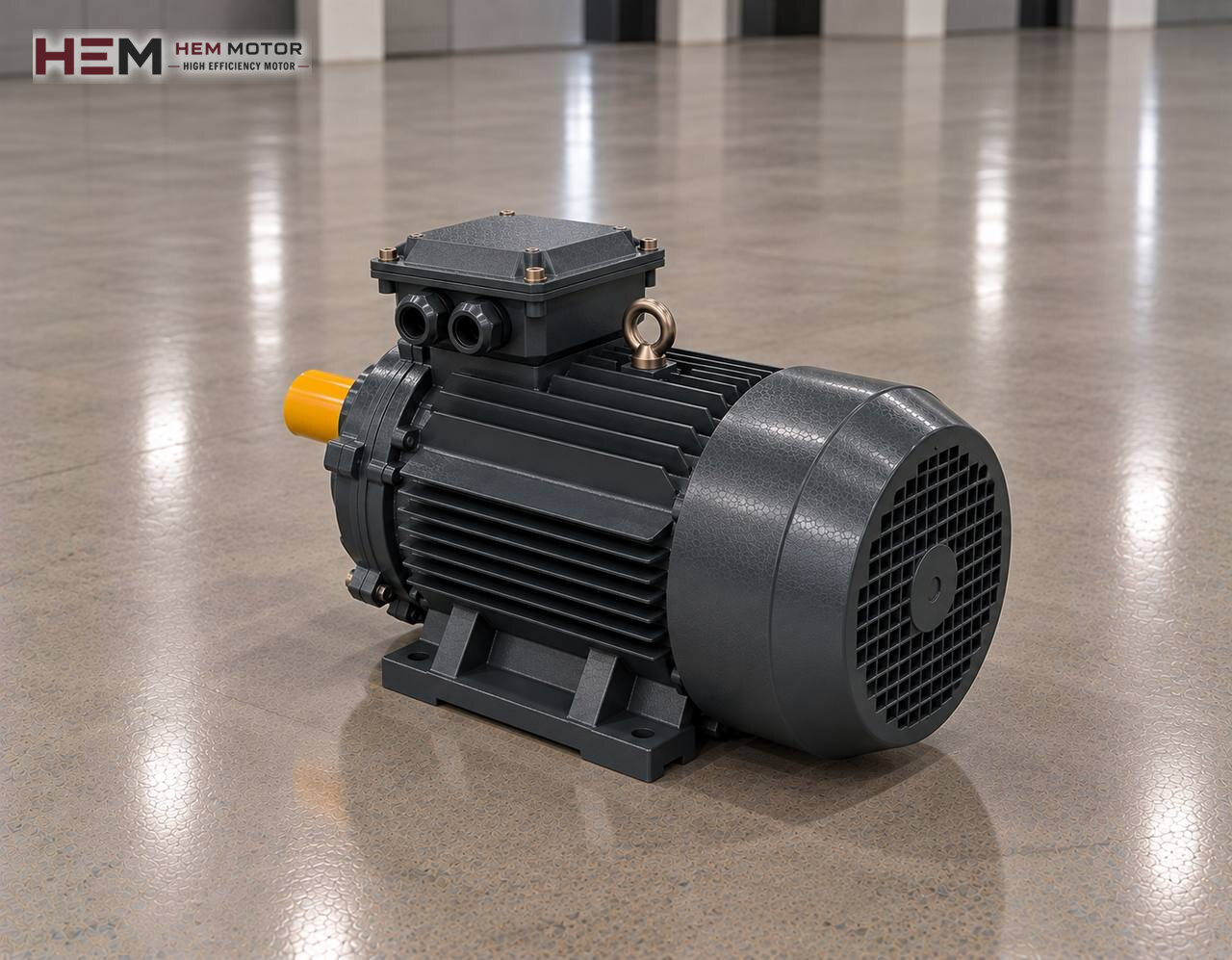
Foot-mounted (B3) frame, terminal box with two cable glands on top and a shaft end with a yellow guard – an illustrative photo of the foot-mounted construction used across this range.
Why are four poles the default for general-purpose machines?
What fixes the speed of an induction machine first of all is how many poles its stator winding has. In a four-pole winding the rotating magnetic field advances half a turn in every supply cycle. For a 50 Hz supply the calculation is: 120 × 50 / 4 = 1500. In other words, the field turns 1500 times per minute.
The comfortable speed band of many machine shafts lies close to this value. When designing an impeller, a pulley or a gearbox input, machine builders frequently take the four-pole motor as their reference; this is also why the nameplate most often met when looking for a replacement motor is a 4-pole one. The balance of this group can be summed up under three headings:
Speed: it suits most machine shafts either through a coupling or with a reasonable transmission ratio.
Torque: about twice that of a two-pole motor of the same power; it leaves enough margin for most loads that do not have a heavy start.
Frame: at most powers it is covered by one IEC frame size smaller than its six-pole equivalent, while its bearings run at a lower peripheral speed than in a two-pole motor.
Why does the rated speed on the nameplate differ from the synchronous speed?
The figure 1500 rpm describes the rotating field, not the rotor; engineers call it the synchronous speed. The rotor always trails that field a little, since the rotor bars carry induced current only while field and rotor turn at different speeds. That lag is known as slip, and without it no torque would be produced. That is why the nameplate of a four-pole motor does not show 1500 but the rated speed measured at rated load.
In HEM Motor's models of this group the rated speed lies in the range of 1340–1465 rpm for aluminium-frame motors and 1400–1490 rpm for cast-iron-frame motors. Slip is relatively large at small powers; the nameplate of the 71M1-4, the smallest member of the family, shows 1340 rpm. As power grows the gap narrows, and the 355M-4 model reaches a rated value of 1490 rpm. Published product data gives no rated speed for the 185 kW unit or the 355 kW unit, so it is not given here; you can ask for the value for these two models when requesting a quotation.
In practice this distinction means the following:
When calculating a pulley diameter, a gearbox output speed or a pump flow, use the rated speed of the selected model instead of 1500.
The speed measured on a motor running without load may come out above the nameplate value; this is not a sign of a fault.
A motor that drops clearly below its nameplate value may indicate overload or a supply problem; in that case current and voltage should be measured.
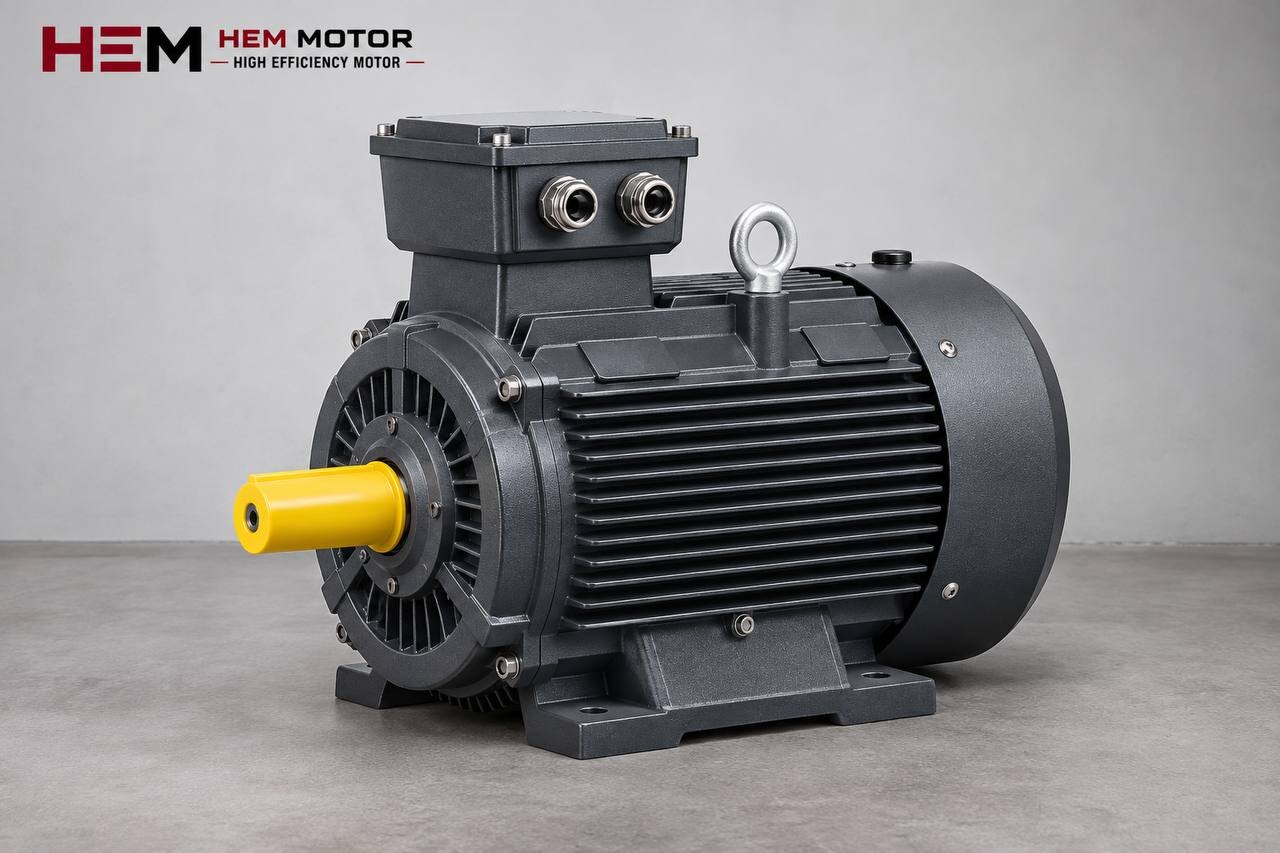
General view of a foot-mounted (B3) three-phase induction motor. Power, speed and frame data are given on each model's own page.
Frame material, power range and voltage options
There are two frame families in the four-pole group. The aluminium frame is light and makes handling and installation easier at small powers. The cast-iron frame starts at small powers and extends up to the largest models; it is generally preferred at sites where a more rigid frame is wanted.
Frame
IEC frame sizes
Output
Winding voltage
Speed at rated load
Aluminium
71M–160M
0.25–11 kW
230/400 V up to 3 kW, 400/690 V from 4 kW
1340–1465 rpm
Cast iron
80M–355L
0.55–355 kW
230/400 V up to 3 kW, 400/690 V from 4 kW
1400–1490 rpm
The winding voltage depends on power: models up to 3 kW are wound for 230/400 V (Δ/Y), models of 4 kW and above for 400/690 V (Δ/Y). Every model is rated for 50 Hz, with an IP55 enclosure and insulation class F. In the 0.55–11 kW range the same model code is offered with both an aluminium and a cast-iron frame; for these pairs, whose speed, torque and current values appear identical in the product data, the installation site and preferred frame settle the matter.
Catalogue prices refer to the basic B3 foot version. Choosing B5, B14 or B35 instead can alter the amount, and this is settled when the order is placed. Up-to-date pricing sits on every model card and on the individual product page, shown in USD (EUR) from the 24.09.2026 IE3 price list. For the complete frame families, see the aluminium-frame and cast-iron-frame motor categories.
Models in this group and current prices
Price for the B3 foot-mounted standard version; other mounting types are confirmed with the order.
Make your selections; a WhatsApp message is prepared and you can edit it before sending. If you are replacing an old motor, add photos of its nameplate and connections.
Example models verified against their product pages
The six entries in this table trace how the range grows from small to large outputs. The values are taken from the technical data on the related product pages; click a model code to open its full data page.
Two trends can be read from the table. First, slip decreases as power increases and the rated speed approaches the synchronous value. Second, torque grows almost in direct proportion to power: going from the 132M-4 to the 160L-4, power doubles and torque also roughly doubles.
Same output, different pole count: what happens to speed and torque
Shaft power is torque multiplied by speed, so holding output fixed while adding poles lowers the speed and raises the torque. In the comparison below, HEM Motor's cast-iron models are placed side by side for three power steps.
Power (kW)
Poles
Model
Rated speed (rpm)
Rated torque (Nm)
4
2
112M-2
2905
13.1
4
4
112M-4
1450
26.3
4
6
132M1-6
968
39.5
15
2
160M2-2
2945
48.6
15
4
160L-4
1465
97.8
15
6
180L-6
978
146.5
45
2
225M-2
2965
144.9
45
4
225M-4
1485
289.4
45
6
280S-6
985
436.3
The same picture appears at all three steps: the four-pole motor delivers roughly twice the torque of the two-pole motor and reaches about two thirds of the six-pole motor's torque. A difference shows on the frame side too: at 4 kW the six-pole model moves up to a 132M frame and at 15 kW to a 180L frame, while the four-pole model stays one frame size lower.
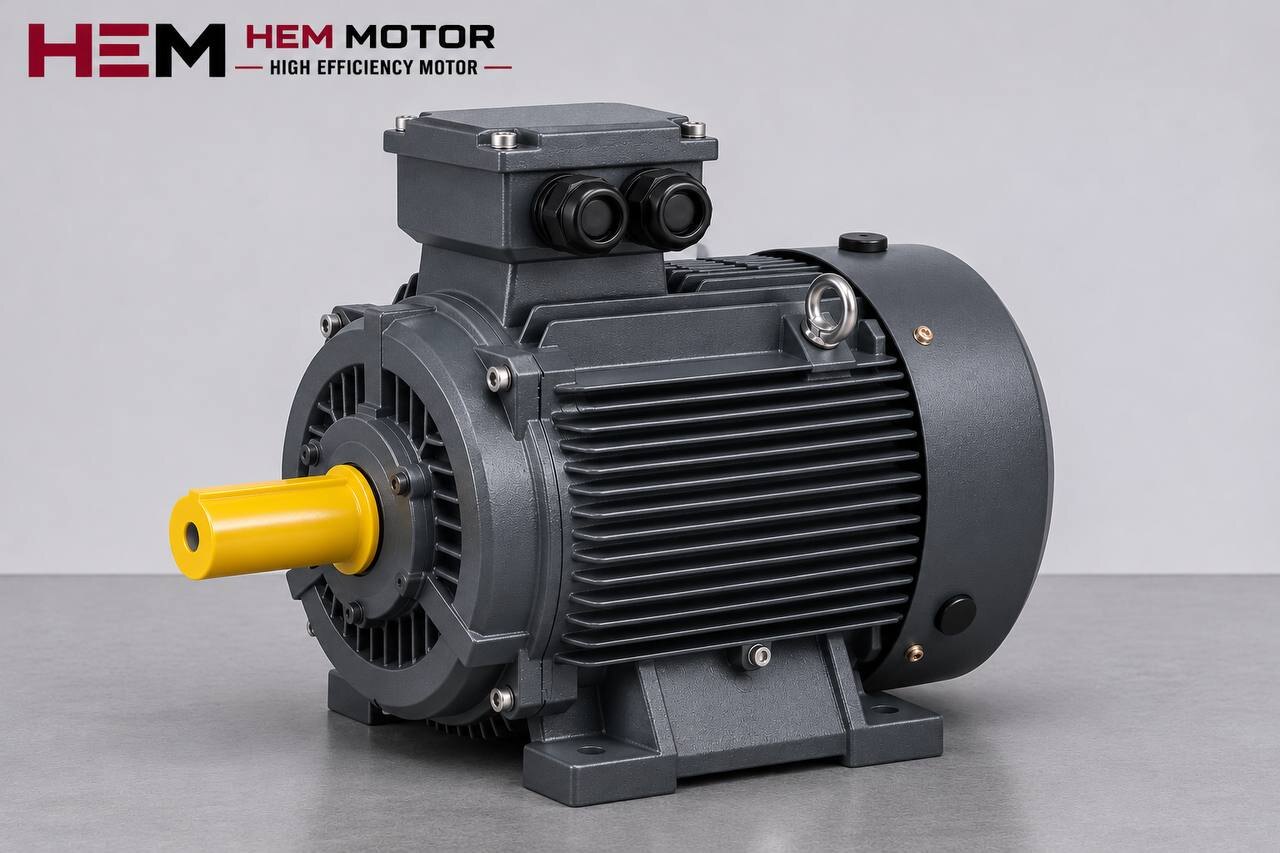
General view of a foot-mounted (B3) three-phase induction motor. Power, speed and frame data are given on each model's own page.
Mechanical and electrical checks when replacing an existing motor
When replacing an old four-pole motor with a new one, a matching IEC frame number on the nameplate is a starting clue, nothing more. Whether the new motor suits the machine becomes clear through the following comparisons:
Shaft diameter and shaft length; whether the coupling or pulley hub matches these dimensions.
Distances between the foot holes and the height of the shaft axis above the base.
For flange designs, the spigot (centring) diameter, the outside diameter of the flange and the bolt-hole layout.
On the electrical side, the winding voltage and connection (Δ/Y; 230/400 V or 400/690 V) against the site's supply voltage.
Pay particular attention to the step between 3 kW and 4 kW. Small models wound for 230/400 V are connected in star (Y) to a 400 V supply, whereas models wound for 400/690 V run in delta (Δ) on the same supply. For this reason the winding voltage of a motor to be used in a panel with a star-delta starter must be checked in advance.
To speed things up, photograph the plate of the motor being removed together with the wiring inside its terminal box and share both pictures on WhatsApp; dimensions and winding connection are reviewed side by side before a model is confirmed. The dimension logic of flange designs is explained on the B5 and B14 flange motors page, and that of foot-and-flange designs on the B34 and B35 motors page. How to read a frame number is explained in the question motor frame number.
Applications where a four-pole motor is often considered
The list below names machines where a four-pole drive is commonly on the shortlist. Seeing your machine here is not proof of fit: load behaviour, the shaft speed actually needed, how power is transmitted (coupling, belt drive or gearbox) and the site conditions decide the final selection.
Centrifugal pumps: if the impeller is designed for this speed band, the motor can be connected through a coupling; for pumps requiring a higher head, two poles may also come into question.
Fans and extractors: since fan speed can be set with belt and pulley, four poles are a common starting point; for large-diameter fans six poles are also evaluated.
Belt and chain conveyors: the motor mostly works together with a gearbox, and the gearbox ratio is calculated from the rated speed.
Screw and piston compressors: the machine maker often gives the pulley ratio for a specific motor speed, so the nameplate value matters.
Agitators and mixers: with viscous products the load at start-up is decisive; use with a gearbox is common.
In geared applications, changing the number of poles directly changes the output speed. A worked example of swapping in a slower motor ahead of an unchanged gearbox is given in our FAQ entry on gearbox output speed.
What to prepare for a quotation and order
To identify the right model the first time, it is enough to send the following information together:
Power (kW), plus a note that a four-pole (1500 rpm) unit is wanted.
Frame preference: aluminium or cast iron.
Mounting arrangement (B3, B5, B14 or B35).
Mains voltage plus the winding connection you need (230/400 V or 400/690 V).
Quantity.
Where possible, pictures of the existing nameplate and terminal wiring.
You can write this information to our WhatsApp line or pass it on by phone. All power and speed combinations are listed on the three-phase model map page, and all models on sale in the buy electric motors section.
Frequently Asked Questions
Is a 4-pole motor the same as a 1500 rpm motor?
Yes. With 50 Hz mains a four-pole winding has a synchronous speed of 1500 rpm, so traders use the pole count and the speed group interchangeably. What the plate actually shows is the rated value, which differs from model to model.
Is it normal for the nameplate to show 1460 or 1485 instead of 1500?
Yes, it is. An asynchronous motor runs slightly below synchronous speed so that it can produce torque. In the models of this group the gap is more noticeable at small powers and smaller at large powers; calculations should always be based on the rated value on the nameplate.
Can I fit a 2-pole motor instead of a 4-pole motor of the same power?
The shaft speed roughly doubles and the torque falls to about half. On a machine connected through a coupling this changes the machine's operating speed; in a system with pulleys or a gearbox the ratio has to be recalculated. Before the change, the speed allowed by the machine maker must be checked.
Should I choose an aluminium or a cast-iron frame?
Both options exist in the 0.55–11 kW range; since the electrical values are the same, the installation site and your frame preference decide. Above 11 kW the four-pole range continues in cast iron alone.
Where do I see the price, and does the mounting type affect it?
Open the model card or its product page – the current figure is there. Listed amounts are for the foot-mounted B3 build; with a flange or combined mounting the figure may differ, and we confirm it when you order.
1500 rpm Electric Motors — Fill in the details and tap “Send Order via WhatsApp”; your order opens as a ready-made WhatsApp message and you just press send.
We use necessary and optional cookies to improve your experience, enhance content and analyse traffic. Under the GDPR, optional (analytics/marketing) cookies are only used with your explicit consent. Please choose your preference below.
Cookie Policy
 English
 Français
 Türkçe
 Español
 Русский
 العربية