 English
 Français
 Türkçe
 Español
 Русский
 العربية


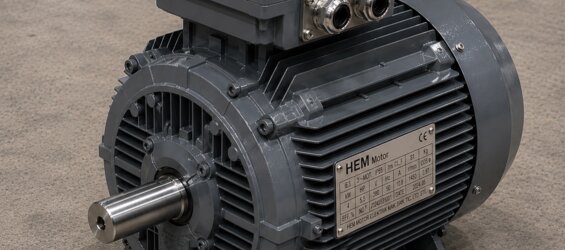
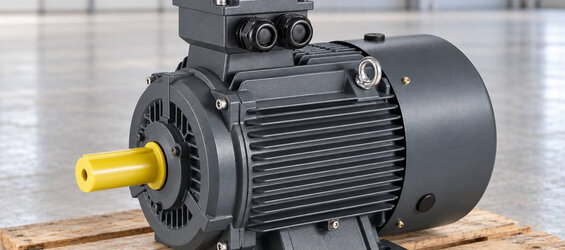
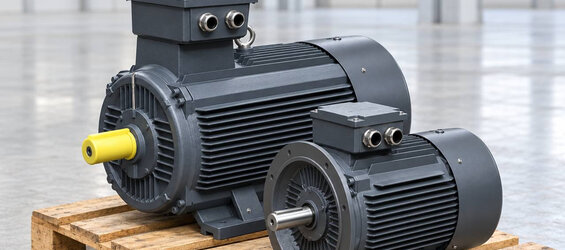
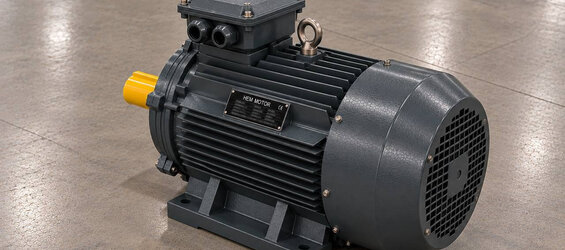
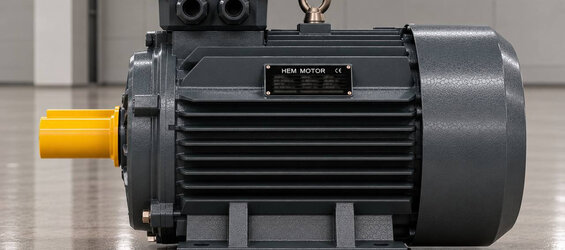
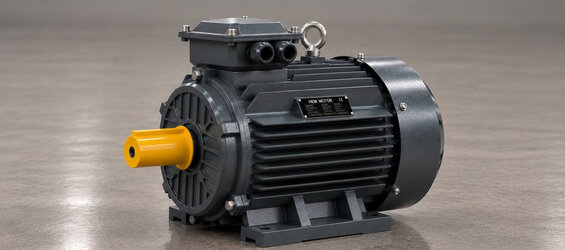
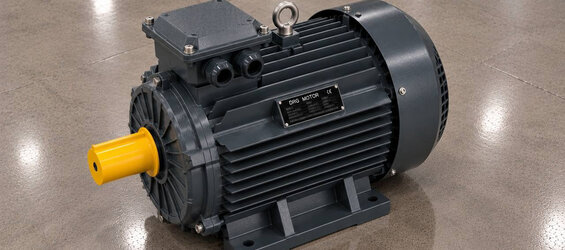
How to Read the Motor Groups on This Page
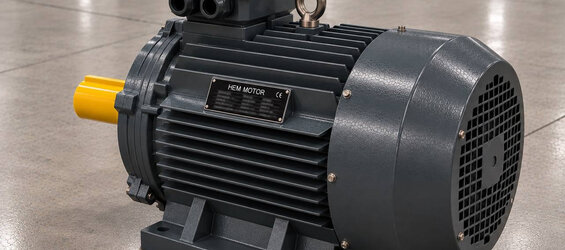
Apart from the single-phase series, every page in the list above covers three-phase motors and looks at the same motor range through a different window. HEM Motor, a company in Buca, İzmir that manufactures, supplies and sells electric motors, offers three-phase asynchronous motors from 0.25 to 355 kW. Within this range 117 models are on sale, covering 29 power steps and three synchronous speeds: 3000, 1500 and 1000 rpm. The difference between the families usually lies not in the motor itself but in the angle of the question: is it about frame material, efficiency level, the supply network or the type of machine?
The common ground is this: across all series the degree of protection is IP55, insulation is class F and the motors are wound for a 50 Hz supply. Models of 75 kW and above have a service factor of 1.15. Our catalogue offers IE3 Premium, IE4 Super Premium and IE5 Ultra Premium (IEC 60034-30-1) options in every family.
The Real Differences Between the Groups
The question that decides the frame: weight or toughness?
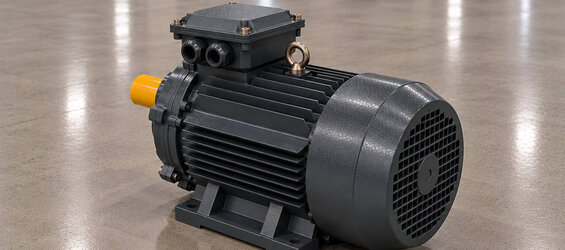
If you need a light, compact frame at low power, the Aluminium Frame Electric Motor Series (0.25–11 kW) page is the right starting point; it covers IEC frames from 63M to 160L. For motors that will work in vibrating, shock-loaded or dusty surroundings, and for outputs above 11 kW, the Cast Iron Frame Electric Motor Series (0.55–355 kW) comes into play. The two series overlap between 0.55 and 11 kW; in that zone the choice depends on the mounting location and how harsh the environment is.
Efficiency level: IE4 and IE5
For pump, fan and compressor drives that run long hours every day, the efficiency class becomes a key decision. The IE4 Super Premium Efficiency Electric Motors and IE5 Ultra Premium Efficiency Electric Motors pages cover these two classes separately. The model pages on sale do not state an IE class; simply name the class you want when you ask for a quotation.
The IE3 baseline, flange mounting and speed control
The IE3 Premium Efficiency Electric Motors page explains which efficiency list the models on sale come from and when IE3 is enough. If the motor bolts to the machine by its flange with no feet, see Flange-Mounted Electric Motors – B5 and B14; if it must be fixed to both the base and the machine, see Foot and Flange Mounted Electric Motors – B34 and B35. If the motor will run at varying speeds on a frequency drive, low-speed cooling and cable topics are gathered on the Inverter-Compatible Electric Motors page.
Supply network, rotor design and model breakdown
If your plant has a 400 V three-phase line, see 3-Phase Electric Motors for 400 V Networks for connection, starting and voltage-rating topics. If you are curious how an asynchronous motor works, including slip and torque, the 3-Phase Asynchronous Electric Motors page deals with it. For anyone who wants to see power, frame and speed model by model, we prepared Three-Phase Electric Motors: 0.25–355 kW Model Map. If you think in terms of machine type and industrial environment, General Purpose Industrial Electric Motors is the better entry point.
The Single-Phase Series Is a Separate Door
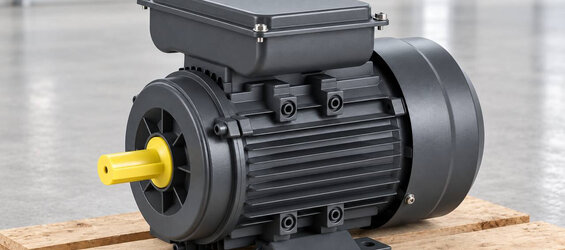
For workshops, small businesses and farm applications with no three-phase line, a separate single-phase series covers 0.18 to 5.5 kW. It appears as a separate card in the list and differs from the three-phase families; details are on the Single-Phase 220 Volt Electric Motors page. If your line is three-phase, there is usually no reason to turn to a single-phase motor.
Where Should the Selection Start?
The shortest way to the right motor is to read the nameplate of the existing one. If there is no nameplate, or you are building a new machine, follow the order below.
1. Power
Take the shaft power the machine needs from the machine builder's data or from the old motor's nameplate. The exact power is set by the machine's load; picking a motor that is too small on a guess is the most common mistake.
2. Speed
At the same power a 2-pole motor turns fast but delivers less torque; a 6-pole motor turns slowly, gives higher torque and usually sits in a larger frame. Consider the machine's shaft speed together with any belt or gearbox ratio in between.
3. Voltage
On HEM models on sale, motors from 0.25 to 3 kW carry a 230/400 V rating and motors from 4 to 355 kW carry 400/690 V. This difference affects starting in the panel: on a 400 V line a 400/690 V motor is connected in delta and allows star-delta starting; if it will run on a drive, say so at the outset.
4. Mounting
Motors are offered as B3, B5, B14, B34, B35 and vertical V1/V3/V5/V6/V15 depending on the frame; flange and shaft dimensions are confirmed with the order. For the options, see the question on mounting arrangements.
5. Operating conditions
If the environment is dusty, damp or hot, state it from the start. A standard IP55 motor is not designed for submerged operation or pressure-water washing; such a condition calls for protection on the machine side or a special motor. Our three-phase series are suitable for speed control with a frequency inverter; long periods at low speed with full torque may need a separate fan, and with long cables a dv/dt or sine filter is considered. PTC/PT100 winding sensors and anti-condensation heaters are order options.
Gather the Data, Then Take the Next Step
When asking for a quotation, send the machine type, power (kW), speed (rpm), voltage, mounting type and quantity together. If you have a photo of the old motor's nameplate, using the send the nameplate and find an equivalent route speeds things up. If you have already chosen a model, the current price is on each product's own page.
Go to the shop: Buy Electric Motors · Get a quote: Contact and quotation