English
 Français
 Türkçe
 Español
 Русский
 العربية

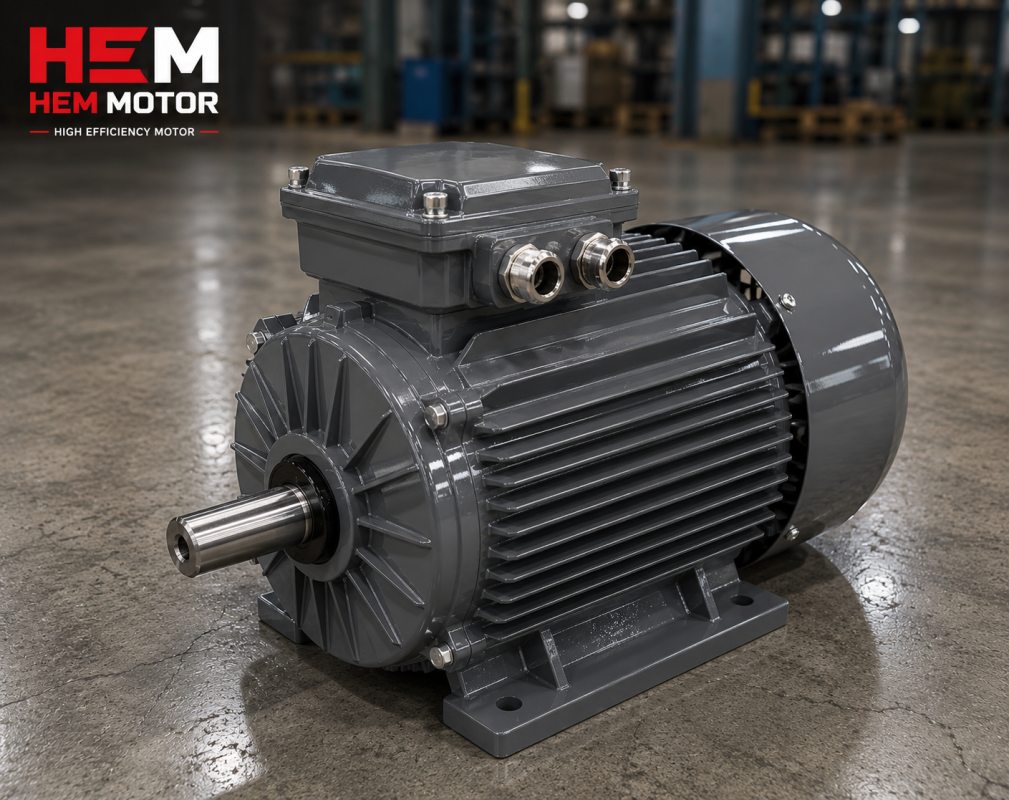
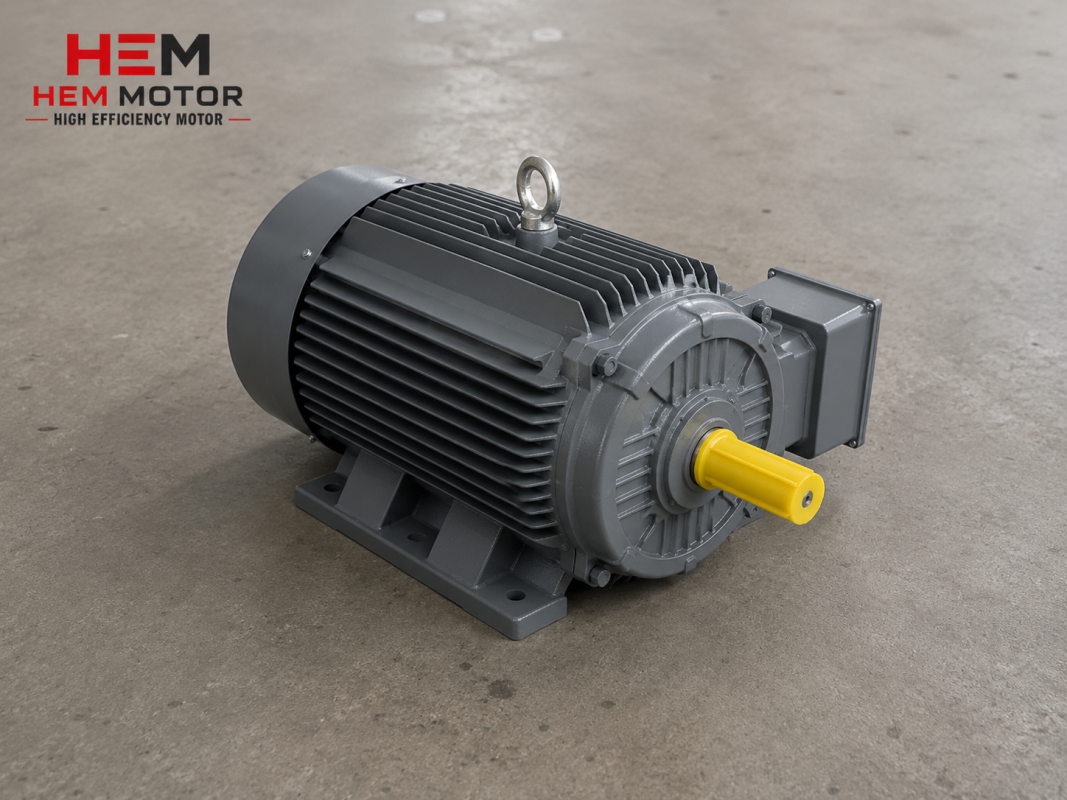
The HEM Motor cast iron frame range consists of 81 three-phase models, stretching from a small 0.55 kW pump motor to a 355 kW mill drive. This page reads the range like a map: IEC frames that grow with power, the effect of pole count on torque at the same kW, the extra values that apply above 75 kW, and the dual choice with aluminium at low power.
To see every model with its price, go straight to the cast iron frame electric motors shop; each model is listed on its own product page.
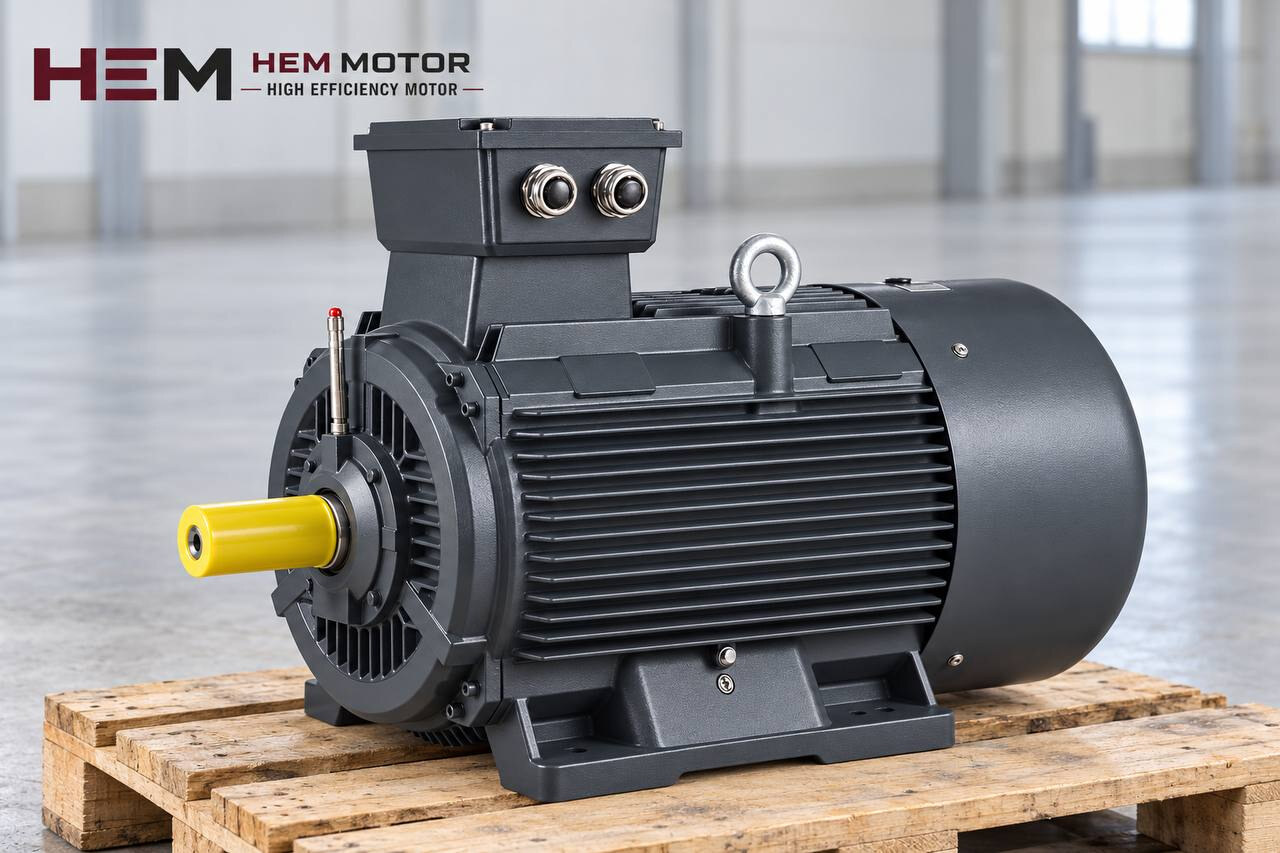
Scope of the 81 Models: 27 Power Steps, Three Synchronous Speeds
The cast iron range starts at 0.55 kW and ends at 355 kW, with 27 power steps in between. Each step is represented by three models with 2, 4 and 6 poles, i.e. 3000, 1500 and 1000 rpm, so the range comprises 81 codes in total. Protection is IP55, insulation is class F and supply frequency is 50 Hz; these three values are common to every model in the range.
The winding voltage also splits by power. The 18 models from 0.55 to 3 kW are wound for 230/400 V (Δ/Y), the 63 models from 4 kW upwards for 400/690 V (Δ/Y). The catalogue states that the frame and end shields are GG20 cast iron, damping impact and vibration and dissipating heat through the cooling fins.
Frame Steps from IEC 71 to 400L
The range uses 15 different IEC frame numbers. Most cast iron models sit in frames 80 to 355, with one exception at each end: the smallest frame is the 0.55 kW 3000 rpm 71M2-2, and the largest is the 400L-6, the 6-pole version of 355 kW.
- IEC 80–112: 0.55–4 kW, small pumps, fans and gearbox inputs.
- IEC 132–160: 3–18.5 kW; frame 160 alone carries 7 models.
- IEC 180–250: 15–55 kW, medium-power compressor and fan drives.
- IEC 280: 45–90 kW, 6 models.
- IEC 315: 75–200 kW, the busiest frame in the range with 14 models.
- IEC 355: 160–355 kW, 11 models.
The frame number gives the shaft centre height in millimetres; the letters S, M and L distinguish short, medium and long frames of the same height. For foot holes, flange and shaft extension, refer to our IEC frame dimensions article and our 2D drawing archive.
2, 4 and 6 Poles at the Same kW: Torque and Frame Comparison
When you keep the power fixed and lower the speed, the torque delivered to the shaft rises and the motor often moves up one frame. Three power steps from the cast iron range show this clearly:
| Power | 3000 rpm (2-pole) | 1500 rpm (4-pole) | 1000 rpm (6-pole) |
|---|---|---|---|
| 22 kW | 180M-2 · 71.1 Nm | 180L-4 · 142.9 Nm | 200L2-6 · 214.4 Nm |
| 55 kW | 250M-2 · 176.9 Nm | 250M-4 · 353.7 Nm | 280M-6 · 533.2 Nm |
| 110 kW | 315S-2 · 352.8 Nm | 315S-4 · 706 Nm | 315L1-6 · 1,063 Nm |
The values are rated torque; selection is made together with the machine's load, the required speed and the mounting conditions. Note that at 55 kW the 2- and 4-pole models share the same 250M frame, and at 110 kW the same 315S frame; in both steps the 6-pole version moves up one frame. The rated current at 400 V changes very little with speed: 185 A, 187 A and 196 A at 110 kW. For other steps see our torque table.
75 kW and Above: SF 1.15, Lifting Eyes and Site Placement
In the upper part of the range, across the 10 steps from 75 kW to 355 kW, all 30 models at the three speeds have a service factor of 1.15. Think of it as a reserve the motor keeps for sudden overloads; it should not be used to downsize the motor by one step when calculating the continuous load. These models sit in frames from IEC 280S to 400L.
With large frames, handling must be planned as carefully as mounting. The parts list in the catalogue shows the lifting eye as the motor's lifting point. Lift only by the eyebolts on the frame, never hang the motor from the shaft. Plan the lifting equipment in advance according to site conditions.
As an example from this power zone, the 200 kW 1500 rpm 315L2-4 delivers 1,282 Nm rated torque at 1,490 rpm with a rated current of 334 A.
0.55–11 kW: Dual Choice with an Aluminium Frame
The first 10 power steps of the cast iron range (0.55–11 kW) are also offered with an aluminium frame. Each of the 30 cast iron codes in this zone appears under the same name in the aluminium range; kW, speed, current and torque match one to one, only the frame material changes. We do not repeat the aluminium details here: the frame map and application examples are on our aluminium frame electric motors page, and the choice between the two materials is covered in our FAQ answer on frame material selection. From 15 kW upwards there is a single option: the cast iron frame.
Frame Selection for Crushers, Mills and Heavy-Starting Machines
The catalogue links crushing and screening applications with torque reserve under shock load and the cast iron frame. In crushers, mills and machines with heavy flywheels, the motor has to accelerate a large inertia from standstill; starting takes longer and the frame is exposed to constant vibration. For such machines, the first values to check are the power, speed and frame code on the existing motor's nameplate.
If a low-speed drive is needed, 6-pole models deliver higher torque at the same power; as the table above shows, this often means one frame larger. For sector-specific details see our pages on stone crushing plant motors, flour mill motors and mining sector motors.
Options Confirmed at Order
- Mounting arrangement: foot, flange and combined designs as well as vertical positions (B3, B5, B14, B34, B35; V1, V3, V5, V6, V15) are supplied depending on frame size. We confirm flange and shaft dimensions together with you at order; details in the mounting arrangements answer.
- Winding protection and humidity: PTC/PT100 winding sensors and an anti-condensation heater are order options.
- Variable speed: the cast iron models can also be driven by a frequency inverter. If the motor will run at low speed with full torque for long periods, a separately powered fan may be needed; if the cable between drive and motor is long, a dv/dt or sine filter comes into play. Share this information with your order (use with an inverter).
- Efficiency class and paint: the 2026 catalogue includes IE3, IE4 and IE5 options; paint is RAL 7012 or RAL 7024.
Choosing and Ordering a Cast Iron Model
All 81 cast iron models are listed, already filtered, in the cast iron frame models category, and together with the aluminium models in our electric motor shop. Each code shows its price on its own page. We deliver the cast iron motors on sale from stock and ship them from our warehouse in Türkiye.
To prepare a quotation, simply tell us the machine the motor will drive, the required power and speed, the supply voltage at your plant, how the motor will be mounted and the quantity needed. If you are replacing an old motor, send a photo of its nameplate and we will identify the matching cast iron model together. Other channels are on our contact page.
Frequently Asked Questions
Which are the smallest and largest models in the cast iron range?
The range opens at 0.55 kW with three speeds; the 2-pole one is in frame 71M2-2. At the top end is 355 kW, whose 6-pole version, 400L-6, is the only frame-400 code in the range.
Is an aluminium frame available from 15 kW upwards?
The 51 models from 15 to 355 kW are offered with a cast iron frame. The dual choice with an aluminium frame stays within the 0.55–11 kW zone.
Can I choose a smaller power with an SF 1.15 motor?
This is not recommended. On models of 75 kW and above, SF 1.15 is a safety margin; motor power should be selected according to the machine's continuous load.
What changes if I switch from 4 to 6 poles at 110 kW?
Rated speed drops from 1,488 to 988 rpm, torque rises from 706 Nm to 1,063 Nm and the frame grows from 315S to 315L. Because the speed delivered to the machine changes, the pulley or gearbox ratio must also be reviewed.
How should I lift a large-frame motor?
Lift only by the lifting eyes (eyebolts) on the frame; never hang it from the shaft. A motor that has been in storage for a long time should have its insulation measured before commissioning.