English
 Français
 Türkçe
 Español
 Русский
 العربية

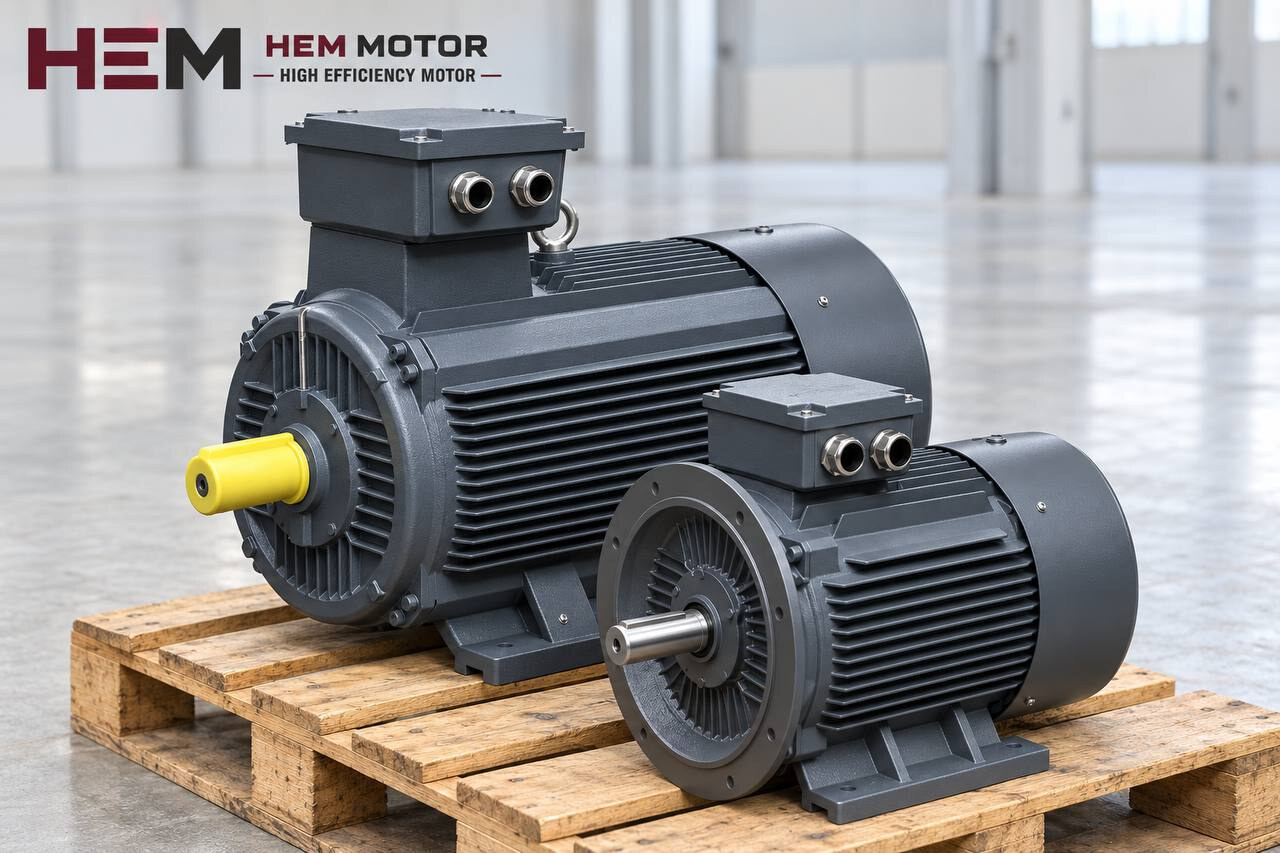
HEM Motor's three-phase range consists of 117 sale models covering 0.25 kW to 355 kW. Read this page as a map of how those 117 models are arranged along three axes — power, IEC frame and speed: if you have a kW value, a speed or the nameplate of an old motor, you can trace from here which model code you will end up with.
Supply connection, winding voltage and starting are covered separately on the 3-Phase Electric Motors page, and list prices on the Three-Phase Electric Motor Prices page.

117 Models, 29 Power Steps and 3 Synchronous Speeds
29 power steps: 0.25 – 0.37 – 0.55 – 0.75 – 1.1 – 1.5 – 2.2 – 3 – 4 – 5.5 – 7.5 – 11 – 15 – 18.5 – 22 – 30 – 37 – 45 – 55 – 75 – 90 – 110 – 132 – 160 – 185 – 200 – 250 – 315 – 355 kW. Every step has one model each at 3,000, 1,500 and 1,000 rpm synchronous speed, which gives 87 different power–speed combinations.
The figure of 117 comes from some combinations being offered with two frame materials:
- Aluminium frame only: the 6 models in the 0.25–0.37 kW range.
- Aluminium and cast iron side by side: the 10 steps from 0.55 to 11 kW — 30 combinations, 60 models. The model code is the same in both frames.
- Cast iron frame only: the 17 steps from 15 to 355 kW — 51 models.
In total, 36 aluminium and 81 cast iron models are listed in our shop. All are IP55, insulation class F and 50 Hz. To decide between the two frames, see the answer to the frame material question and the cast iron frame motors page.
IEC Frame Steps by Power Range
The 117 models use 16 different IEC frame numbers. The list below gives the power range of each frame number in the range. The ranges overlap because of speed: the same frame takes a higher power with a 2-pole winding and a lower power with a 6-pole winding.
- IEC 63: 0.25 kW at 3,000 rpm only (63M2-2)
- IEC 71: 0.25–0.55 kW
- IEC 80: 0.37–1.1 kW
- IEC 90: 0.75–2.2 kW
- IEC 100: 1.5–3 kW
- IEC 112: 2.2–4 kW
- IEC 132: 3–7.5 kW
- IEC 160: 7.5–18.5 kW
- IEC 180: 15–22 kW
- IEC 200: 18.5–37 kW
- IEC 225: 30–45 kW
- IEC 250: 37–55 kW
- IEC 280: 45–90 kW
- IEC 315: 75–200 kW
- IEC 355: 160–355 kW
- IEC 400: 355 kW at 1,000 rpm only (400L-6)
For shaft and flange dimensions, use the frame dimension table and the 2D technical drawings.
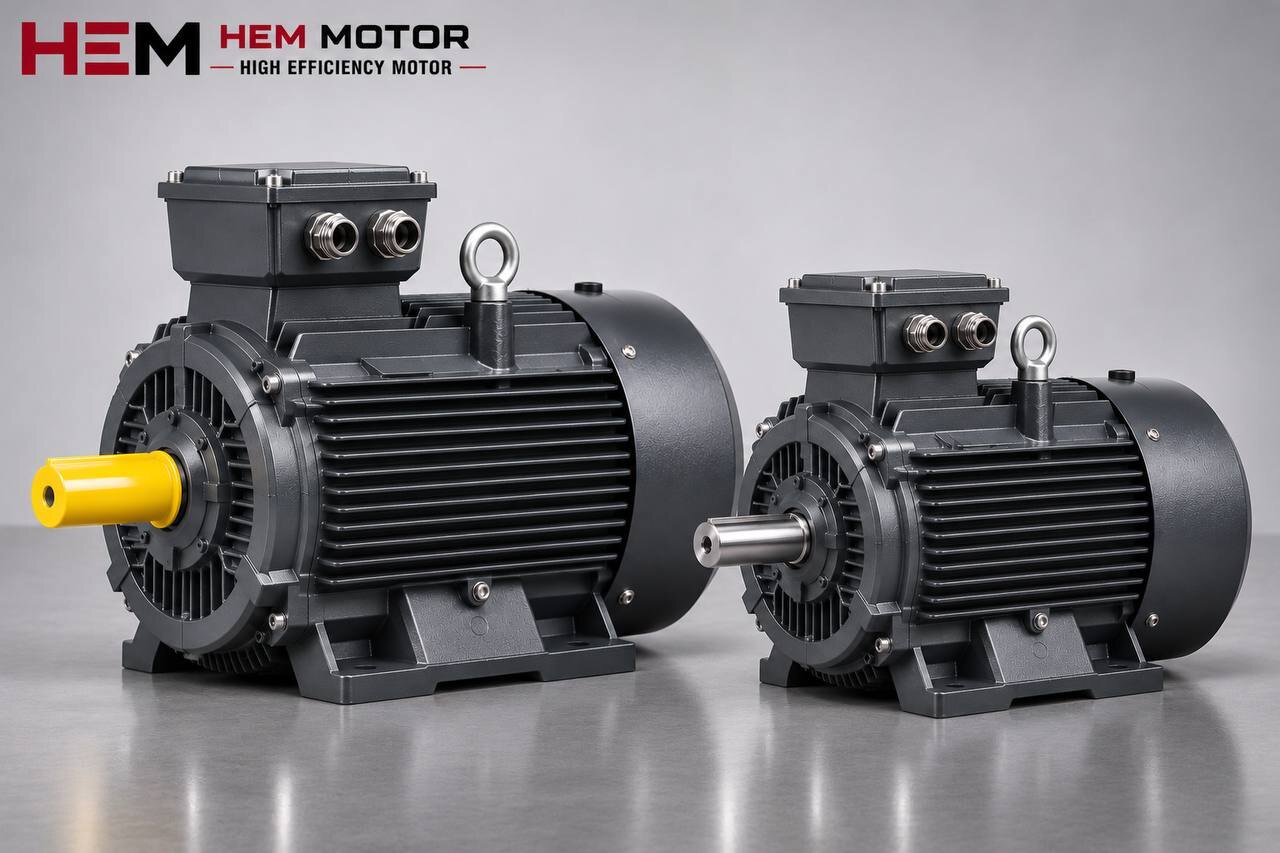
Torque Difference Between 2, 4 and 6 Poles at the Same Power
At constant power, the rated torque delivered to the shaft rises as speed falls. HEM's data shows this relationship very clearly:
22 kW
- 180M-2: 2,955 rpm, 71.1 Nm, 38.5 A
- 180L-4: 1,470 rpm, 142.9 Nm, 39.7 A
- 200L2-6: 980 rpm, 214.4 Nm, 42.5 A
55 kW
- 250M-2: 2,970 rpm, 176.9 Nm, 93.5 A
- 250M-4: 1,485 rpm, 353.7 Nm, 97.6 A
- 280M-6: 985 rpm, 533.2 Nm, 98.1 A
At both powers torque rises in a 1 : 2 : 3 ratio while the 400 V rated current rises by only about 5–10 percent. In other words, 6 poles at the same power usually means one frame size larger. Values for other powers are in the torque table.
Service Factor 1.15 from 75 kW Upwards
In the 10 power steps from 75 to 355 kW, at all three speeds, a total of 30 models are supplied with SF 1.15. The service factor shows that the motor carries a load margin above its nameplate power under rated conditions; for a 110 kW model this margin corresponds to 126.5 kW on paper.
This margin is a safety allowance against sudden load swings; it is not recommended as a reason to pick one power step lower once the continuous load has been calculated. For shock loads see stone crushing plant motors.
Typical Machine Pairings in Small, Medium and Large Power
The pairings are a guide; the final decision depends on the machine's load and environment.
0.25–4 kW: light drives
Aluminium-frame models dominate this band. Geared belts often use 1,500 rpm; the 4 kW 112M-4 model, for example, delivers 26.3 Nm rated torque. See conveyor belt motors.
5.5–55 kW: pumps, fans and compressors
3,000 rpm is common for centrifugal pumps; at 5.5 kW the 132S1-2 model gives 2,930 rpm and 17.9 Nm. On the fan and compressor side 1,500 rpm models lead; 180L-4 at 22 kW and 250M-4 at 55 kW are typical members of this group. Details are on the pump electric motors and compressor motors pages.
75–355 kW: heavy industry
Crushers, mills and large fans use 1,000 rpm models for high torque. The 110 kW 315L1-6 model produces 1,063 Nm rated torque at 988 rpm; the 315S-2 model of the same power gives 352.8 Nm.
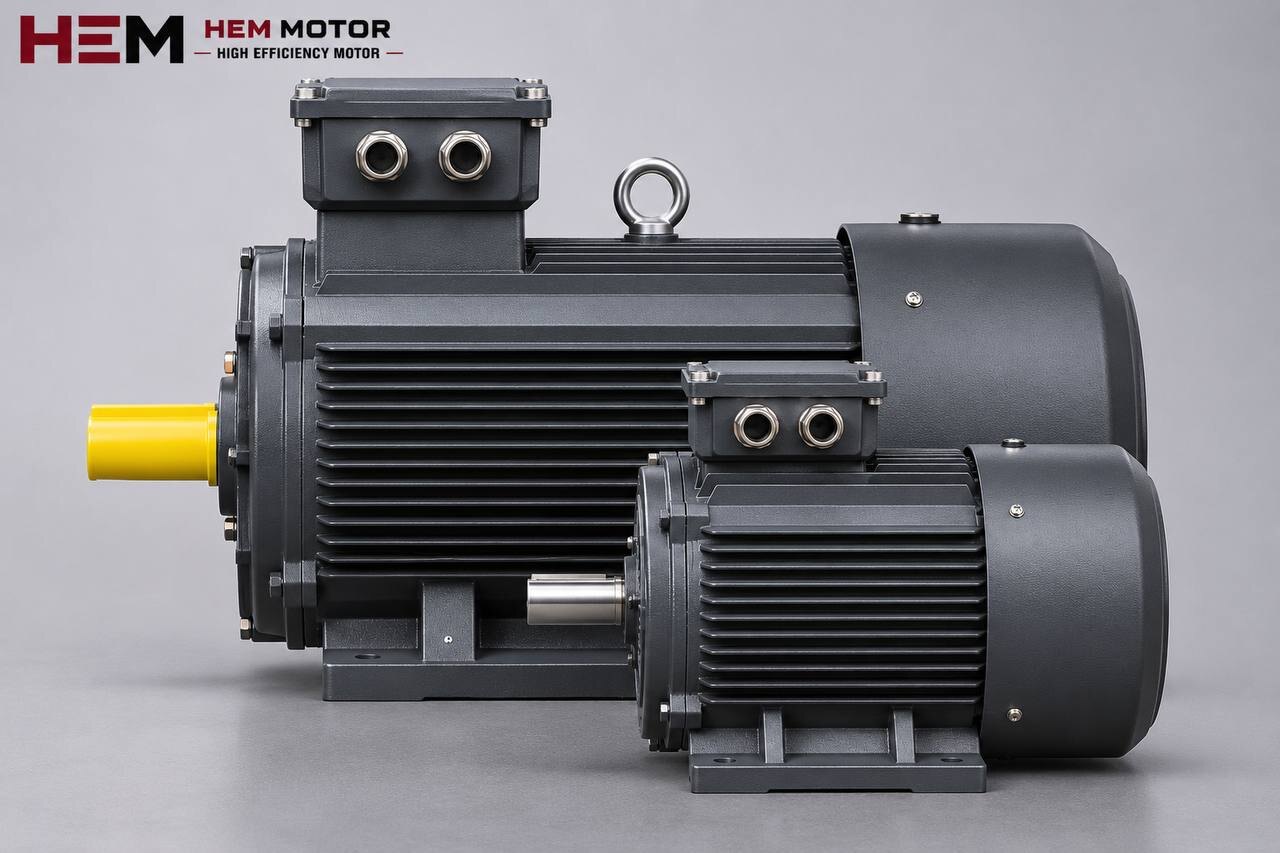
Four Steps from Nameplate Data to the Right HEM Model
- Read the power. If the nameplate states kW, use it directly; if it only gives HP, match it with the HP equivalent on the product cards.
- Round the speed to the synchronous value. Rated speeds in the range between 2,730 and 2,982 rpm belong to the 3,000 rpm class, 1,340–1,490 rpm to the 1,500 rpm class and 855–990 rpm to the 1,000 rpm class.
- Compare the IEC frame. Compare the frame code on the nameplate, including its letter (132S and 132M are different, for example), with the code of the HEM model.
- Confirm with current. Compare the 400 V current on the nameplate with the rated current on the model card. The 7.5 kW 1,500 rpm model, for instance, has a rated current of 14.3 A; a large deviation suggests the nameplate may belong to a different voltage or speed.
Order Options Common to All Powers
As connection layouts, foot-mounted (B3), flanged (B5, B14), foot+flange (B34, B35) and vertical (V1/V3/V5/V6/V15) versions are offered as far as the frame size allows; flange and shaft sizes are settled in the quotation (mounting arrangements). PTC or PT100 can be added to monitor winding temperature, and an anti-condensation heater for damp plants with frequent stops.
For motors that will run on a drive, state the application conditions with the order: our three-phase series are suitable for frequency inverters; if continuous full torque is needed at low speed a separate fan, and with a long motor cable a dv/dt or sine filter, is considered (inverter operation). The 2026 product catalogue includes IE3/IE4/IE5 options.
Quotes and Purchasing for Three-Phase Motors
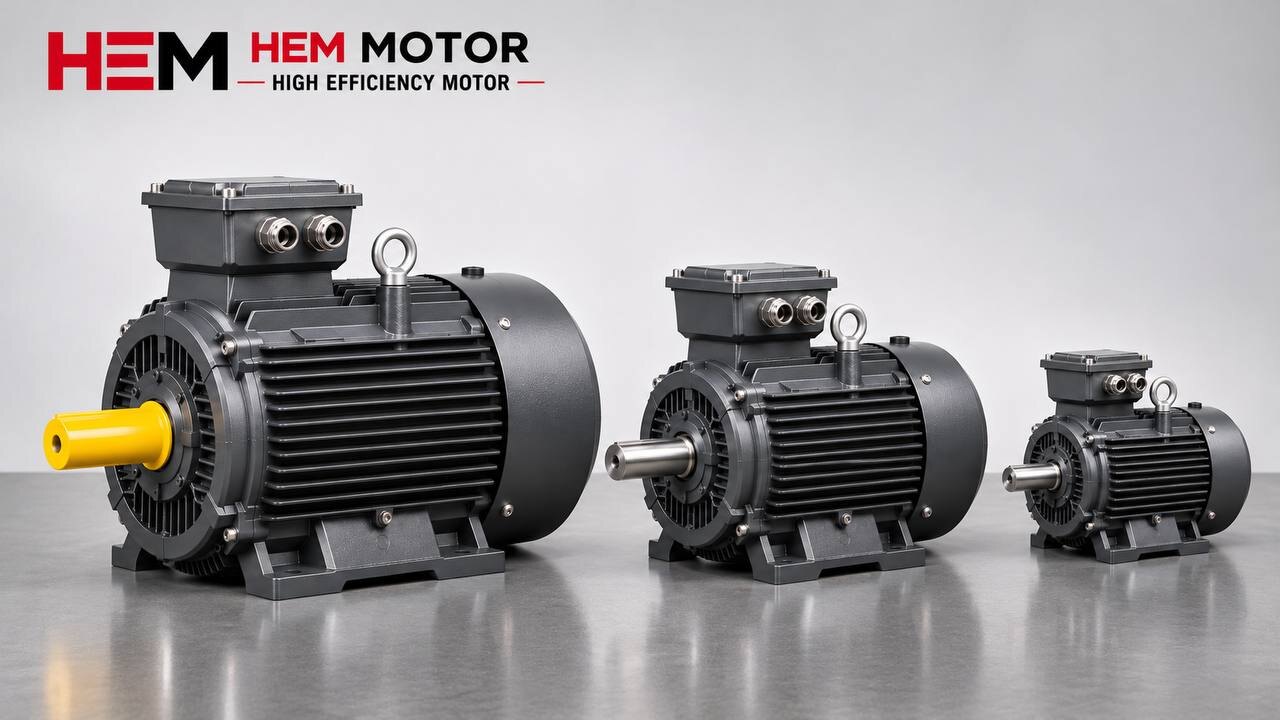
All 117 models are listed in the buy electric motors shop; to filter by frame, use the aluminium-frame models and cast iron frame models categories. The current price is shown on each product page; motors on the sales list leave from stock at our warehouse in Türkiye.
So that we can choose the right step between 0.25 kW and 355 kW together, include the following in your quote request: the machine the motor will drive (pump, fan, crusher, conveyor, etc.), the required power (kW) and speed (rpm), the supply voltage at the site, the mounting type (foot, flange or vertical) and how many units you need.
If you have a motor to replace, send a photo of its nameplate and we will tell you the equivalent HEM model. Phone, WhatsApp and e-mail channels are on the contact page.
Frequently Asked Questions
Which are the smallest and largest models in the three-phase range?
The smallest model is the 0.25 kW, 3,000 rpm aluminium-frame 63M2-2, with a rated current of 0.64 A and rated torque of 0.87 Nm. The largest power is 355 kW, and its 1,000 rpm option is in the 400L-6 frame.
Why are there two product pages for the same kW?
Between 0.55 and 11 kW every power–speed combination is offered with both an aluminium and a cast iron frame. The model code and electrical values are identical; the difference is the frame material.
What changes if I choose 6 poles instead of 4 at the same power?
Speed drops from 1,500 to 1,000 rpm and rated torque rises by about 1.5 times. At 22 kW it goes from 142.9 Nm to 214.4 Nm, and the frame grows from 180L to 200L.
Which models have SF 1.15?
All 30 models of 75 kW and above. This value is a safety margin; it should not be used to select a smaller motor.
If the nameplate speed is 1,450 rpm, which series should I look at?
1,450 rpm falls into the 1,500 rpm synchronous speed class, so you should look at the 4-pole models. Once power and IEC frame are matched as well, the model code becomes clear.