 English
 Français
 Türkçe
 Español
 Русский

- 1. What does the information on an electric motor nameplate mean?
- 2. Does the kW on the nameplate show power consumption or shaft power?
- 3. Why do two electric motors of the same power draw different currents?
- 4. Why is the actual speed of a 1,500 rpm electric motor different?
- 5. What changes if I choose a 2-, 4- or 6-pole electric motor of the same power?
- 6. What power and speed range do HEM Motor three-phase electric motors cover?
- 7. What is the difference between IE3, IE4 and IE5, and which should I choose?
- 8. How is an electric motor's electricity consumption calculated?
- 9. Is fitting a bigger electric motor always an advantage?
- 10. Do electric motor dimensions change when moving from IE3 to IE4 or IE5?
- 11. Should I choose an aluminium or a cast-iron frame?
- 12. What does a frame number (such as 132M or 160L) mean, and how is the shaft size found?
- 13. What is the difference between B3, B5, B14 and B35 mountings?
- 14. Why does load characteristic differ when selecting pump, fan and conveyor electric motors?
- 15. What difference does loaded or unloaded starting make for a compressor electric motor?
- 16. Why is starting difficult for crusher electric motors?
- 17. How is an electric motor selected for a machine with frequent starts and stops?
- 18. What is the difference between continuous (S1) and intermittent duty?
- 19. Besides a photo, what information is needed to find an equivalent for an old electric motor?
- 20. Why do selection criteria differ between coupling and belt-and-pulley drives?
- 21. How do pulley diameter and belt tension affect the electric motor?
- 22. The new electric motor's shaft and flange fit; what else should I check?
- 23. Up to what power are single-phase 220 V electric motors available, and when are they preferred?
- 24. What does the capacitor do in a single-phase electric motor, and how is the direction of rotation changed?
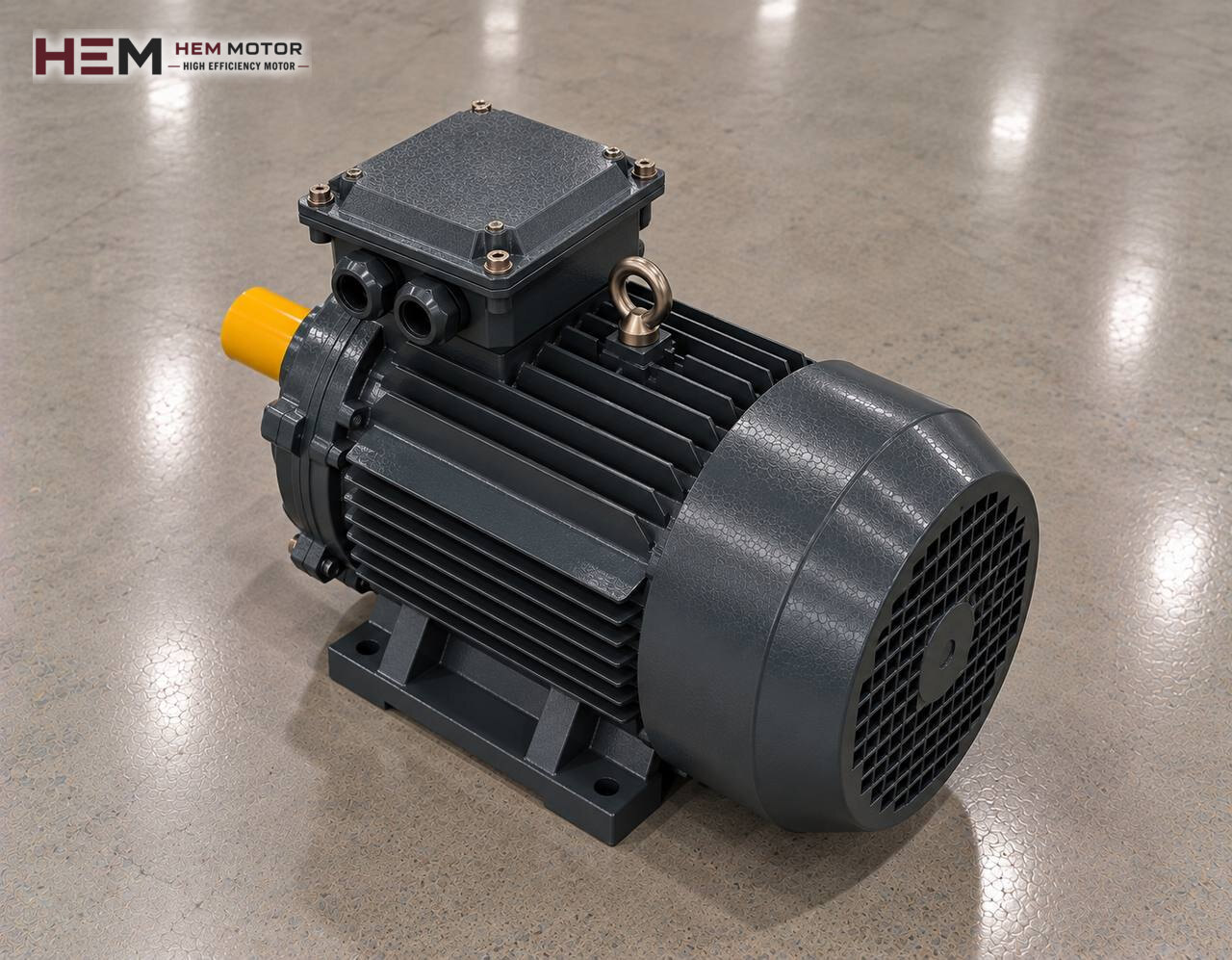
This page brings together the technical questions asked when choosing an electric motor or replacing an existing one: how to read the nameplate, how power, speed and torque relate, efficiency classes and energy consumption, frame, shaft and flange dimensions, selection by machine type, and single-phase 220 V motors.
The examples use real model values from the HEM Motor catalogue. They are not a final selection; the final choice depends on the machine load, required speed, mounting and operating conditions.
You can find a suitable model by power and speed in the buy electric motors store; every product page shows the current price and technical data. If you are replacing a motor, send a photo of its nameplate via the send motor nameplate page; with the machine type, speed, mounting and quantity we will prepare a suitable equivalent and a quotation. For other questions, reach us on WhatsApp.
Send the motor power, speed, mounting type and quantity on WhatsApp. If you are replacing an existing motor, you can also send a photo of its nameplate.
Ask on WhatsApp- Electric Motor Connection and Starting
- Using Electric Motors with Inverters
- Electric Motor Maintenance and Overheating
- Gearbox Selection and Use
- Price, Quotation, Order and Delivery
- Electric Motor Faults
- Electric Motor Power, Current and Calculations
- The Right Electric Motor for Each Machine and Plant