English
 Français
 Türkçe
 Español
 Русский


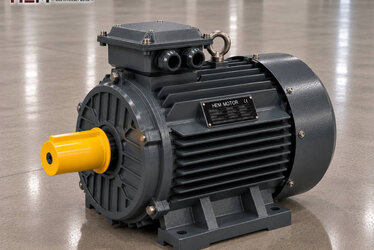
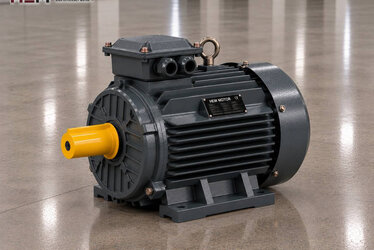
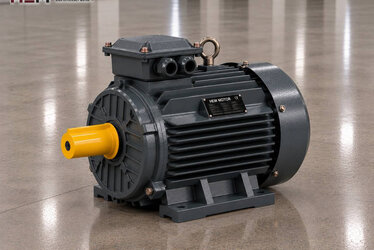
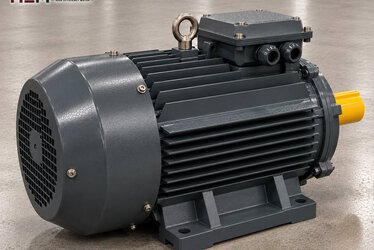
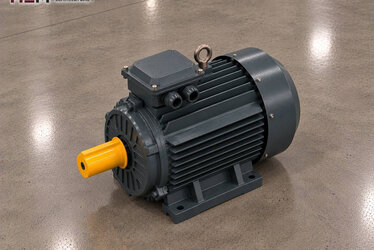
In a feed mill, dozens of machines run in sequence from raw material intake to the bag: grain and meal rise to the silo by elevator, are broken down in the grinder, weighed by dosing screws, blended in the mixer, compressed in the pellet mill and cooled if required, then packed. The load the motor meets is different in each of these machines. This page maps the motors of the feed line; the details of individual machines are left to the sub-pages.

Machines on the Feed Line
Grinding and crushing: A hammer mill or roller crusher brings the grain to the required fineness. High speed, large rotor inertia and current that fluctuates with the feed rate are typical of this section; details are on the Feed Grinder and Hammer Mill Motor page.
Dosing and feeding: Ingredients are transferred to the weigh hopper by small screws and rotary feeders according to the formula. Frequent starts and speed adjustment are decisive; the Feed Dosing and Feeder Motor page covers this topic.
Mixing: Horizontal ribbon, paddle or vertical auger mixers make the batch homogeneous. Starting with a full trough and the torque increase when liquid is added are explained on the Feed Mixer Motor page.
Pelleting: The pellet mill carries the largest motor on the line. The load that rises as the die fills and the heavy inertia are covered on the Feed Pellet Mill Motor page.
Conveying: Elevators and screws move material between sections; interlocking sequence and line cleaning are discussed on the Feed Elevator and Screw Conveyor Motor page.
In addition, the cooler fan, aspiration fan, sieve and packing drives are small but continuously running motors of the line.
Large Motors, Small Motors
Power distribution in a feed plant is uneven. The pellet mill and the grinder alone draw most of the installed power; elevators, screws and feeders are many in number but individually small. These two groups should be considered separately. For large motors, starting current, transformer capacity and starting method come first; for small motors, the simplicity of keeping spares matters most. Using motors of the same frame and flange speeds up replacement in case of a fault.
For small farm-type grinders and mixers where no three-phase supply is available, single-phase 220 V electric motors (0.18–5.5 kW) can be considered.
Nature of the Load: Fluctuating, Constant or Variable
A hammer mill brings a fluctuating load: current rises as feed increases, and foreign objects or damp grain create sudden peaks. Mixers and screws are constant-torque loads; the load does not fall when they slow down. A pellet mill draws a high load that keeps changing with the moisture and temperature of the material between die and roller. On fans, power drops quickly with speed, so drive-based adjustment is most useful there.
Automation that sets the feed rate according to the main motor's current is the most practical way to protect the motor from overload on grinders and pellet mills. A frequency inverter on the feeder side is used for this.
Starting, Transmission and Mounting
The heavy rotor of the grinder and the die-roller assembly of the pellet mill lengthen the start. If thermal protection is not selected for this time, the motor may trip before reaching speed. On high-power drives, star-delta connection, a soft starter or a drive is used to reduce the current surge; which one suits is determined by the machine maker's starting data.
Grinders are usually coupled directly to the motor and require a two-pole motor in the 3,000 rpm class. Pellet mills use a gearbox or belt; four-pole motors are common. Mixers, elevators and screws run at low speed through a reducer. The mounting arrangement can be B3, B5, B14, B34, B35 or vertical depending on frame size; we confirm flange and shaft dimensions together at the order. Details on matching the motor to a reducer are on our electric motors for gear reducers page.
Dust, Steam and Heat
A feed plant has flour-like organic dust, and the pellet section has steam and heat coming from the conditioner. IP55 protection suits ordinary dust and humidity; however, a dust layer building up on the motor reduces cooling and should be cleaned regularly. Standard motors are not designed for zones where organic dust forms an explosive atmosphere; if the plant has a zone classification, state it in the order. In the hot, humid air of the pellet section an anti-condensation heater, and on a constantly loaded grinder motor a PTC winding sensor, can be added with the order.
Example Motors by Feed Machine
| Machine | Nature of the load | Value to check | Example HEM model |
|---|---|---|---|
| Hammer mill | High speed, fluctuating current | Rotor diameter, screen hole size | 45 kW 225M-2 (2,965 rpm) |
| Pellet mill | Heavy, constantly changing load | Die diameter, capacity | 90 kW 280M-4 (1,486 rpm, SF 1.15) |
| Horizontal feed mixer | Full start, constant torque | Batch volume, gear ratio | 22 kW 180L-4 (1,470 rpm) |
| Elevator / screw | Constant torque, interlocked operation | Capacity, height | 3 kW 100L2-4 (1,450 rpm) |
| Dosing screw | Frequent starts, speed control | Dosing accuracy | 1.1 kW 90S-4 (1,445 rpm) |
The motors in the table are examples; the final choice depends on the machine load, required speed, mounting arrangement and operating conditions.
Information Needed for a Quote
Send us which feed machine you need a motor for, the required power and speed, the supply voltage, the mounting arrangement, the starting method and the quantity. If you are looking for a spare motor, you can use the route of finding an equivalent by sending a nameplate photo.
You can find the models with prices on the buy electric motors page and go to our contact page for WhatsApp and phone. For plants where grain turns into flour, our flour mill electric motors page, and for farm machines the agricultural machinery electric motors page, may also be useful.
Frequently Asked Questions
Why does the motor of a feed grinder trip often?
When the feed exceeds the grinder's capacity or the screen clogs, the current rises. Setting the feed according to motor current and monitoring the screen usually solves the problem; the thermal setting must also suit the starting time.
Should a pellet mill motor be 1,500 rpm?
Most pellet mills use a four-pole motor with a gearbox or belt, but the die speed is determined by the machine maker. The power and speed given by the manufacturer should be the basis.
Can a single-phase motor be used on a small farm-type feed machine?
Yes, our single-phase series covers 0.18–5.5 kW. Check with the machine maker that the starting torque is sufficient for the machine.
Does dust in a feed plant harm the motor?
An IP55 frame protects against dust getting inside; still, dust building up on the frame reduces cooling. Regular cleaning and keeping the fan cover clear are enough.
Can motors of different brands be used together in the same plant?
Yes; what matters is that the power, speed, frame, flange and shaft dimensions fit the machine. We can do this matching together using the nameplate data.