English
 Français
 Türkçe
 Español
 Русский

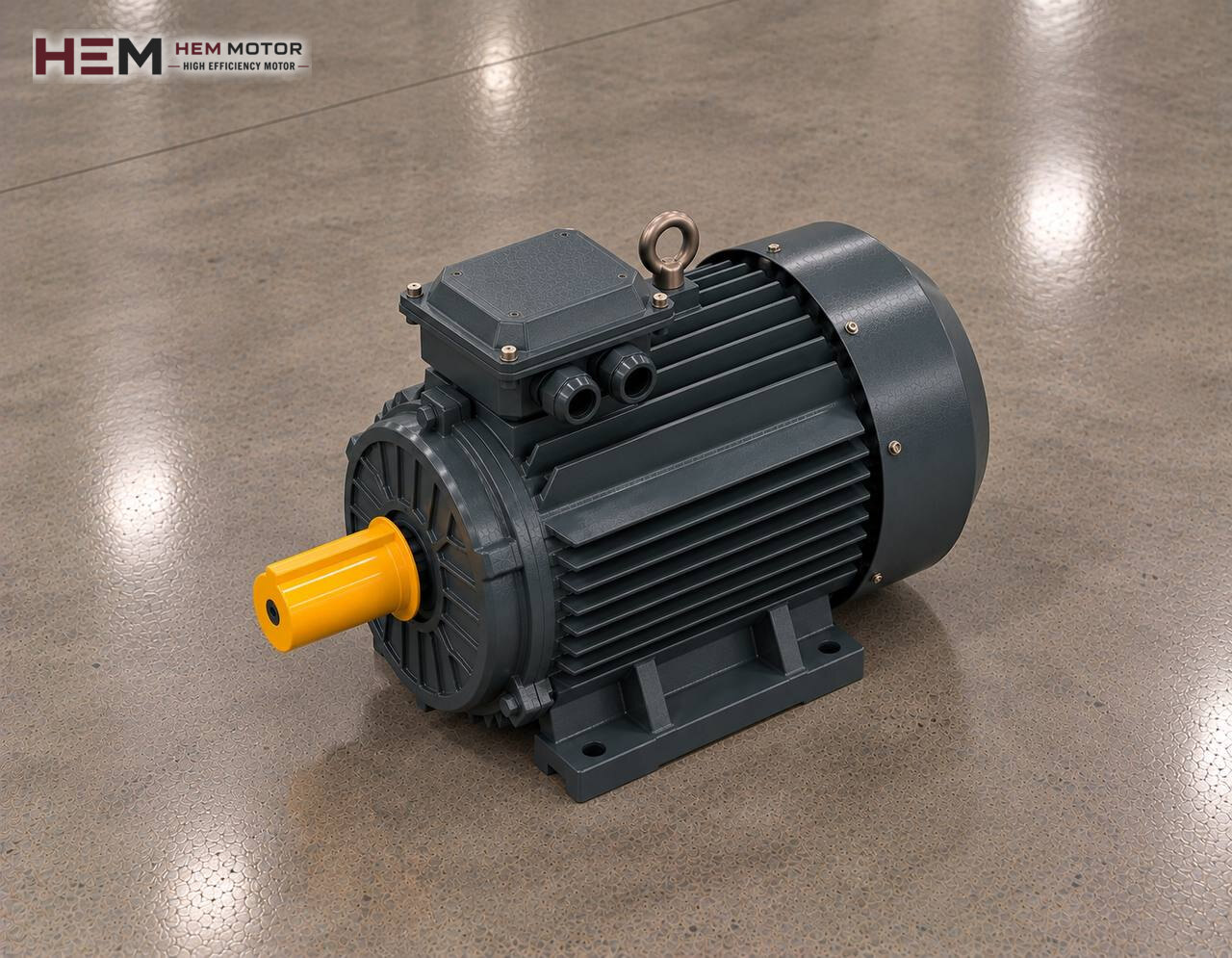
A feed recipe is made of dozens of ingredients: alongside tonnes of maize and meal, a few kilograms of vitamin premix, salt, limestone and enzymes must also enter the mix in the right amount. The arrangement that sends these ingredients from silos and small bins to the weighing hopper is called the dosing and feeding system. This page covers the motors that turn dosing screws, rotary cell feeders and small additive feeders; for the other machines of the feed mill, go back to the feed machinery electric motors page.

The job of a dosing and feeding machine
In a feed plant, dosing is done by batch weighing. For each ingredient in the recipe, the control system starts the feeder under the relevant silo; as the weight on the scale approaches the target, the feeder slows down, and when it reaches the target it stops. Then the feeder of the next ingredient starts. When the scale hopper is full, its contents are discharged into the mixer.
So the motor of a dosing feeder has a different job from that of a conveying screw. Its task is not to carry material far, but to release the required amount at the required moment and stop at once. In one batch each feeder runs, slows and stops several times; in a day the motor starts hundreds of times. Dosing accuracy also depends largely on speed control in the last few seconds.
Feeder types and motor load
Dosing screw
A short screw connected to a silo or bin outlet. It often works at two speeds: fast feeding delivers most of the ingredient and slow feeding the final part. The motor load depends on the pressure of the material column above the screw and on how free-flowing the material is. Under a full silo the screw turns while carrying the weight of the material; this is markedly more than the load the same screw sees under an empty bin.
Rotary cell feeder (rotary valve)
A cell rotor turning inside a housing releases a fixed volume of material on every revolution. It serves both for dosing and as an airlock; placed on a pneumatic conveying line or under a filter, it stops air from escaping. Its motor is small and turns at low speed through a gearbox. A grain or foreign object jammed between rotor and housing causes a sudden torque rise.
Micro-dosing feeders
For small-quantity additives such as vitamins, minerals and medication, very small screw or vibratory feeders are used. They usually work on a separate small scale and dose to an accuracy of a few hundred grams. Their motors are at the level of HEM's smallest frames.
Frequent starts, slowing down and the frequency inverter
The real strain for a dosing feeder motor is not power but frequent stop-start. At every start the motor briefly draws several times its rated current, and this heat builds up in the winding. Fast-slow feeding is done with a two-speed motor or a speed-controlled drive. Today the most common solution is a frequency inverter: it softens the start, limits the starting current and brings the screw down to the required low speed in the final stage.
On a screw that runs slowly on an inverter for long periods, the fan on the motor shaft also turns slowly and cooling drops. If slow feeding lasts only a few seconds per batch, this is usually not a problem; but if there is a dosing screw running continuously at low speed, an independent cooling fan may be needed. If the cable between inverter and motor is long, a filter may be needed. Our three-phase motors are suitable for inverter drive; simply state your operating mode with the order. For details, see the inverter-compatible electric motors page.
Mechanical factors that spoil dosing accuracy
When the feeder stops, the screw or rotor must stop immediately; otherwise extra material flows into the scale and the batch weight overshoots the target. Because inertia is small, the motor stops quickly on most feeders, but material may keep spilling from the end of the screw. To prevent this, some plants fit a fast-closing flap at the feeder outlet; in some designs a brake is added to the motor. If a brake motor is needed, state it clearly in the order.
Material bridging in the silo is another common problem. When the flow stops, the screw turns empty, the scale does not fill and the system forces the feeder to run for a long time. A vibrator or agitator arm at the silo outlet restarts the flow. Current monitoring can report this to the controls by showing whether the screw is turning empty or full.
Mounting and environment
Dosing feeders are lined up under the silos on a narrow, crowded floor. The motor is mostly flange-mounted on the gearbox; because of the lack of space, right-angle gearboxes and small-flange (B14) motors are common. Depending on the frame, HEM motors are offered in B3, B5, B14, B34, B35 and vertical V1/V3/V5/V6/V15 versions; we confirm the flange and shaft size against the gearbox in the order. For flange options, see the B5 and B14 flange motors page.
The floor under the silos is dusty, and some additives such as vitamins and minerals can be abrasive or hygroscopic. IP55 protection limits dust ingress; cleaning the fan cover and frame is important for cooling. On small motors that start frequently, a PTC sensor in the winding is a practical way to track heating and is an order option. If there is an area classified for dust explosion, a standard IP55 motor is not designed for that condition; state this in the order.
Example HEM models and selection table
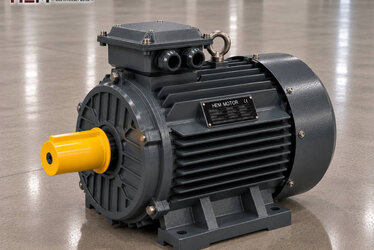
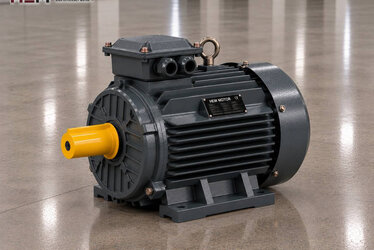
Dosing systems use the smallest motors in the plant. For a micro-additive feeder the 0.55 kW aluminium 80M1-4 delivers 3.75 Nm at 1,400 rpm. Where low speed is wanted on rotary cell feeders, the 6-pole 0.75 kW aluminium 90S-6 (935 rpm, 7.66 Nm) reduces the gear ratio. On a medium dosing screw the 1.1 kW aluminium 90S-4 (1,445 rpm, 7.27 Nm), and on large dosing screws under silos the 3 kW aluminium 100L2-4 (1,450 rpm, 19.8 Nm) can be shown as examples. For small plants with a single-phase supply, the single-phase electric motor series covers 0.18–5.5 kW.
| Feeder | Operating mode | Key selection point | Example HEM model |
|---|---|---|---|
| Micro-additive feeder | Small quantity, precise stop | Brake or flap, inverter | 80M1-4, 0.55 kW |
| Rotary cell feeder | Fixed volume, low speed | Gear ratio, jam protection | 90S-6, 0.75 kW |
| Dosing screw under a bin | Fast-slow feeding | Starts per hour, PTC | 90S-4, 1.1 kW |
| Dosing screw under a full silo | Material column pressure | Starting torque, bridging | 100L2-4, 3 kW |
These pairings are examples; the right motor is determined by looking at the feeder's capacity and accuracy, the required screw or rotor speed, the connection method and the conditions on the floor under the silos.
What to send us for a dosing motor
Tell us the type of feeder (screw, rotary valve, micro feeder), under which machine or silo it works and which ingredient it delivers. Add the motor power (kW), speed (rpm), supply voltage, mounting type and gearbox connection, whether it runs on an inverter, any brake requirement and the quantity. Because a dosing system contains many identical feeders, the quantity matters for the quotation. Sending a nameplate photo of the motor to be replaced speeds up frame and flange matching.
You can find small-power models in the aluminium frame motors list and current prices for all models on the buy electric motors page. Our WhatsApp and phone details are on the contact page.
Frequently Asked Questions
Why does the dosing screw motor often overheat?
A dosing feeder starts many times a day and every start heats the winding. Soft starting with an inverter, reviewing the number of starts per hour and monitoring winding temperature with a PTC usually solve the problem.
Why is the scale target constantly overshot?
Material may keep spilling from the screw end after the feeder stops, or the slow feeding speed may be too high. Lowering the slow speed, adding a closing flap at the outlet or using a brake motor improves dosing accuracy.
Why does the rotary valve motor suddenly stop and trip?
A large particle or foreign object may have jammed between rotor and housing. The motor protection opens the circuit at that moment. The valve should not be restarted before it is cleaned, and you should check whether there is a screen or magnet above the silo.
Can a single-phase motor be used for a dosing feeder in a small farm plant?
Since the single-phase series covers 0.18–5.5 kW, it is an option for small feeders. However, in a dosing arrangement that needs frequent starts and speed adjustment, a three-phase motor with an inverter offers a more flexible solution.