English
 Français
 Türkçe
 Español
 Русский

The pellet mill is the machine that draws the most electricity in a feed plant. It presses steam-conditioned mash through a perforated ring die and turns it into cylindrical rods; most of the motor's power is spent on friction and compression. This page covers the mill's main motor and the auxiliary drives right around it; for the plant's grinding, mixing and conveying machines, see the feed machinery electric motors page.

What happens inside a pellet mill?
The heart of the mill is a steel ring die with thousands of holes around it, and two or three press rollers that turn freely inside it. The main motor rotates the die; the rollers stay on fixed axes and, turning as they rub against the inner face of the die, push the feed out through the holes. Knives outside the die cut the emerging rods to the desired length.
In this process energy goes into compressing the feed and overcoming friction along the hole walls. As the ratio of die thickness to hole diameter (compression ratio) increases, the pellet becomes harder but the torque on the shaft also rises. The same mill may press soft poultry feed easily but struggle with fibrous ruminant feed or fine-hole fish feed. The mill manufacturer sets the motor power according to die diameter and capacity.
Main motor load: torque that rises as the die fills
A pellet mill's load is tightly linked to the feed rate. The faster the feeder screw delivers mash to the conditioner, and the conditioner to the die, the more current the main motor draws. In modern mills the main motor current is measured and the feeder speed is adjusted to it, so the motor is held just below its rated current at full capacity. This means the main motor runs at almost full load for many hours.
Die choking is this machine's best-known fault. When damp or cold feed fills the die, the rollers cannot push it through, torque rises quickly and the motor is strained. On most mills a safety coupling or shear pin disconnects the drive at this moment; the second line of protection is the motor's thermal and current protection. After a choke the die is cleaned and restarted empty.
Starting: empty, but with heavy inertia
Unlike machines that start full, such as mixers or feeders, a pellet mill normally starts with the feeder off and the die empty. With no load, the breakaway torque is low; however, a large-diameter die, belt pulleys or a gearbox create considerable inertia, and the motor may take several seconds to reach rated speed. For this reason, star-delta or soft starters are common for large motors on these machines, limiting the starting current drawn from the supply.
The empty-start assumption holds only if the feed interlock works correctly. If the die stays full of feed after a power cut, the motor tries to start under load; that is why cleaning the die by hand after an outage is recommended. On this machine a frequency inverter is used more for starting and process control than for speed adjustment; at high power, inverter selection and cable filtering are assessed separately.
Transmission: gearbox or belts
There are two transmission families on pellet mills. On gear-driven mills the main motor is coupled to a gearbox integrated into the mill; the motor is usually foot-mounted or foot-and-flange, and coupling alignment must be set carefully. On belt-driven mills one or two motors are connected to the die shaft with V-belts or ribbed belts; in a twin-motor layout both motors must have the same power and speed, and belt tension must be kept equal.
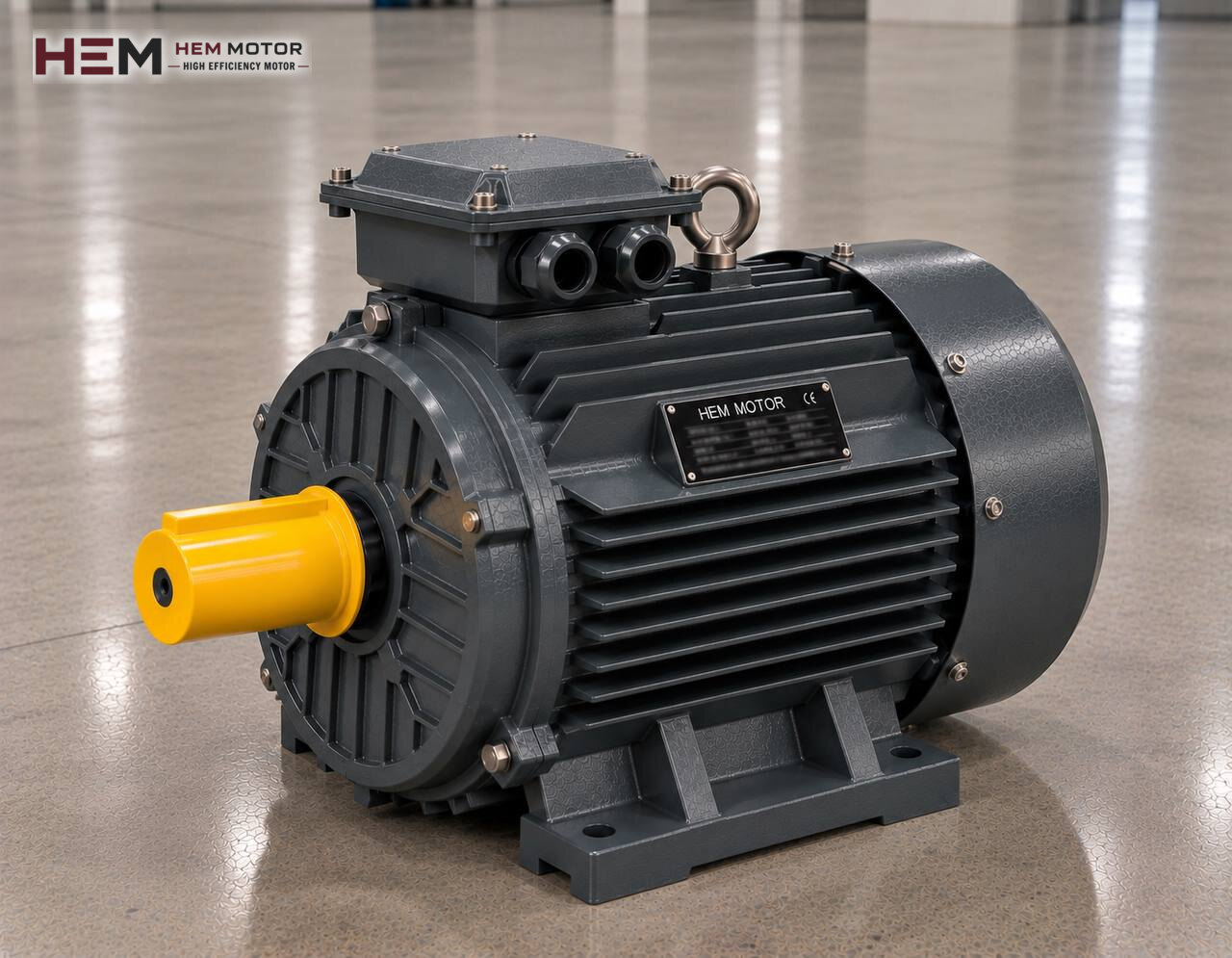
With belts, the radial load on the motor bearing is high; pulley diameter and number of belts should be stated with the order. HEM motors are available in foot-mounted and foot-and-flange designs in large frames too; we confirm the shaft dimension against the coupling or pulley bore together with the order.
Conditioner, cooler and auxiliary drives
In front of the mill are the feeder screw and the conditioner. The conditioner is a trough that mixes steam-injected feed on a paddle shaft; its motor runs through a gearbox or belts and sits in a hot, humid environment. Behind the mill are the pellet cooler (counterflow tower), cooler fan, crumbler and screen. Each needs its own motor, with power far below the main motor.
Motors near the steam line face high temperature and humidity; an anti-condensation heater and a PTC winding sensor are order options. IP55 protection limits flour and feed dust; oily dust collecting on the fan cover must be cleaned regularly. If the plant has an area classified for dust explosion risk, a standard IP55 motor is not designed for that condition; the machine builder's measure or a special motor is required, and this must be stated clearly with the order.
Example HEM models and selection table
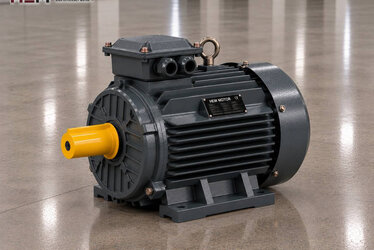
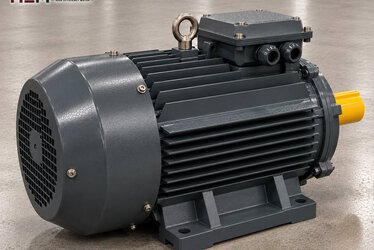
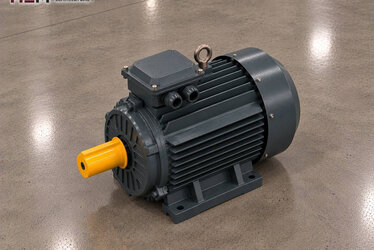
The main motor of pellet mills is usually 4-pole. On small and medium mills the 55 kW cast iron 250M-4 gives 353.7 Nm at 1,485 rpm. On larger mills the 90 kW cast iron 280M-4 (1,486 rpm, 578.4 Nm) and the 132 kW cast iron 315M-4 (1,488 rpm, 847.2 Nm) are models worth checking; both have a service factor of 1.15. For auxiliary drives such as the conditioner, the 5.5 kW cast iron 132S-4 (1,460 rpm, 36 Nm) can serve as an example.
| Mill section | How the motor works | To state when ordering | Example HEM model |
|---|---|---|---|
| Conditioner and feeder | Continuous, hot and humid environment | Gearbox input, anti-condensation heater | 132S-4, 5.5 kW |
| Small–medium mill main motor | Long periods at full load, choking risk | Transmission type, starting method | 250M-4, 55 kW |
| Large mill, gear drive | High torque, large inertia | Coupling, shaft dimension, PTC | 280M-4, 90 kW |
| Large mill, belt or twin-motor drive | High radial load, equal load sharing | Pulley diameter, number of belts | 315M-4, 132 kW |
The models in the table are examples; the final selection depends on the machine load, required speed, mounting and operating conditions.
Information list for a pellet mill motor
So that we can prepare a quotation, send us the mill's machine brand and die diameter, required motor power (kW), speed (rpm), plant voltage, mounting arrangement (foot, foot-and-flange), transmission type (gear or belt), starting method and quantity. A photo of the old motor's nameplate makes selection easier, especially at high power. The list of large frames is on the cast iron frame motors page, and all models with current prices are in the shop. Use the contact page to reach us via WhatsApp or phone.
Frequently Asked Questions
Which starting method does a pellet mill main motor use?
Because the mill starts empty with the feed off, star-delta or soft starters are common at high power. If the die is full after an outage, it should be cleaned first.
Is the motor damaged when the die chokes?
The safety coupling or shear pin disconnects the drive and the motor's thermal protection trips. Frequent choking is related to feed moisture and conditioner temperature; the process settings, not the motor, should be reviewed.
What should be done if one motor on a twin-motor belt-driven mill is replaced?
The new motor must match the power and speed on the other's nameplate. Two motors with different slip values do not share the load equally, and one is constantly overloaded.
Can a 6-pole motor be used on a pellet mill?
It can, but the die peripheral speed has been calculated together with the transmission ratio. If the number of poles changes, the pulley or gear ratio must also change; this decision should be made with the mill manufacturer.