3000 rpm electric motors are three-phase asynchronous motors whose stator winding is built with 2 poles, in other words a single pole pair. With 50 Hz mains, the rotating magnetic field turns 3000 times a minute; under load the shaft runs slightly behind it. In this group HEM Motor offers models covering outputs from 0,25 kW to 355 kW. All of them are IP55 protected with class F insulation and appear in the list as foot-mounted B3 units. As the fastest of the three speed groups, these motors deliver the lowest torque for a given output, so the choice usually starts with one question: does the machine need speed or force?
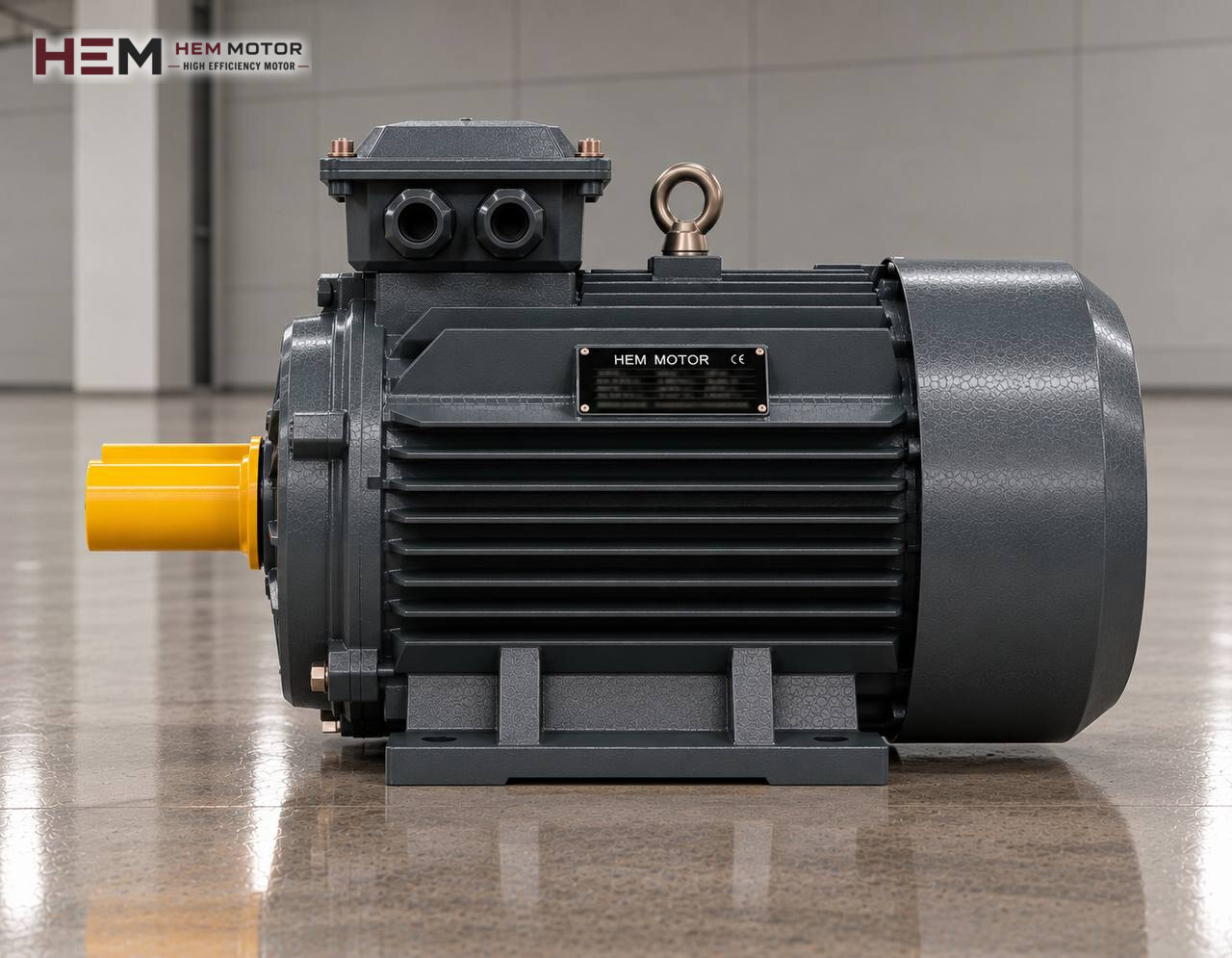
A sample photo illustrating the B3 foot arrangement used across this range; speed and output are printed on every model's nameplate.
One pole pair: the fastest rotating field the supply can give
Pole count is the first thing that fixes shaft speed in an induction motor. The more poles the winding forms, the less distance the rotating field covers in one electrical cycle. With a two-pole winding the field completes a full turn every cycle. The calculation is 120 × frequency / number of poles: 120 × 50 / 2 = 3000 rpm synchronous speed. With four poles this value halves, with six poles it drops to one third.
In practice this means the highest speed you can take from an asynchronous motor on the same supply, without pulleys or gears in between, is found in this group. If a higher shaft speed is needed, a pulley ratio or a frequency inverter comes in. If a lower speed is needed, a gearbox or a motor with more poles is usually considered. If inverter operation is planned, also read the notes on the inverter compatible electric motors page.
Why the nameplate never says exactly 3000: synchronous and rated speed
3000 rpm describes the field, and the rotor always lags it a little. For current to be induced in the rotor bars, a small speed difference between field and rotor is required. That gap is known as slip, and its size follows the load. When the motor runs idle the shaft comes very close to the synchronous value; loaded to its nameplate output it drops to rated speed.
The catalogue rated speeds of the models in this group lie between 2730–2982 rpm. Slip is relatively large in small frames: the 0,25 kW 63M2-2 runs at 2730 rpm at rated load. As output rises the gap narrows; the value given for the 160 kW 315L1-2 is 2980 rpm. For aluminium frame models the range is 2730–2945 rpm, for cast iron models 2750–2982 rpm.
For two cast iron models, 185 kW and 355 kW, the list gives no rated speed; for these two models the value is confirmed at the quotation stage. When calculating on the machine side, use the rated speed on the chosen model's nameplate, not the figure 3000. In a pulley diameter, pump flow or cutting speed calculation this small difference can change the result. For an explanation of the same effect based on four poles, see our FAQ on the real shaft speed of four-pole motors.
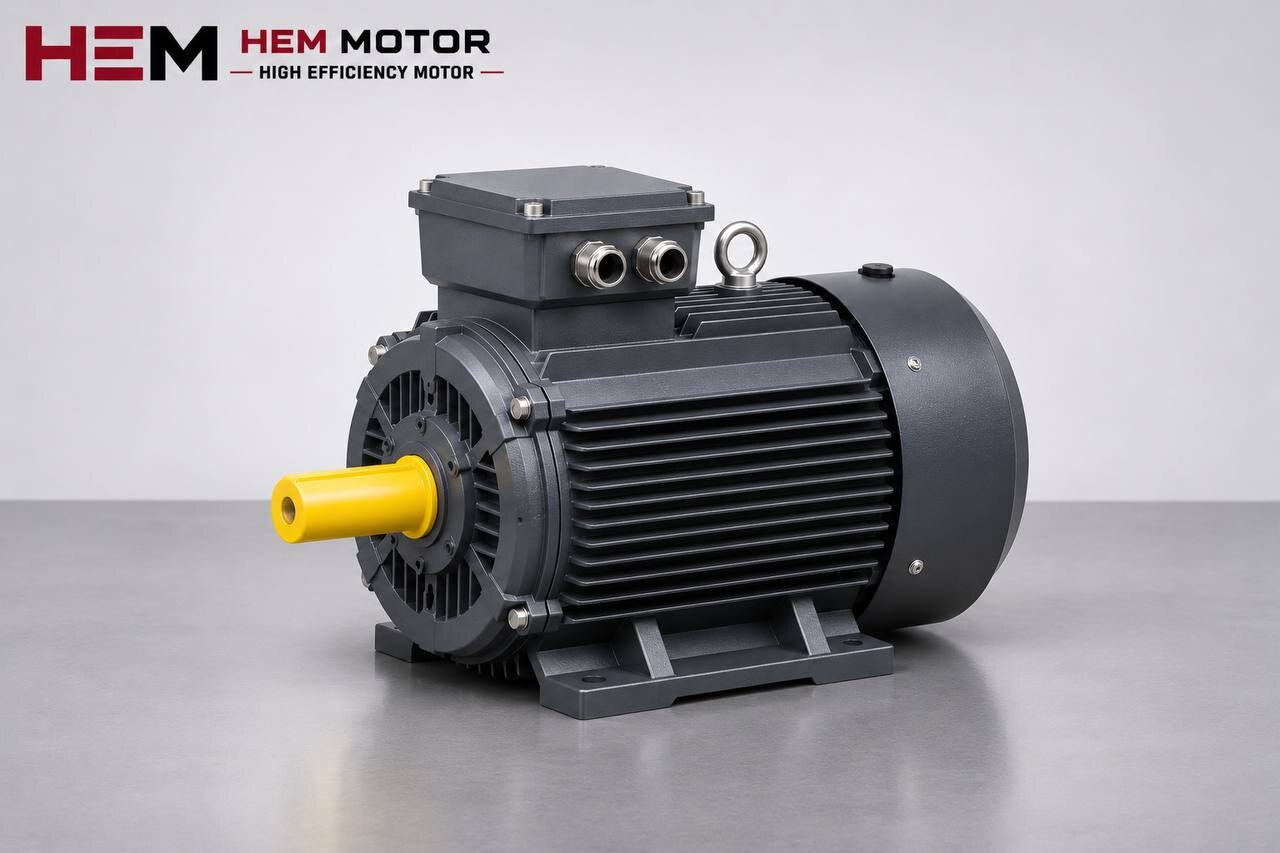
General view of a foot-mounted (B3) three-phase induction motor. Power, speed and frame data are given on each model's own page.
Frame material, IEC frames and voltage options
The group comes in two frame materials, aluminium and cast iron. At every output between 0,55–11 kW the same model code is available in both materials; anything above 11 kW is cast iron only.
Frame material
Output range
IEC frames
Rated speed span
Winding voltage
Aluminium
0,25–11 kW
63M, 71M, 80M, 90S, 90L, 100L, 112M, 132S, 160M
2730–2945 rpm
Δ/Y: 230/400 V up to 3 kW, 400/690 V from 4 kW
Cast iron
0,55–355 kW
From 71M up to 355L
2750–2982 rpm
Δ/Y: 230/400 V up to 3 kW, 400/690 V from 4 kW
A distinctive detail of this group is the 63M frame. Among HEM's three speed groups, the 63M frame exists only on the two-pole side, in the 0,25 kW aluminium 63M2-2 model. For small fans, small pumps or appliance drives where mounting space is tight, this is usually the first model to look at.
The winding voltage is split in two by output: up to 3 kW 230/400 V (Δ/Y), 4 kW and above 400/690 V (Δ/Y). On a 400 V supply, motors in the first group are connected in star, those in the second in delta. If star-delta starting is planned, the winding must run in delta at 400 V; the 4 kW and larger models in this group are built that way. All options by frame material are collected in the aluminium frame electric motors and cast iron frame electric motors categories.
Models in this group and current prices
Price for the B3 foot-mounted standard version; other mounting types are confirmed with the order.
Make your selections; a WhatsApp message is prepared and you can edit it before sending. If you are replacing an old motor, add photos of its nameplate and connections.
Examples from different points of the output range
The models below are sorted from small to large and represent different points of the range. Values are catalogue rated values. Current pricing is shown in the product list and on every product page.
The 132S frame carries both a 5,5 kW (132S1-2) and a 7,5 kW (132S2-2) model. Because one frame code can hold different outputs, orders should always be placed with the full model code. If you want to see every output step in one table, the three-phase model map makes this easier.
Same kW, different pole count: what happens to torque?
When output is held constant, torque is inversely proportional to speed. Roughly, T (Nm) ≈ 9550 × P (kW) / n applies. The two-pole motor, having the highest speed, therefore applies the least force to the shaft at the same nameplate output. Two examples with real data:
At 4 kW: the 112M-2 gives 13,1 Nm at 2905 rpm; the 112M-4 gives 26,3 Nm at 1450 rpm; the 132M1-6 gives 39,5 Nm at 968 rpm. Here the two-pole and four-pole models share the same 112M frame, but the four-pole one has nearly twice the torque.
At 37 kW: the 200L2-2 gives 119,4 Nm; the 225S-4 gives 237,9 Nm; the 250M-6 gives 358,7 Nm. At this output the two-pole model sits in the smallest frame.
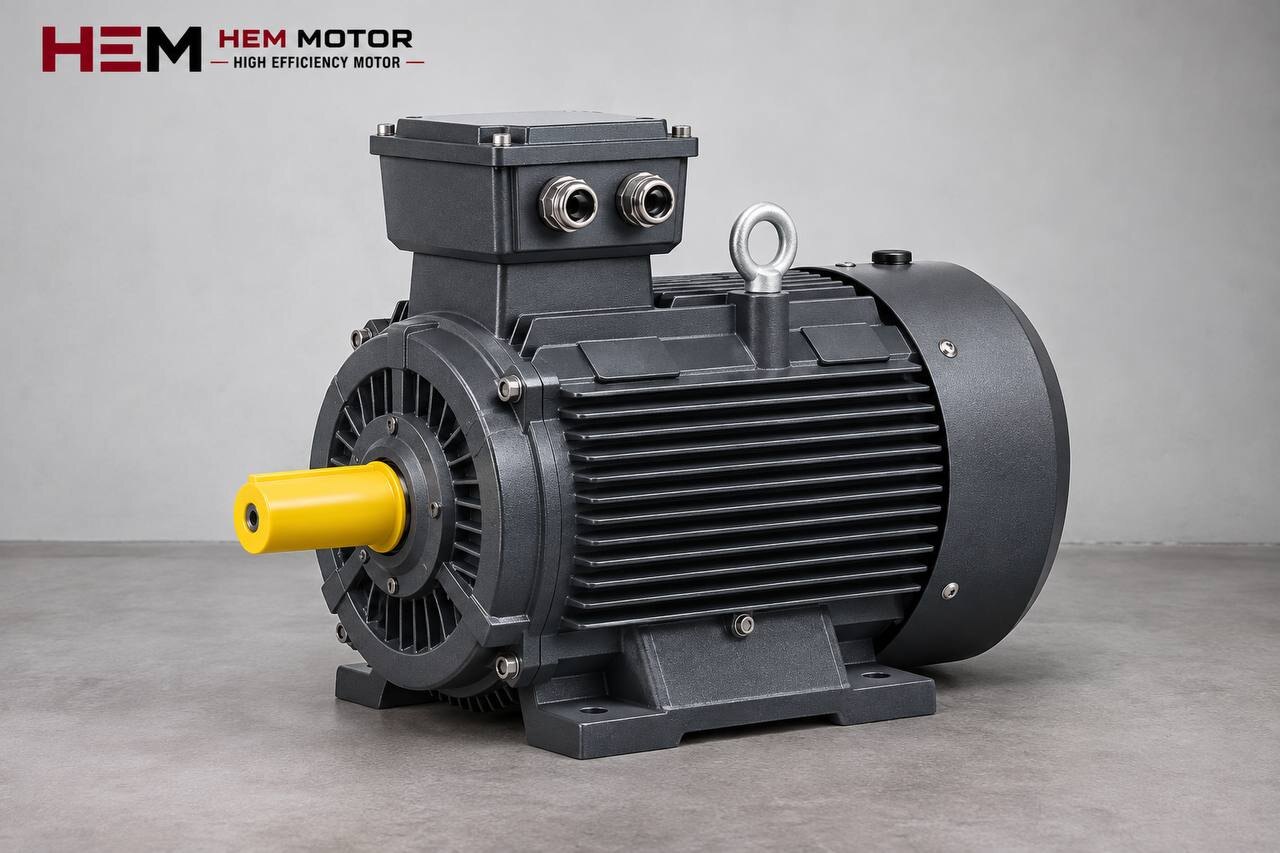
General view of a foot-mounted (B3) three-phase induction motor. Power, speed and frame data are given on each model's own page.
High speed does not suit every load: check load torque first
Even when motor output looks sufficient, what the machine really needs may be torque. On heavy-starting loads or loads that need high force at low speed (a loaded conveyor, a mixer for dense material, a crusher, a hoisting arrangement and the like), a two-pole motor gives less torque at the same kW, so it either needs a high-ratio gearbox or may not be suitable. If the torque the load demands at start exceeds what the motor can deliver, the motor cannot reach speed, current stays high for a long time and the protection trips.
When speed is reduced with a gearbox, output torque rises by the ratio (losses aside). However, to reach the same output speed, a larger ratio is chosen with a two-pole motor. The effect of changing the motor on an existing gearbox is explained with an example in the gearbox FAQ on swapping motor speed; the logic is the same for two poles.
At high speed the mechanical details are also more sensitive. The balance of the coupling, pulley or fan wheel fitted to the shaft, bearing lubrication and support, and noise in operation must be handled more carefully than with a low-speed motor. With a belt and pulley drive, the load that pulley diameter and belt tension place on the shaft end must also be checked. Because the limits for these items depend on the installation and the driven machine, no numerical values are given here; if you are unsure, describe your application to us.
Where two-pole motors usually come up
The following are applications where a two-pole motor is frequently evaluated. Naming a machine is not proof that a motor fits; load, required speed, transmission type (coupling, belt and pulley, gearbox) and working conditions decide.
Centrifugal pumps, booster and circulation pumps connected directly by coupling
Some fan and blower types that need a high tip speed
Machines working at high cutting speed, such as circular saws, grinders and sanders
Drives with low starting torque where speed is kept or raised by pulleys
In a centrifugal pump the impeller and pump curve are prepared for a specific speed. Connecting a two-pole motor to a pump selected for a four-pole motor raises flow and pressure, and the pump's power demand also climbs quickly with speed; the motor may be overloaded. Fans behave in a similar way. For this reason, check the pump or fan manufacturer's data before making such a change.
Checking mounting dimensions and electrical match
When choosing a replacement for an old motor, a matching IEC frame number is only a starting point. The following points must be compared one by one:
Mounting type: B3 foot, B5 or B14 flange, B35 foot and flange
Shaft diameter and shaft length, key size
Foot hole spacing and shaft centre height
Flange dimensions (on flanged designs)
Winding connection (Δ/Y) and rated voltage versus the site supply
Listed prices refer to B3 foot units. Other mountings such as B5, B14 or B35 can alter the price; this is settled when you order. For flanged designs, see the B5 and B14 flange-mounted motors and B34 and B35 foot and flange motors pages. What the frame number tells you and how to find the shaft size is explained in the frame number question. Fastest of all: photograph the old nameplate and the terminal box wiring and share both on WhatsApp; we check dimensions and connection from those images.
What to have ready when asking for a quote
Required kW, plus confirmation that a 2-pole unit is what you want
Mounting type (B3, B5, B14, B35)
Supply voltage and connection type
Preferred frame material (aluminium or cast iron)
Quantity
For replacements, a nameplate picture of the unit being removed
Sales and quotations are handled via WhatsApp and by phone. The general purchasing steps are summarised in the buy electric motors category.
Frequently Asked Questions
At what speed does a 3000 rpm motor actually run?
3000 rpm is the synchronous speed. Under load the shaft turns more slowly because of slip; the rated speeds of the models in this group lie between 2730–2982 rpm. The exact value for each model is stated in its own technical data.
Which is the smallest motor in this group?
It is the 0,25 kW 63M2-2 aluminium frame model. Among HEM's speed groups the 63M frame exists only on the two-pole side, which is why it is often asked about for tight mounting spaces.
Can I connect a two-pole motor in place of a four-pole motor?
Even if the dimensions match, the machine will then run at about twice the speed, and torque at the same output drops to nearly half. In a pump, fan or geared arrangement this change can overload the machine. First check the machine's required speed and load torque.
Why does a two-pole motor give less torque at the same output?
Power equals torque multiplied by speed, apart from a constant. When speed is high, the torque needed to deliver the same output is lower. For example, at 4 kW the 112M-2 gives 13,1 Nm and the 112M-4 gives 26,3 Nm.
Can a 3000 rpm motor be used with a frequency inverter?
It depends on the application. Inverters are common on pumps and fans that need speed adjustment; however, the operating range, cooling and mechanical limits must be evaluated together with the load. If you send your application via WhatsApp, a suitable model is determined together.
3000 rpm Electric Motors — Fill in the details and tap “Send Order via WhatsApp”; your order opens as a ready-made WhatsApp message and you just press send.
We use necessary and optional cookies to improve your experience, enhance content and analyse traffic. Under the GDPR, optional (analytics/marketing) cookies are only used with your explicit consent. Please choose your preference below.
Cookie Policy
 English
 Français
 Türkçe
 Español
 Русский
 العربية