English
 Français
 Türkçe
 Español
 Русский
 العربية

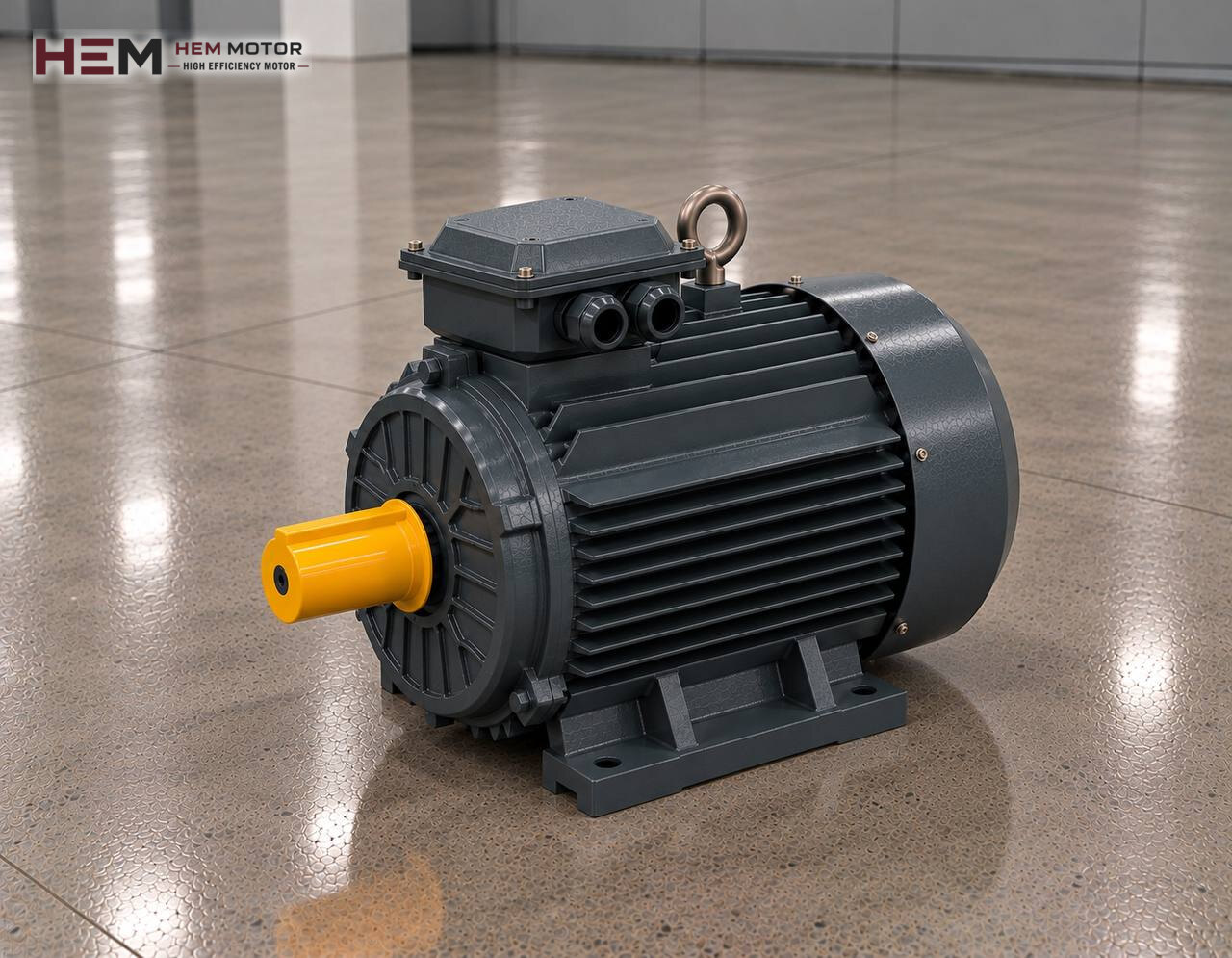
In a reciprocating air compressor the crankshaft drives the pistons up and down through connecting rods; on every suction and discharge stroke a portion of air is compressed and sent to the receiver tank. From car repair shops and joinery workshops to paint booths and small production lines, this is the most common source of compressed air. This page covers the electric motor that turns the compressor head; a general comparison of compressor types is on the compressor electric motors page.

Torque that changes on every crankshaft turn
As the piston rises from bottom dead centre, cylinder pressure climbs quickly and resistance at the shaft grows until the discharge valve opens. On the way back down the resistance falls almost to zero. At the motor shaft this means a torque wave repeated once or several times per revolution. On single-cylinder heads the wave is pronounced; on two- or three-cylinder V or W heads the cylinders fire in turn and the load is spread more evenly.
The compressor pulley is usually finned and heavy. It acts as a flywheel that smooths the torque wave, and its fins blow air over the cylinder and the intercooler pipe. The motor therefore indirectly carries the pulley's cooling duty as well as the compression work.
Single stage versus two stage: the difference for the motor
In a single-stage head air reaches final pressure in one cylinder. In a two-stage head a large low-pressure cylinder first compresses air to an intermediate pressure; after the intercooler, a small high-pressure cylinder brings it to final pressure. Two-stage heads are chosen for jobs needing higher tank pressure, and shaft power rises for the same air delivery.
When replacing the motor of an existing head, the head speed and power recommended by the compressor manufacturer should be considered together. Running above the rated head speed may seem to add delivery, but it accelerates valve and ring wear and can push the motor above its nameplate current.
Tank-mounted belt layout and direction of rotation
In workshop units the motor and head are bolted side by side on a common plate above the tank. The motor pulley is small, the compressor pulley large; head speed is set by this diameter ratio. Motor feet usually sit in slotted holes and the belt is tensioned by sliding the motor outward. A 4-pole (1,500 rpm) motor is the most common choice in this layout.
Direction of rotation matters on a reciprocating compressor: the finned pulley must blow air towards the cylinder, and on splash-lubricated heads the oil dipper works correctly only in the direction shown by the arrow. If a three-phase motor runs backwards, swap two phase leads. The belt guard should stay in place both for safety and to direct cooling air from the pulley.
Starting, pressure switch and duty ratio
Reciprocating compressors are mostly designed for intermittent duty: they stop when the tank is full and restart when pressure drops. At each start the motor draws several times its rated current for a few seconds. Small ratings are started direct on line; our models from 4 kW upwards, labelled 400/690 V, suit star-delta starting on a 400 V supply, while those of 3 kW and below do not.
If the head unloader fails to vent the cylinder, the motor tries to start against a pressurised cylinder and the overload trips. Large industrial reciprocating units in continuous service do not stop; the head idles with suction valves held open. If starts per hour are high, a PTC thermistor in the winding, available as an order option, is a practical way to monitor heating.
Vibration and heat in the compressor room
Reciprocating masses shake the tank and the common plate. This vibration can loosen motor foot bolts, upset belt alignment and tire the bearings. Anti-vibration mounts under the tank feet, bolt checks during maintenance and belt tension kept at the manufacturer's value directly affect motor life.
The cylinder head and discharge pipe get very hot; in a small room this heat also warms the motor's cooling air. Our motors come with an IP55 enclosure and class F insulation and cool themselves through the frame fins with their own fan. If oil mist and dust stick to the fins, heat dissipation drops; the fan cover should be cleaned regularly. For outdoor units an anti-condensation heater can be requested.
Sample motors and selection table
| Compressor layout | Motor load | Point to check | Sample HEM model |
|---|---|---|---|
| Small single-cylinder workshop head | Pronounced torque wave, frequent starts | Starts per hour, head unloader | 3 kW 100L2-4 (1,450 rpm) |
| Two-cylinder V head | Smoother torque, intermittent duty | Pulley ratio, direction of rotation | 4 kW 112M-4 (1,450 rpm) |
| Two-stage head | Higher shaft power at high pressure | Head speed, star-delta | 5.5 kW 132S-4 (1,460 rpm) |
| Large-tank service compressor | Long fill time, hot room | Overload setting, ambient temperature | 7.5 kW 132M-4 (1,460 rpm) |
The models in the table are examples; final selection depends on machine load, required speed, mounting and operating conditions. For instance, the 112M-4 delivers 26.3 Nm and the 132M-4 49.1 Nm rated torque. For harsher sites the same ratings are also available with a cast iron frame.
Information needed for a motor request
Send us the compressor brand and machine type (single or two stage), motor power (kW), speed (rpm), supply voltage, mounting arrangement, pulley diameter, starting method and quantity. A photo of the old motor's nameplate gives most of the details on its own. For homes or small workshops without a three-phase supply, our single-phase electric motor range can be considered.
Current prices of the models are shown in our electric motor shop. For WhatsApp and phone, go to our contact page.
Frequently Asked Questions
Can a 3,000 rpm motor be used on a reciprocating compressor?
Some small direct-coupled heads use a 2-pole motor. Most belt-driven heads use a 4-pole motor and a pulley ratio. Selection follows the compressor manufacturer's data so that head speed is not exceeded.
Does reverse rotation damage the compressor?
The pulley fins stop cooling the cylinder and lubrication can fail on splash-lubricated heads. Check the direction against the arrow on the belt guard; if it is wrong, swap two phase leads.
Why does the compressor slow down and the motor heat up as the tank fills?
As tank pressure rises, the work in each compression stroke increases and motor current goes up. If the upper setting of the pressure switch exceeds what the head allows, the motor may run above nameplate current continuously.
Should I choose an aluminium or a cast iron frame?
Both frames are available up to 11 kW. Aluminium is common on tank-mounted layouts where light weight is wanted; cast iron can be preferred in hot, dusty rooms with high vibration.