English
 Français
 Türkçe
 Español
 Русский

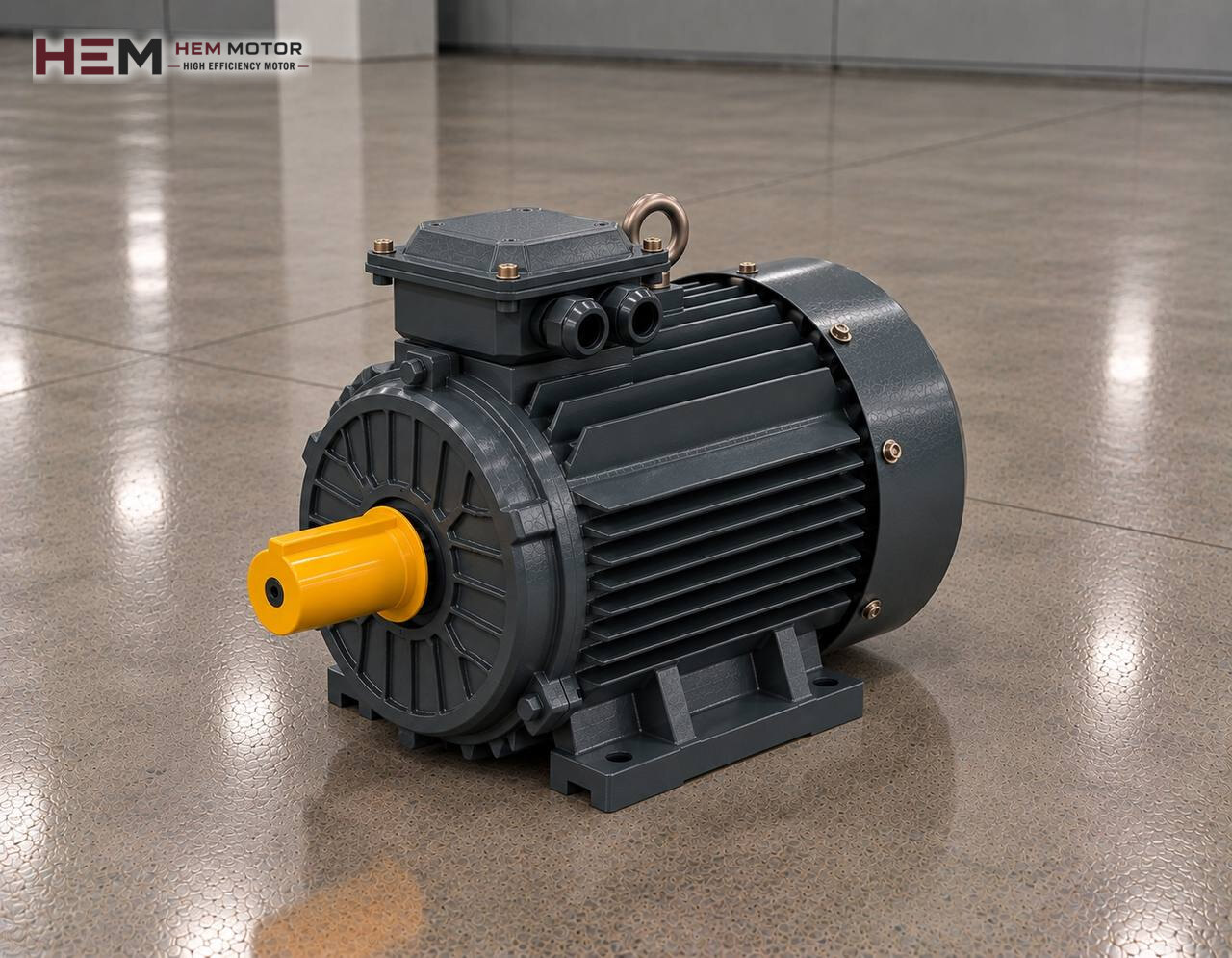
A plastic shredder pre-shreds large, thick plastics that are hard to feed into a granulator — purge lumps, drums, IBC tanks, bundles of pipe and baled film — with slowly turning knife shafts. This page belongs to plastic and rubber processing motors and covers the main drive and auxiliary motors of the shredder. The difference between a shredder and a high-speed granulator changes the motor selection directly.

Slow shaft, high torque: why is a shredder different?
A granulator turns fast and cuts the material; a shredder turns at a few tens of revolutions per minute and tears and rips it. The same motor power is converted here into very high torque at very low speed. This conversion is done not by the motor but by the gearbox placed in between, or by a belt and gearbox combination. The motor is usually 4-pole or 6-pole and is connected to the gearbox input by a flange or a coupling.
The nature of the load is also different. When a knife tooth grips a thick piece, torque rises within seconds and drops suddenly when the piece breaks off. The motor current therefore does not draw a smooth line but a wave that keeps rising and falling. Besides motor power, it matters that the gearbox, coupling and shaft connections can carry this fluctuation.
Single-shaft shredder: pusher, rotor and screen
In a single-shaft machine the material drops into the hopper and a hydraulic pusher presses it against the rotating rotor. Small square knives on the rotor tear pieces off the material against a fixed counter knife; the process continues until the pieces pass through the screen under the rotor. In this arrangement the main motor turns the rotor through belts and a gearbox or directly through a gearbox.
The pusher is moved by a hydraulic unit. The unit's motor turns the hydraulic pump; the pushing force is set by the cylinder and system pressure, not by the motor. Smart controls pull the pusher back when the main motor current rises and push it forward again when it falls. The hydraulic unit motor is selected by pump flow and pressure; for the general framework see the electric motors for hydraulic pumps page.
Twin-shaft and four-shaft shredders
In a twin-shaft machine two knife shafts turn towards each other; hooked discs grab the material and tear it between them. There is no screen; piece size is set by disc thickness. Each shaft can be turned by its own motor-gearbox unit, or a single drive can turn both shafts together through a gear case. In the two-motor arrangement, load sharing between the shafts is monitored by the control.
Four-shaft machines add two cleaning shafts below the two cutting shafts to produce smaller, more uniform pieces. As the number of drives grows, each motor gets smaller, but total power and control complexity increase. When buying a spare motor, noting which shaft belongs to which motor and the direction of rotation prevents confusion later.
Jamming, reversing and starting
Reversing is common behaviour for shredders. When the main motor current passes the set limit, the control stops the shaft, turns it back briefly and then tries forward again. If the jam does not clear after a few attempts, the machine raises an alarm. Because this cycle stops and restarts the motor frequently, winding heat builds up faster than on an ordinary machine.
Direction is changed by a pair of contactors or a frequency inverter. Because an inverter slows the shaft gently before reversing and limits starting current, the gearbox teeth also receive fewer shocks. HEM's three-phase series are suitable for inverter operation. If high torque is needed at low speed for long periods, the motor may need cooling by a separate fan, and if the cable between panel and motor is long a dv/dt or sine filter may be needed; write these details in your order. An explanation of the topic is on the inverter compatible electric motors page.
A shredder usually starts with a full hopper. The reduced torque of star-delta starting is therefore often not enough; depending on the machine's solution, starting is done with an inverter or after the hopper is emptied. On machines that reverse often, a PTC or PT100 sensor in the winding is an optional order item that strengthens the protection.
Gearbox connection, mounting and working environment
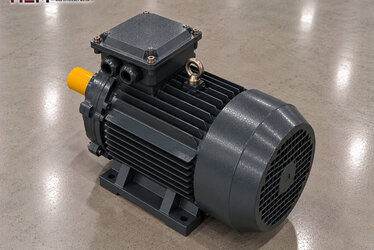
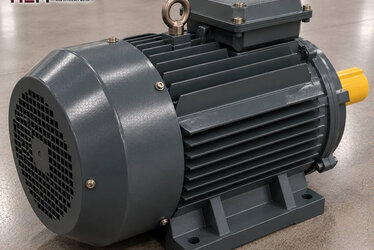
The main motor can sit directly on the gearbox with a B5 flange, or a foot-mounted B3 motor can be fixed to the frame and drive the gearbox through a coupling. Depending on frame size, B14, B34, B35 and vertical V1, V3, V5, V6, V15 versions are also available; we confirm the flange and shaft dimensions together at the order stage. For gearbox matching, the electric motors for gearboxes page is helpful.
The area around a shredder is dusty, vibrating and often outdoors. Cleaning film scraps and dust out of the fan cover from time to time and checking foot and flange bolts against vibration extend motor life. For machines standing outdoors in the rain, an anti-condensation heater can be ordered for humid periods.
Example motors by shredder type
| Drive | Load on the motor | What to check | Example HEM model |
|---|---|---|---|
| Small single-shaft shredder rotor | Fluctuating torque, belt and gearbox | Rotor diameter, screen, pusher control | 22 kW 180L-4 (1,470 rpm) |
| Large single-shaft shredder rotor | Start with full hopper, reversing | Starting method, gearbox input | 55 kW 250M-4 (1,485 rpm) |
| Twin-shaft shredder (per shaft) | High torque at low speed | Gear ratio, load sharing | 30 kW 225M-6 (980 rpm) |
| Pusher hydraulic unit | Pump drive, varying pressure | Pump flow, system pressure | 5.5 kW 132S-4 (1,460 rpm) |
The values are examples; actual power and speed are determined once the machine builder's data, the material processed, hourly capacity and gear ratio are known. The nameplate of the existing motor is always the first place to look.
Information we need to prepare a quote
Please send: machine type (single, twin or four-shaft shredder), the drive where the motor will be replaced, power (kW), speed (rpm), plant voltage, mounting type and gearbox flange, use of an inverter or reversing, and quantity. If you have a motor with a readable nameplate, you can share a photo as described on the send a motor nameplate page.
For priced models go to the buy electric motors shop, and for our WhatsApp line and phone numbers to the contact page.
Frequently Asked Questions
Should I choose a 4-pole or a 6-pole shredder motor?
That depends on the gear ratio and the input speed specified by the machine builder. If the gearbox is not changed, choose the same number of poles as the old motor; otherwise shaft speed and knife behaviour change.
Why does the motor heat up as reversing becomes more frequent?
Every stop and restart produces extra heat in the winding. If the number of reversals has increased, check knife wear, feed quantity and pusher setting; you can ask for a motor with a PTC sensor to monitor winding temperature.
On a twin-shaft machine, should both motors be the same model?
Mechanically symmetrical machines usually use the same power and speed. Still, which motor is connected to which shaft and the directions of rotation should be verified with nameplate photos before ordering.
What can be done if the shredder motor must stop immediately?
Stopping time depends on the machine's safety design; inverter braking is one option. If a brake motor is needed, state it in your order.