English
 Français
 Türkçe
 Español
 Русский

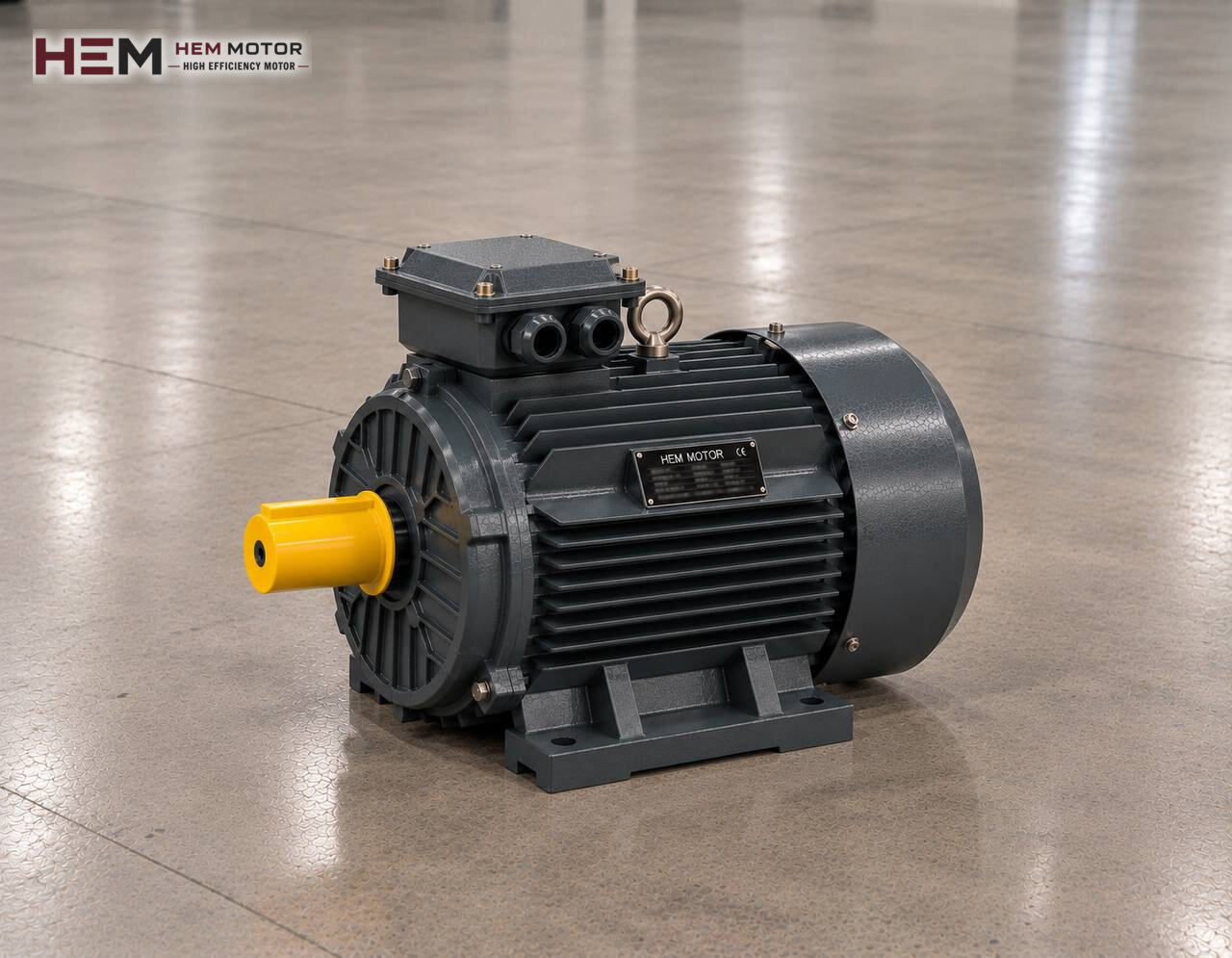
A belt conveyor works by an endless rubber or PVC belt, tensioned between two pulleys, running over carrying idlers. The belt carries the material, and what moves the belt is friction on the surface of the drive pulley. This page explains the motor that turns that pulley and how the belt's particular behaviour affects motor selection; the general overview of the conveyor family is on the conveyor belt electric motors page.

Belt, pulley and take-up: where motion is transmitted
On a belt conveyor, the motor torque is not transferred to a gear or a chain but to the surface where the belt wraps around the pulley. The wider the wrap angle and the more suitable the tension, the more pull is transmitted without slipping. This is why the pulley surface is often lagged with rubber.
The take-up (screw, gravity or carriage type) provides the force pressing the belt onto the pulley. If the take-up is slack, the belt slips on the pulley before the motor reaches full power; if it is too tight, unnecessary load is placed on the pulley and gearbox bearings, and therefore on the motor. So take-up adjustment must be right before looking at the motor; otherwise even a powerful motor will not solve the problem.
The resistances that set motor power
On a horizontal belt, most of the power goes to friction: rotating resistance of carrying and return idlers, the belt flexing as it moves over the idlers, and the drag of scrapers and skirt rubbers. These items grow as the belt gets longer and the number of idlers increases. If there is an incline, the power needed to lift the material is added on top.
This calculation is the conveyor designer's job and is based on belt width, speed, capacity, length and incline. On the motor side, what matters is that the calculation is made for the heaviest loading and the coldest operating condition; in winter, idlers with stiff grease and a hardened belt noticeably increase resistance. On an existing line, the most reliable data are the nameplate of the running motor and a current measurement under load.
Starting long belts: stretch and slip
A belt is an elastic element. When the motor starts with a sudden torque, the belt next to the drive pulley tightens at once, while the belt at the far end stays still for a moment. On long conveyors, this delay causes belt surging, slip on the pulley and strain at the splices. Something that goes unnoticed on a short packaging belt becomes decisive on a quarry belt hundreds of metres long.
So on long belts that start loaded, the goal is to raise torque gradually. A soft starter does this by limiting current; an inverter also allows the ramp time and belt speed to be set. On some large conveyors a fluid coupling is fitted between motor and gearbox; the motor accelerates independently of the load and the coupling passes torque gently to the belt. Which route to choose depends on belt length, supply capacity and starting frequency.
Drive location and connection types
The most common layout puts the motor and gearbox at the head pulley, i.e. the discharge end, so the belt is pulled on the loaded side. Three connection solutions stand out:
- Shaft-mounted gearbox: The gearbox sits directly on the pulley shaft and is held to the frame by a torque arm; the motor is connected to the gearbox by its flange. A compact solution that needs no alignment.
- Motor-coupling-gearbox on a base: On heavy belts, motor and gearbox sit on a baseframe with a flexible or fluid coupling between them. A foot-mounted motor and correct alignment are needed.
- Belt and pulley plus gearbox: Used at plants that want to adjust belt speed by changing pulleys.
Drum motors (motorised pulleys), where the motor is built into the pulley, are not included in HEM Motor's 2026 catalogue; the options on this page are standard three-phase motors that sit outside the pulley. For matching with gearboxes see the electric motors for gearboxes page, and for flange types the B5 and B14 flange motors page.
The difference between light and heavy belts
Belts on packaging, logistics and assembly lines are short, level and lightly loaded; the motor is usually small and stops and starts often. Here aluminium frame motors and compact gearboxes are a practical match. If speed adjustment is wanted to follow the product, an inverter is used.
Quarry, mining and plant belts are long, inclined and dusty; the load is continuous and heavy, and starts are often made with a loaded belt. On such lines a cast iron frame motor offers a housing that stands up better to dust and impact. For a motor on an open site, an anti-condensation heater and a PTC winding sensor can be added as order options; dust building up on the frame fins should be cleaned regularly.
Example HEM models and selection table
4-pole motors used with a gearbox are the most common choice on belt conveyors. On a light parcel belt, the 2.2 kW aluminium 100L1-4 delivers 14.5 Nm at 1,450 rpm; on slightly more loaded lines the 4 kW aluminium 112M-4 can be considered. On a medium-sized aggregate belt, the 15 kW cast iron 160L-4 produces 97.8 Nm at 1,465 rpm; on a long main transport belt, the 37 kW cast iron 225S-4 delivers 237.9 Nm at 1,485 rpm and draws 66.1 A at 400 V.
| Belt type | Load character | What to watch | Example HEM model |
|---|---|---|---|
| Packaging and assembly belt | Light, frequent stop-start | Compact gearbox, speed adjustment | 100L1-4, 2.2 kW (aluminium) |
| Logistics and parcel belt | Light to medium, long running | Flange type, supply voltage | 112M-4, 4 kW (aluminium) |
| Aggregate and sand belt | Continuous, dusty, loaded start | Take-up, starting method | 160L-4, 15 kW (cast iron) |
| Long main transport belt | Heavy, marked belt stretch | Ramp, coupling, supply capacity | 225S-4, 37 kW (cast iron) |
These models are for guidance; the actual motor is determined by the real belt load, the required belt speed, the drive connection and site conditions.
Information to send for a quote
Briefly describe the machine or line where the conveyor is used, the belt length and incline. Then add the motor power (kW), speed (rpm), supply voltage, mounting type, gearbox connection and the quantity required. If an old motor is to be replaced, send a photo of its nameplate; this makes matching the same frame and flange easier.
You can find current prices for aluminium and cast iron models on the buy electric motors page. To reach us by WhatsApp or phone, see our contact page.
Frequently Asked Questions
If the belt slips on the pulley, is fitting a stronger motor the solution?
Usually not. Slip comes from insufficient take-up force, worn pulley lagging or a wet belt. These should be corrected first; motor power should only be increased if the calculation is genuinely insufficient.
What is the difference between a drum motor and a motor mounted outside?
An external motor and gearbox are maintained separately, only the faulty part is replaced in a breakdown, and they are available in standard frame dimensions. A drum motor is more compact but is not included in HEM Motor's 2026 catalogue.
Pulleys or an inverter for changing belt speed?
If the speed will change once, a pulley or gearbox ratio is enough. If speed is adjusted often to suit the product, an inverter is more practical; our three-phase series can be driven by an inverter, and long running at low speed under full load or a long cable should be stated in the order.
Can two separate drives be used on a long belt?
Yes; on very long conveyors the load is split between two pulleys. In that case the motors should have the same power and speed, and load sharing should be balanced with an inverter or coupling; the conveyor designer sets the arrangement.