English
 Français
 Türkçe
 Español
 Русский

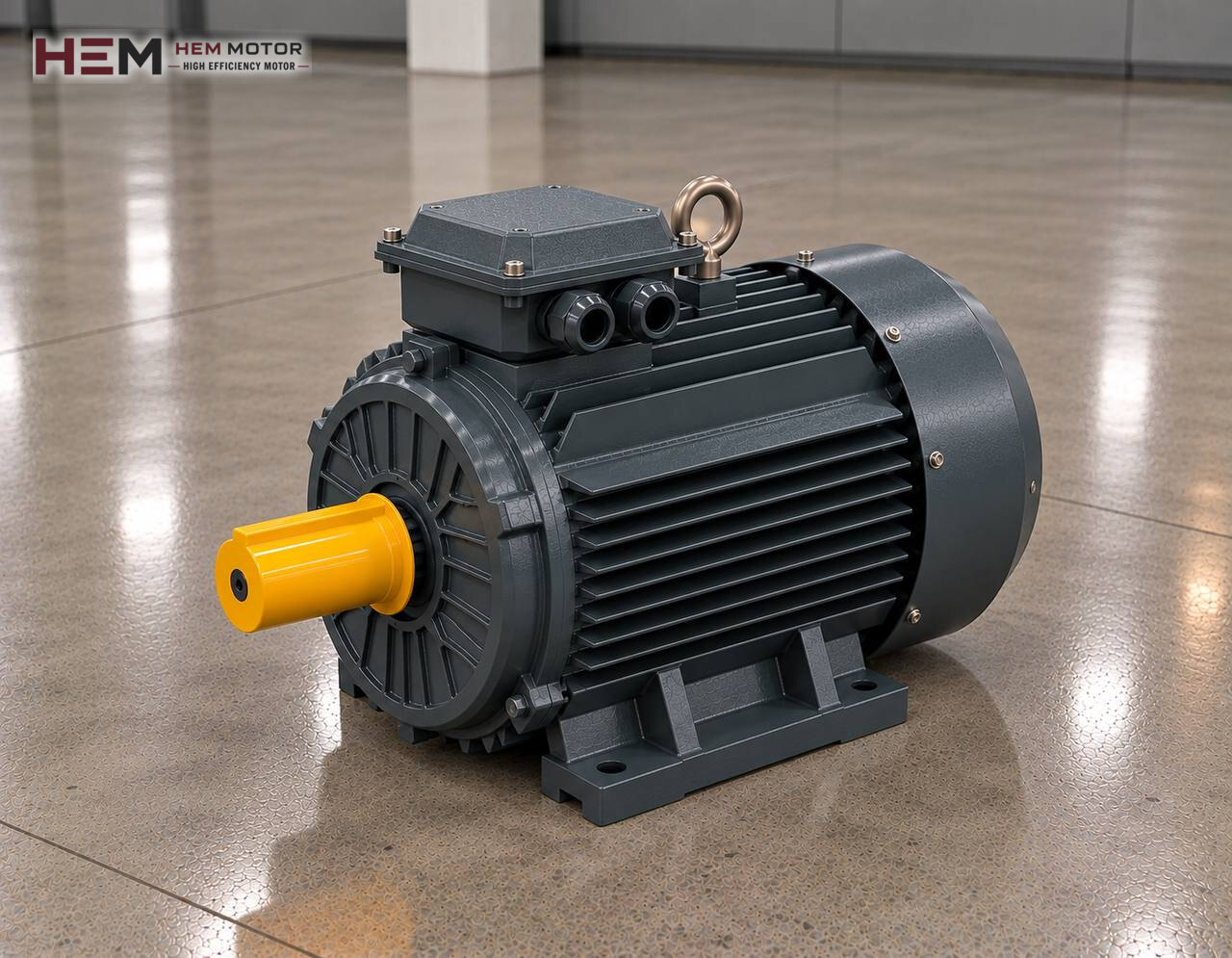
Lines that carry cartons, pallets, crates or sheet bundles one by one usually rely on driven rollers or chains instead of a belt. This page covers the three-phase motor that drives roller and chain conveyors; for the general picture of belt, screw and bucket conveyors, see the conveyor belt electric motors page.

What do roller and chain lines carry differently?
A belt conveyor moves bulk material as one continuous stream. Roller and chain lines handle the load piece by piece: every pallet or carton is a separate mass, it enters the line at intervals and is often stopped at a station. The motor therefore deals with discrete loads whose weight and number keep changing, not with a smooth flow.
On the chain side there are two distinct families. Pallet and slat chain conveyors carry the product on top of the chain; drag chain (en-masse, redler type) conveyors pull bulk material such as grain, ash or wood chips through an enclosed trough with chain flights. In the second case the load is continuous and friction in the trough consumes most of the motor power.
Drive layouts: chain and sprocket, line shaft and zone motors
On driven roller conveyors the most common layout links the sprocket at the end of each roller to the next one with a short chain; a single geared motor at the start of the zone turns all the rollers together. On light carton lines the rollers may be connected to a longitudinal line shaft with O-belts. In both cases one motor usually drives a zone a few metres long, and long lines are divided into several zones.
Motorised rollers with a low-voltage motor built into the roller tube are a separate product and are not part of the HEM Motor 2026 catalogue. The advice here applies to the standard three-phase motor that drives a zone through a gearbox.
On a chain conveyor the motor turns the head sprocket shaft. With a sprocket that has few teeth, the chain speeds up and slows down as it wraps around it; this polygon effect reaches the gearbox and the motor as a small but regular torque ripple. On long chains, maintaining the take-up therefore also affects motor life.
Accumulation, stop-start and positioning load
On pallet lines the product is often accumulated in front of a station. With friction (slip-clutch) rollers the motor keeps running while the blocked pallet slips and waits; the motor is not idling during this time but carries a steady load that covers the friction of all slipping loads. With zero-pressure accumulation each zone stops and starts with its own motor, and the number of starts per hour rises noticeably.
With frequent starts, winding heat can matter more than the continuous load. Get the number of starts and the load at each start from the machine builder; for zones with very frequent starts a PTC winding sensor can be requested with the order. Smooth acceleration matters so that pallets do not tip and cartons do not slide; a frequency inverter provides this with a ramp and matches the speed of neighbouring zones.
If a pallet must be held at a certain point on an inclined chain line or at a station, holding is solved with a brake or a backstop arrangement in the gearbox. Brake motors are not in the 2026 catalogue; define this requirement together with the machine builder.
Gearbox and how the motor is connected
Because roller speeds are low, the motor almost always runs with a gearbox. Shaft-mounted helical-bevel or worm gearboxes are common in zone drives; the motor sits directly on the gearbox input flange. The motor's B14 or B5 flange and shaft diameter must therefore match the gearbox input exactly. Foot-mounted B3, foot-and-flange B34/B35 and vertical positions are also available depending on frame size; we confirm flange and shaft dimensions together with the order. The ratio and output torque are the machine builder's calculation; for the motor side, the electric motors for reducers page will help.
Warehouse, cold room and dusty trough
In logistics warehouses the environment is clean, but motors often sit under racks where air hardly moves; the front of the fan cover must not be blocked. In cold stores the motor is prone to condensation when idle; an anti-condensation heater is an order option. In drag chain troughs dust settles on the motor fins and needs regular cleaning. HEM motors are IP55; a standard motor is not designed for food lines washed with pressurised water, so in that case the machine builder's protective measure or a special motor is needed and must be stated with the order.
In zones that run at low speed with full torque for long periods on an inverter, cooling from the shaft-mounted fan drops and a separately powered fan may be needed. If the motor-to-inverter cable is long, a dv/dt or sine filter is considered. Please state these conditions with the order; details are on the inverter compatible motors page.
Example HEM models
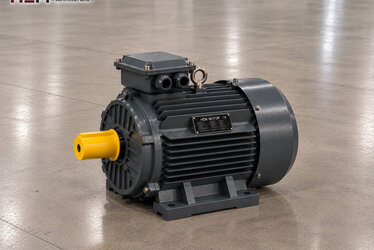
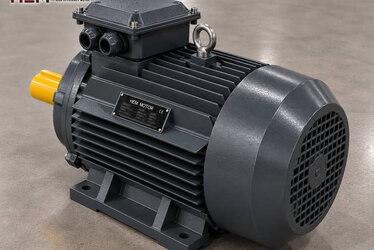
Roller and chain zone drives are mostly low-power, and a 4-pole motor matches the gearbox input well. For light carton zones the 0.75 kW aluminium 80M2-4 (1,420 rpm, 5.04 Nm), for pallet zones the 1.5 kW aluminium 90L-4 (1,445 rpm, 9.91 Nm) or the 3 kW aluminium 100L2-4 (1,450 rpm, 19.8 Nm) can serve as examples. If a heavier drive is needed on a drag chain bulk trough, the 5.5 kW cast iron 132S-4 (1,460 rpm, 36 Nm) is one of the models worth checking.
| Conveyor type | Motor load | Value to check when ordering | Example HEM model |
|---|---|---|---|
| Line-shaft light carton conveyor | Light, continuous rotation | Line shaft speed, number of belts | 80M2-4, 0.75 kW |
| Chain-and-sprocket driven pallet roller | Discrete heavy load, frequent starts | Starts per hour, PTC | 90L-4, 1.5 kW |
| Friction accumulation zone | Steady friction of slipping pallets | Number of accumulated pallets | 100L2-4, 3 kW |
| Slat chain conveyor | Chain pull, polygon effect | Sprocket teeth, take-up | 100L2-4, 3 kW |
| Drag chain (redler) trough | Continuous bulk load, trough friction | Capacity, trough length | 132S-4, 5.5 kW |
The models in the table are examples; the final selection depends on the machine load, required speed, mounting and operating conditions.
Information needed for a quotation
Send us the machine type on your line (roller, slat chain, drag chain), the motor power per zone (kW), speed (rpm), supply voltage, mounting arrangement, gearbox input flange and the quantity you need. If a motor is being replaced, sending a photo of its nameplate speeds things up. All models and current prices are on the shop page; for WhatsApp or phone, use the numbers on the contact page.
Frequently Asked Questions
Can several roller zones be driven by one motor?
On short lines, zones chained to one another can run from a single motor. If the zones must stop and start independently, each gets its own geared motor; the choice depends on the line's accumulation logic.
Which number of poles is common on roller conveyors?
Because zone gearboxes are mostly selected for a 1,500 rpm input, a 4-pole motor is common. The input speed on the existing gearbox nameplate should be kept.
Why does the motor on a roller line get hot?
Frequent stop-start, a constantly slipping load in friction accumulation or long running at low speed on an inverter are the most likely causes. The number of starts, the current drawn and the inverter speed should be checked together.
Can a single-phase motor be used on a small workshop line?
Where no three-phase supply is available, the 0.18–5.5 kW single-phase series can be considered; details are on the single-phase electric motor page.