English
 Français
 Türkçe
 Español
 Русский

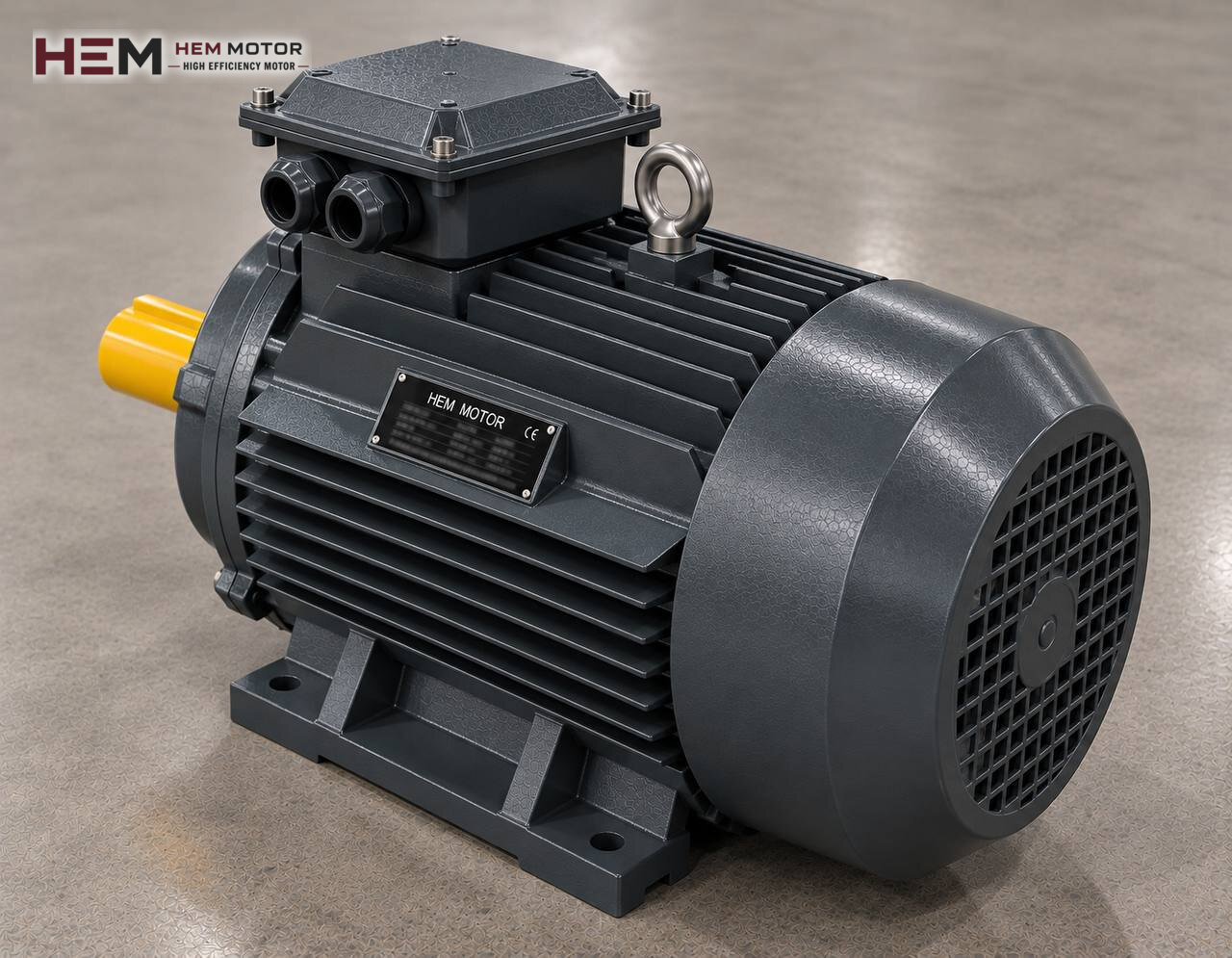
A bucket elevator lifts bulk materials such as grain, feed, cement, clinker and aggregate using buckets fixed to a belt or chain running inside a vertical casing. What sets it apart from other conveyors is that almost all of the motor's work is raising the material. This page explains the motor that turns the elevator's head pulley; the general overview covering belts, screws and elevators together is on the conveyor belt electric motors page.

How does an elevator work?
Material arriving at the bottom of the elevator (the boot) fills the buckets as they pass round underneath. The buckets rise and, as they turn around the head pulley, throw the material into the discharge chute by centrifugal force or by gravity. Empty buckets travel down the return leg to the boot. The drive is always at the top, on the head pulley; the boot pulley acts as the take-up.
There are two main types: in centrifugal discharge elevators the buckets are spaced and run at relatively high speed; they are common for free-flowing materials such as grain and feed. In continuous (positive) discharge elevators the buckets are adjacent and the speed is low; they are preferred for fragile or abrasive materials and heavy duty. The carrying element may be a belt or a chain; chain elevators stand out for hot and coarse material.
Most of the motor load is lifting
In an elevator, the power requirement comes essentially from the hourly capacity multiplied by the lift height. Added to this are the buckets digging material in the boot (filling resistance) and friction in pulleys, bearings and chain. In an elevator whose height doubles, the power needed for the same capacity also roughly approaches double; this is why an elevator motor is markedly larger than that of a belt carrying the same tonnage horizontally.
The type of material also matters. Dense and coarse material in the boot makes bucket filling harder; wet or sticky material stays in the buckets and adds weight on the return leg. Exact power is set by the elevator manufacturer's calculation; on an existing plant, the nameplate of the running motor is the most reliable reference.
Starting with full buckets and running back
The most dangerous moment for an elevator is a power cut while running loaded. Buckets on the rising leg are full, those on the descending leg are empty; when the drive stops, this imbalance tries to turn the belt or chain backwards. An elevator that runs back dumps material into the boot and chokes it. This is why elevators have a backstop connected to the gearbox or head shaft. The backstop is part of the machine; on the motor side, it is necessary to check that the direction of rotation is connected correctly at commissioning, as running in reverse can damage the backstop.
A start may also have to be made with full buckets and a choked boot. If the boot is full, the buckets try to pull themselves out through the material and the motor is strained well above rated torque. A soft starter reduces the shock but may not provide enough torque in a choked boot. The right starting method should be evaluated together with the elevator height, bucket arrangement and the plant's supply conditions.
Head drive arrangement and mounting
The motor and gearbox sit at the highest point of the elevator, often on a narrow platform. Two layouts are common: the gearbox is mounted on the head shaft and the motor is connected to the gearbox by its flange; or the motor stands on a foot base and is connected to the gearbox by a coupling. Large elevators may have a separate auxiliary (inching) drive for slowly turning the buckets during maintenance.
HEM motors are supplied, depending on frame, in foot-mounted (B3), flange (B5, B14) and foot-and-flange (B34, B35) designs; flange and shaft compatibility with the gearbox input is checked in the order. For the gearbox side see the electric motors for gearboxes page, and for the foot/flange combination the B34 and B35 foot-and-flange motors page.
Dust, height and monitoring at the elevator head
The elevator head is where dust concentrates; flour, feed or cement dust raised during discharge sticks to the motor fins. IP55 protection limits dust ingress, but the frame must be kept clean for cooling. Ex/ATEX motors for zones with a dust explosion risk in grain and flour plants are not included in HEM Motor's 2026 catalogue; if there is such a zone classification, tell us in your order.
If the elevator head is outdoors, a rain cover and an anti-condensation heater should be considered. A PTC/PT100 sensor for winding temperature is an order option. On elevators, belt slip or breakage is detected by monitoring motor current and with a speed (rotation) sensor; these sensors belong to the machine's controls, but current monitoring gives early warning of a choked boot.
HEM model examples for the elevator head
4-pole cast iron motors used with a gearbox are common on elevator drives. On a small feed elevator, the 5.5 kW 132S-4 delivers 36 Nm at 1,460 rpm. On a medium-height grain elevator, the 11 kW 160M-4 produces 71.7 Nm at 1,465 rpm. On tall, heavy cement or clinker elevators, frames such as the 22 kW 180L-4 and 45 kW 225M-4 come into question; the 225M-4 delivers 289.4 Nm at 1,485 rpm and draws 80.2 A at 400 V.
| Elevator type | Load characteristic | What to check | Example HEM model |
|---|---|---|---|
| Small feed elevator | Free-flowing material, centrifugal discharge | Gearbox ratio, dust | 132S-4, 5.5 kW |
| Grain elevator | Continuous lifting, medium height | Backstop, starting | 160M-4, 11 kW |
| Cement elevator | Dense, abrasive material | Loaded start, boot blockage | 180L-4, 22 kW |
| Tall chain clinker elevator | Heavy, hot, coarse material | Starting method, auxiliary drive | 225M-4, 45 kW |
The examples are for guidance only; the motor is determined by the elevator's real capacity, height, pulley speed, connection type and environment.
What should you write when asking for a quote?
State which plant the elevator is in, the material it carries, its height and whether it is belt or chain type. Then add the motor power (kW), speed (rpm), supply voltage, mounting type, gearbox connection and quantity. If it is replacing an old motor, share a photo of its nameplate.
Current prices of the models are on the buy electric motors page. You can reach us by WhatsApp or phone using the numbers on the contact page.
Frequently Asked Questions
Why do the buckets run back when the elevator motor stops?
Full buckets on the rising leg are heavier than empty buckets on the descending leg. If there is no backstop or it is faulty, the belt runs back. The backstop is part of the machine; checking it should be included in elevator maintenance.
Is it right to restart the motor when the boot is choked?
No. First the material in the boot should be cleared, then the elevator should be started empty or lightly loaded. Repeated start attempts with a choked boot heat the winding and strain the belt or chain.
Can the elevator speed be changed with an inverter?
Our three-phase motors can be driven by an inverter. However, on a centrifugal discharge elevator speed affects how cleanly the buckets discharge; any speed change should be agreed with the elevator manufacturer. If there will be long running at low speed and a long cable, state it in your order.
Which frame suits the motor at the elevator head?
At a dusty, vibrating elevator head, a cast iron frame is the common choice. On small, light elevators an aluminium frame up to 11 kW can also be chosen; the decision depends on the platform, gearbox and ambient conditions.