English
 Français
 Türkçe
 Español
 Русский

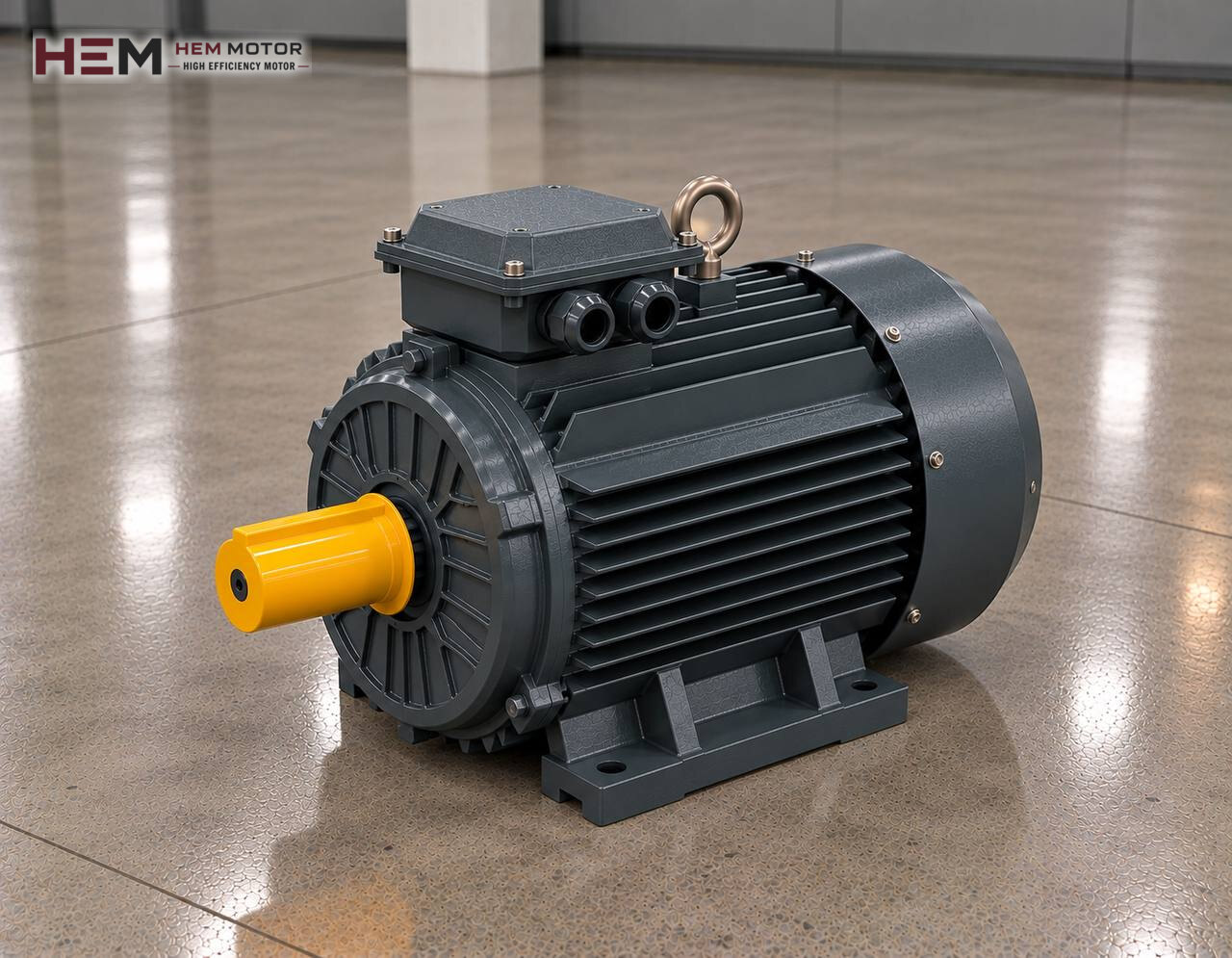
A heat recovery unit is a ventilation unit that transfers heat from the exhaust air leaving a building or production area to the fresh air being drawn in. There are plate heat exchanger, rotary wheel and run-around coil types; all have two separate airflows, and each airflow is moved by at least one fan. This page covers the three-phase motors that drive the fans of these units used in industrial and commercial facilities such as factories, warehouses, sports halls, swimming pools, canteens and office buildings. For the whole sector, see the HVAC sector electric motors page.

Two Airflows, Two Fans: Which Part Does the Motor Turn?
Inside the unit there is a supply (fresh air) fan and an extract (exhaust) fan. The motor turns the impellers of these fans either directly on its own shaft or via a belt and pulleys. The heat exchanger, filters, dampers and controls are parts of the unit itself; the motor takes over none of their tasks. Rotary wheel units also have a small drive that turns the wheel slowly; this drive is often a small geared motor or stepped motor specific to the unit, and replacing it with a standard motor depends on the unit manufacturer's approval.
This article does not cover small domestic, wall-mounted heat recovery units or air conditioner spare parts. Our subject is plant-type units installed for large airflows, whose motor can be reached through a service door.
Telling Standard Induction Motor Units from EC Fan Units
In a significant share of compact heat recovery units produced in recent years, fan and motor come as a single part: external rotor, electronically commutated (EC) plug fans. These fans are made together with their own electronics and cannot be replaced by a standard IEC frame motor; these EC motor compact fan assemblies are not included in HEM Motor's 2026 catalogue.
The standard three-phase motor belongs in units where the fan impeller sits on a separate shaft or directly on an IEC motor shaft. These are generally seen in larger, modular-casing units: belt-driven centrifugal fans or plug fan impellers directly coupled to the motor. The easiest way to tell which type you have is to look at the motor nameplate. If it shows an IEC frame code (e.g. 112M, 132S), number of poles and 400 V three-phase values, it is a standard induction motor; if it shows only a fan model, control inputs and electronic values, it is most probably an EC fan.
Where Do You Find Fan Power and Speed?
The power the fan needs depends on airflow and on the total pressure the fan must overcome. In a heat recovery unit this pressure includes, alongside the duct system, the resistance of the heat exchanger, filters and dampers. As filters get dirty the resistance rises; the design is usually made for the dirty-filter condition. These data come from the unit or fan manufacturer. On an existing unit, the motor nameplate and, if present, the fan nameplate are the most reliable source.
Speed varies with the impeller type. In directly coupled plug fans, motor speed equals fan speed; so the number of poles cannot be chosen differently from the value set by the fan manufacturer. In belt-driven fans, fan speed is set by the ratio of pulley diameters, and the motor is usually four-pole. As fan power changes roughly with the cube of speed, even a small speed difference noticeably changes motor load; this ratio is an approximate rule and depends on the system's characteristics.
Nor is it necessary for the supply and extract fans to have the same power. Because filter, duct and heat exchanger resistances can differ in the two airflows, the motor ratings of the two fans may differ; check each separately.
Motor Dimensions Inside the Casing and Connection Checks
In a heat recovery unit the motor is placed inside a tight casing, often on a fan slide rail or tensioning rail. Before replacement, the IEC frame size is the first point of comparison; then the following are checked:
- Mounting arrangement: on belt-driven fans usually a foot-mounted (B3) motor and slide rail; on directly coupled plug fans a flange or foot-and-flange version
- Foot hole spacing and adjustment travel on the slide rail
- Shaft diameter, shaft length and key; fit with the impeller or pulley hub
- Orientation of the terminal box; whether the cable entry fits in installations very close to the casing wall
- Voltage, connection and rated current; the protection setting in the unit's own panel
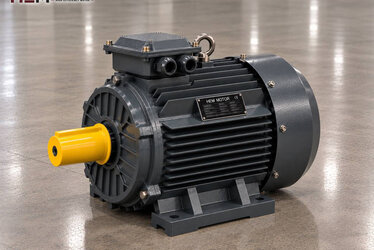
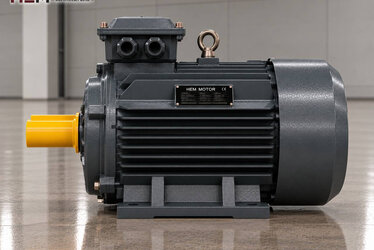
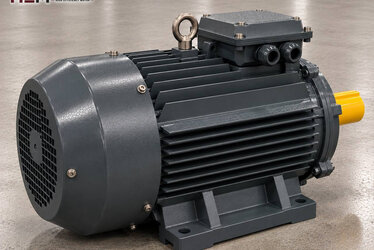
HEM Motor offers three-phase motors in B3, B5, B14, B34, B35 and vertical versions depending on frame; flange and shaft dimensions are confirmed when ordering. For general dimensions by frame, see the frame size table article.
The Nature of the Exhaust Air and the Motor's Environment
The motor often sits inside the airflow, on the suction or discharge side of the fan. So the ambient temperature is not just that of the plant room but that of the air the motor is in. The motor on the supply side runs with cold outdoor air in winter, while the one on the extract side runs with warm and sometimes humid air leaving the building. Catalogue values apply to ambient temperatures from −15 to +40 degrees and altitudes up to 1,000 m; if outdoor air falls below this range or the motor sits in heated air, state this in the order.
The content of the exhaust air also matters. In indoor swimming pools and laundries the exhaust air is very humid and may carry chlorine or chemical vapour; canteens and industrial kitchens have grease vapour; some production areas have dust. Our motors are IP55 protected with class F insulation; this protection is not specifically designed for running in continuously saturated, chemical-laden or greasy air. If such exhaust air is involved, solutions such as moving the motor out of the airflow are the unit manufacturer's decision; share the situation in the order. In areas with solvent vapour or an explosive atmosphere a standard motor cannot be used; Ex-certified motors are not included in HEM Motor's 2026 catalogue.
To prevent the heat exchanger freezing in winter, some units reduce the supply fan's speed or stop the fan for short periods. This mode means the motor makes long stops in cold air; an anti-condensation heater against moisture inside the housing can be added as an order option.
Airflow Control, Frequency Converter and Belt Arrangement
In heat recovery units, airflow is usually adjusted by a frequency converter; an occupancy sensor, carbon dioxide sensor or time schedule changes fan speed. Keeping supply and extract fans balanced matters for building pressure, and the unit's controls establish that balance. Our three-phase ranges can be used with a converter; for long periods at low speed with full torque a separate fan may be needed, and if the cable between motor and converter is long, a dv/dt or sine filter is assessed. Since load also falls at low speed in fan applications this situation is rare, but converter operation should still be stated in the order. Details are on the inverter-compatible motors page.
On belt-driven fans, pulley alignment and belt tension are readjusted when the motor is changed. An over-tight belt wears the motor bearing, a slack belt wears the belt. If the pulley ratio is changed, fan speed and therefore motor load change too; such a change should be made according to the unit manufacturer's data. For a general look at fan applications, the centrifugal fan electric motor page is useful.
Example Fan Motors by Unit Type
| Unit and fan arrangement | Example HEM model | Point to check |
|---|---|---|
| Small-capacity unit, belt-driven centrifugal fan | 1.1 kW 90S-4 (1,445 rpm, aluminium) | Slide rail adjustment travel, pulley hub |
| Medium-capacity unit, directly coupled plug fan | 4 kW 112M-2 (2,905 rpm, aluminium) | Fan speed, shaft-impeller connection |
| Large modular unit, belt-driven fan | 11 kW 160M-4 (1,465 rpm, cast iron) | Belt tension, converter setting |
The models in the table are examples, not a final selection; suitability is verified separately taking into account fan data, speed, dimensions inside the casing and the nature of the exhaust air.
Information to Send When Replacing a Fan Motor
The best start for a replacement is a legible photo of the motor nameplate; add the unit's own nameplate if needed. How to take the photo is explained on the send motor nameplate page. You can send the information via WhatsApp; the numbers are on the contact page.
- Photo of the motor nameplate: power, speed, voltage, current and frame code
- Whether the motor to be replaced is on the supply or extract fan
- Fan arrangement: belt-driven or directly coupled plug fan
- Mounting type, shaft diameter and space constraints inside the casing
- Nature of the exhaust air: humidity, grease vapour, dust or chemicals
- Whether it runs with a converter, and the cable length
- Quantity; whether both fans will be changed together
Motor Groups You Can Explore in the Shop
You can find all models on the buy electric motors page. For the small and medium powers used in most heat recovery units, see the aluminium frame motors category, and for large modular units the cast iron frame motors category. The products linked in the table are examples; suitability for your unit is verified separately. For similar fan units, the air handling unit fan motor page can also help.
Frequently Asked Questions
Can I fit a standard motor in place of the EC fan in my unit?
It cannot be replaced directly. EC fans contain motor, impeller and electronics as a single part. Switching to a standard motor means changing the fan impeller and the control as well; that decision belongs to the unit manufacturer.
Must the supply and extract fan motors be the same?
They do not have to be. Because resistances in the two airflows can differ, the motor powers can also differ. Assess each motor according to its own nameplate.
Is a standard motor also used for the motor that turns the rotary wheel?
Wheel drives are generally small motor arrangements specific to the unit. Replacing one with a standard motor requires the unit manufacturer's approval; if you send a nameplate photo, we can assess it together.
Does a fan motor running in pool exhaust need extra precautions?
Pool exhaust is very humid and may carry chlorine. An IP55 motor is not specifically designed for continuous operation in this environment; measures such as moving the motor out of the airflow should be discussed with the unit manufacturer and stated in the order.