English
 Français
 Türkçe
 Español
 Русский
 العربية

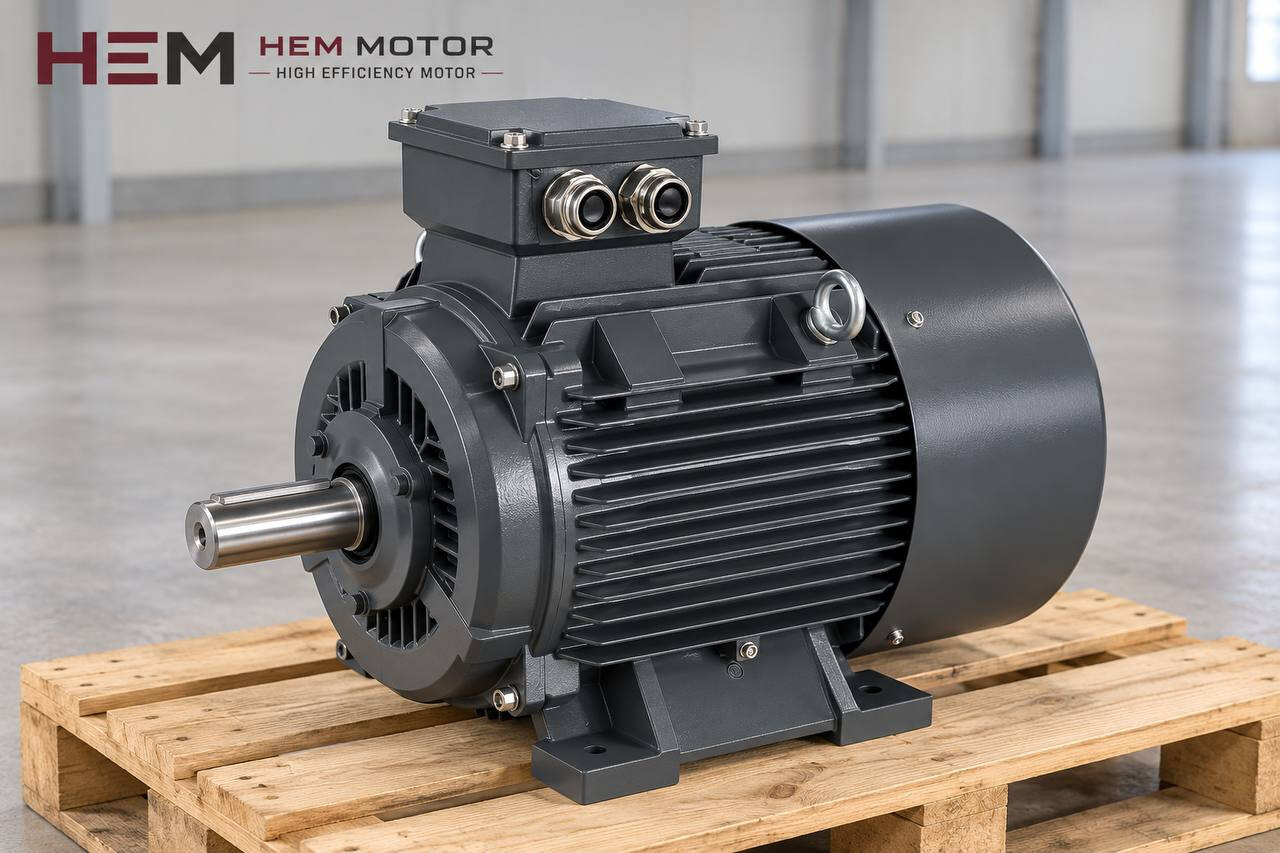
In a centrifugal (radial) fan the impeller moves the air and the scroll housing collects it and turns it into pressure; the power that spins the impeller comes from a three-phase asynchronous electric motor. This page covers the motor side of the job: load, connection and protection. For an overview of the other types, such as axial, burner and jet fans, the Fan and Extractor Motors page is a good starting point.

Radial Impeller and Scroll: What Load Does the Motor Carry?
Air enters the impeller eye axially, is flung outwards between the blades and slows down in the widening section of the scroll, gaining pressure. Because it delivers much higher pressure than an axial fan at the same flow, this design is chosen for systems with filters, long ducts or cyclones.
The motor sees two kinds of load: the shaft power needed to push the air and the rotational inertia of the impeller mass. The first sets the current in continuous operation, the second sets the starting time. Shaft power rises roughly with the cube of speed; this is an approximate rule that depends on system resistance, and the exact value comes from the fan curve.
Our similarly named centrifugal pump electric motor page deals with pumps that move liquids; here the subject is fans that move air and gas.
How Does Blade Type Change the Power Curve?
Each blade geometry loads the motor differently; the extreme points in operation matter as much as the design point.
Forward-curved blades
Many short blades curved towards the direction of rotation give high flow from a small housing. The critical feature is that absorbed power keeps rising as flow increases. A trial run without ducting, a removed filter or a fully open damper pushes the fan to the right-hand end of its curve and the motor can be overloaded. The motor is assessed for the lowest-resistance operating condition.
Backward-curved blades
The blades lean against the direction of rotation. The power curve peaks at a certain flow and then falls; if the motor is selected for this peak, no overload occurs. Common in extraction and process air.
Radial (straight) blades
The blades run straight out from the hub; they resist dust build-up and wear and are used on lines that convey material. Power rises with flow and the impeller is often heavy, so overload and long starting have to be considered together.
Impeller on the Shaft, or Belt and Pulleys?
In a direct-drive arrangement the impeller sits on the motor shaft or on a fan shaft joined by a coupling, and fan speed equals motor speed; on a 50 Hz supply it stays in the 3000, 1500 or 1000 rpm class with 2, 4 or 6 poles. If the impeller is mounted directly on the shaft, its weight and residual unbalance fall on the motor bearings; the shaft end and keyway must match the fan manufacturer's drawing.
In a belt-driven arrangement the pulley ratio sets the fan speed: fan speed is roughly motor speed × motor pulley diameter ÷ fan pulley diameter, slightly lower because of belt slip. Fine-tuning the flow becomes easy, but belt tension adds a radial force to the motor shaft. Fitting the pulley close to the shaft shoulder, not over-tensioning the belt and not choosing a very small motor pulley protect the bearings; if a high radial load is expected, state it in the order.
Depending on frame size, foot (B3), flange (B5, B14), foot-and-flange (B34, B35) and vertical (V1, V3, V5, V6, V15) versions are available; we confirm flange and shaft dimensions together with you at order stage. Foot-mounted frames are common on belt-driven fans, foot-and-flange B34/B35 frames on fans whose impeller hangs from the flange.
Heavy Impeller, Long Start: Starting Method and Overload Setting
The inertia of a large steel impeller can be many times that of the rotor; the motor draws high current until it brings this mass up to rated speed, and starting takes longer. If this time is ignored, the overload relay trips during starting or the winding heats more than necessary at every start.
- Star-delta reduces starting current, but because torque also drops, the changeover moment needs careful setting with a heavy impeller.
- Soft starter limits current and torque with a ramp; the ramp time is set according to impeller inertia.
- Frequency inverter manages both starting and operating speed. Our three-phase motors can be driven by an inverter; long operation at low speed with high torque may call for a separate cooling fan, and a long motor cable may call for a dv/dt or sine filter. Tell us about these in your order; for details see inverter-compatible electric motors.
A centrifugal fan absorbs least power with its inlet damper closed; starting with the damper closed eases acceleration but does not change the inertia. The overload relay is set to the rated current on the nameplate and its trip class is chosen to suit the starting time. On fans with frequent stops and starts, PTC/PT100 winding sensors can be added at order stage. For protective devices, see our article on thermal relay and fuse selection.
The Motor on Dust Collection and Extraction Lines
In bag-filter dust collection systems the fan usually sits on the clean-air side of the filter. As the bags load, resistance rises and flow falls; right after cleaning the fan draws more air. With forward-curved or radial blades this means current rises after cleaning; the motor is assessed for both the clean and the loaded filter.
On sawdust, grinding dust or granule lines where the fan runs on the dirty-air side, material building up on the impeller creates unbalance and the vibration reaches the bearings through the shaft; regular impeller cleaning protects the motor too. In areas classified as explosive dust atmospheres, a standard IP55 motor is not designed for this condition; a special motor is required, state it in the order.
Fans Handling Hot Gas (ID Fans) and the Temperature Limit
Induced-draught (ID) fans on boiler, drying and kiln lines draw flue gas. The motor stays outside the gas stream, but heat travels towards it along the impeller and shaft; the fan manufacturer cuts this off with a cooling disc on the shaft and a separate bearing housing. A standard IP55, class F motor is not designed to run inside hot gas; tell us the motor's ambient temperature in your order.
Because hot gas is light, the fan absorbs little power in operation; at a first start with cold air, however, power rises markedly and the motor is checked for this condition. Applications requiring a certified motor for smoke extraction in a fire are a separate class; a standard motor is not designed for that class.
Selection Table by Blade Type and Drive Arrangement
| Blade type / drive arrangement | What it means for the motor | Watch in selection | Order information |
|---|---|---|---|
| Forward-curved blades | Power rises as flow increases | Power with damper open, without filter | Fan curve, lowest-resistance condition |
| Backward-curved blades | Power curve peaks, overload limited | Peak power, continuous duty | Design point, speed |
| Radial (straight) blades | Heavy impeller, power rises with flow | Starting time, unbalance from wear | Impeller inertia or weight, starting method |
| Direct drive | Fan speed equals motor speed | Number of poles, impeller load on bearings | Shaft end and flange dimensions, mounting |
| Belt and pulley | Speed set by pulley ratio | Radial load, pulley diameter and position | Pulley diameters, belt type, shaft end |
The rows in the table are for pre-selection; the final decision rests on the fan curve, required speed, connection type and operating conditions. For example, on belt-driven extraction fans the 15 kW 160L-4 (1,465 rpm) or 18.5 kW 180M-4 (1,470 rpm), and on large dust collection fans the 45 kW 225M-4 (1,485 rpm) can be considered.
What We Need for a Quotation
To prepare a quotation we need: the type of machine or plant and the fan's blade type, the required power (kW) and speed (rpm), supply voltage, mounting arrangement, drive type (direct or belt), starting method and the quantity required. Photographing and sending the nameplate of the old motor speeds things up; how to take it is explained in our motor nameplate article.
Prices for all models are in the buy electric motors section; motors in stock are dispatched from our warehouse in Turkey. For building ductwork see our ventilation motors page, and for project questions our contact page.
Frequently Asked Questions
Why does the motor trip on overload when the fan runs without ducting?
On forward-curved and radial-blade fans, flow and absorbed power rise as resistance falls. A trial without ducting or filter takes the fan to the right-hand end of its curve and the motor exceeds its rated current. Do the trial with the damper throttled.
Is changing the pulley enough to raise the speed of a belt-driven fan?
Speed rises, but power rises roughly with the cube of speed. Even a small speed increase can take the motor above its rated power; before changing the pulley, check the motor power and the fan's maximum permitted speed.
Why does a fan with a large impeller take so long to start?
The impeller's inertia is much greater than the rotor's; the motor draws high current for a long time while accelerating this mass. The starting method and the trip class of the overload relay are chosen for this time.
Can a standard motor be fitted to a fan drawing hot flue gas?
Yes, if the motor stays outside the gas stream and is protected by the fan manufacturer's heat barrier; state the ambient temperature in your order.