English
 Français
 Türkçe
 Español
 Русский

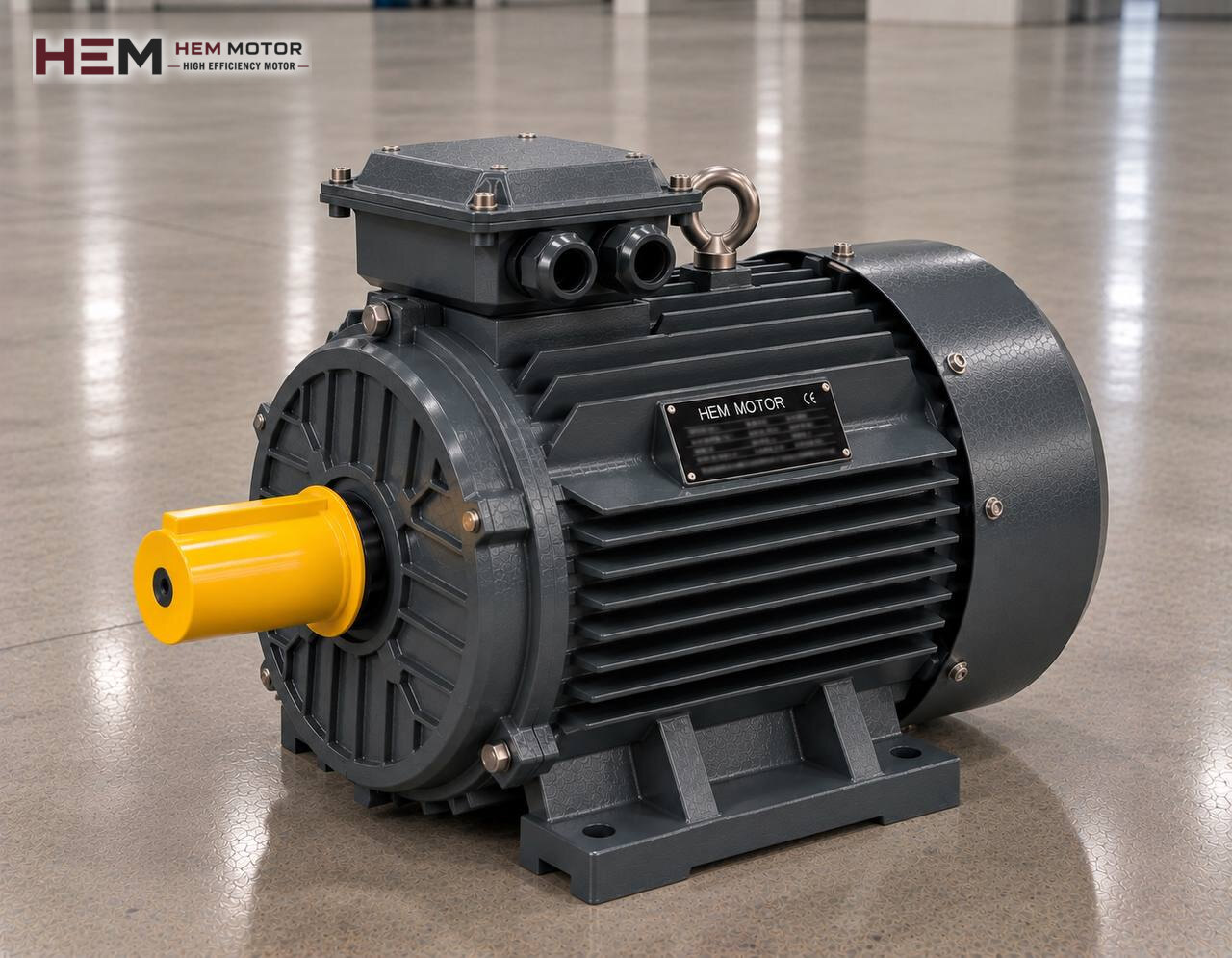
A plug fan is a centrifugal impeller without a scroll housing, placed in an open chamber (plenum) inside an air handling unit or ventilation cabinet. Because the impeller sits directly on the motor shaft, the motor does more than supply power here: it carries the impeller and fixes its speed. An overview of all fan types is on the fan and extractor motors page; this page deals only with the conditions specific to the motor that drives a plug fan.

An Impeller Without a Housing: The Loads the Motor Carries
In a scroll fan the air is collected in a spiral casing around the impeller and leaves through a single outlet. A plug fan has no such casing: the impeller throws the air drawn through the inlet cone outwards all around it into the chamber, and the chamber behaves like a pressure box. For the unit designer this makes it possible to take the duct connection in any direction and to shorten the cabinet.
On the motor side three separate loads come together. The first is the torque the impeller needs for moving air. The second is the impeller's weight: since the wheel hangs on the shaft end, the motor's drive-end bearing carries a constant radial load. The third is the impeller's inertia; a large backward-curved plug fan wheel strains the motor for a noticeable time while accelerating. That is why impeller diameter and weight matter as much as the kW figure in motor selection and should always be requested from the fan maker.
Speed Is Set by the Drive, Not by a Pulley
In a belt-driven cabinet fan the operating point is adjusted by changing pulleys. A plug fan has no pulley, so the impeller turns at motor speed; on a 50 Hz supply that speed follows from the number of poles. For example, our 4-pole 112M-4 model runs at 1,450 rpm under load and our 2-pole 100L-2 model at 2,895 rpm. The impeller speed required by the design often falls somewhere between these two values.
For this reason plug fans are almost always run from a frequency converter: at commissioning the required airflow is found through the drive frequency, and in service the speed is readjusted as the filter loads up or the building's demand changes. The value to check when selecting the motor is the shaft power at the highest frequency the drive will reach; since fan power rises quickly with speed, even a few hundred rpm above the design speed can push the motor past its rated value. If operation above 50 Hz is planned, this and the maximum frequency must be stated clearly in the order.
Our three-phase motors can be driven by a frequency converter. Long running at low frequency with full torque is rare for plug fans, but if such operation is planned a separately supplied cooling fan may be needed; if the drive sits in a panel outside the unit and the cable is long, a dv/dt or sine filter on the motor side is considered. Details are on the inverter compatible electric motors page.
Where the Motor Sits in the Cabinet and How It Is Mounted
In a plug fan the motor is fixed on a bracket or base frame opposite the inlet side and stands in the conveyed air. Air in an AHU is usually filtered and mild, which helps the motor cool; however, the air temperature rises in a fan right after a heating coil, and humidity increases after a humidifier. The temperature and humidity range of the air reaching the motor should be stated in the order.
The connection is usually a foot-mounted (B3) motor bolted to the base frame or a flange-mounted (B5, B35) motor seated on the fan bracket. Which arrangement is available for which frame is listed on the mounting arrangements page; flange and shaft dimensions are confirmed with every order. In units where the base frame stands on anti-vibration mounts, connecting the motor cable with a flexible section, turning the terminal box towards the service door and passing the cable through the cabinet wall with a sealed gland make the job easier.
Fan Walls: Many Small Motors Instead of One Large One
In high-airflow units several small fans arranged side by side can be used instead of one large plug fan; this arrangement is called a fan wall (fan array). On the motor side the result is this: when one fan fails, the others speed up to cover part of the gap. This requires each motor to run below its rated power in normal service but to be able to go higher in the backup scenario.
In a fan wall the motors are usually chosen as the same model, which makes keeping spares easier. Whether each motor is fed by its own drive or from a common drive changes the protection and cabling layout; this information should be shared at the quotation stage. For small-wheel fan walls the aluminium frame series is often preferred for its lower weight.
Example Motors for Plug Fan Applications
| Application | Motor situation | Point to watch | Example HEM model |
|---|---|---|---|
| High-speed plug fan in a small unit | Direct drive, with VFD | Power at the highest frequency | 3 kW, 2,895 rpm, 100L-2 |
| Fan wall module | Many units of the same model | Higher load in backup mode | 4 kW, 1,450 rpm, 112M-4 |
| Medium-size supply fan | Wheel on shaft end, in the airstream | Impeller weight, bearing load | 7.5 kW, 1,460 rpm, 132M-4 aluminium |
| Large exhaust plug fan | Large wheel, long run-up | Acceleration time, protection setting | 15 kW, 1,465 rpm, 160L-4 cast iron |
The models in the table are examples; the final choice depends on the impeller's actual power demand, the required speed range, the mounting layout and the operating conditions inside the unit.
Maintenance: Balance, Bearings and Filter Monitoring
Because the wheel sits directly on the shaft, any imbalance in it goes straight into the motor bearing. Dust or dirt collecting on the impeller upsets the balance; regular cleaning and a balance check after the impeller has been removed and refitted protect bearing life. A clean seating surface between the impeller hub and the shaft, and a sound key connection, serve the same purpose.
As the filter loads up, system resistance rises; in a plug fan with a drive the control system raises the speed to keep the airflow, and the motor load grows accordingly. Recording the motor current before and after a filter change is therefore a good habit. A PTC or PT100 sensor to monitor winding temperature and, if the unit stays off for long periods, an anti-condensation heater can be added as order options.
Information Needed for a Quotation
For a plug fan motor, send us: the machine and fan type (AHU, cabinet, fan wall), the required power, the lowest and highest impeller speed, the supply voltage and whether a drive is used, the mounting type (foot or flange) and the quantity. If you are replacing an existing motor, sending a photo of its nameplate is a good start.
All models and current prices are on the buy electric motors page. Our WhatsApp and phone numbers are on the contact page.
Frequently Asked Questions
Can a plug fan motor be run above 50 Hz?
It is possible with a frequency converter; however, in this range the torque the motor can deliver falls while the power the fan needs rises. The maximum permissible speed of the impeller and motor and the power needed at that speed must be calculated, and the maximum frequency written in the order.
Can the old motor be reused when converting a belt-driven cabinet fan to a plug fan?
Usually not, because in a belt drive the motor speed and the impeller speed differ. In a plug fan the motor must both have the right number of poles for the impeller speed and be able to carry the wheel on its shaft end; selection is based on the new impeller's data.
Does a plug fan motor need extra protection because it sits in the airstream?
A standard IP55 motor is suitable for filtered AHU air at normal temperature. If there is high temperature after a heater, heavy humidity after a humidifier or chemical vapour, this condition should be stated in the order; additional measures or a special motor are considered if needed.
Should each fan in a fan wall have its own drive?
This depends on the unit maker's control design. Separate drives make it easier to monitor and protect each motor individually; with a common drive, separate thermal protection is needed for each motor. Tell us which layout is chosen when requesting a quotation.