English
 Français
 Türkçe
 Español
 Русский

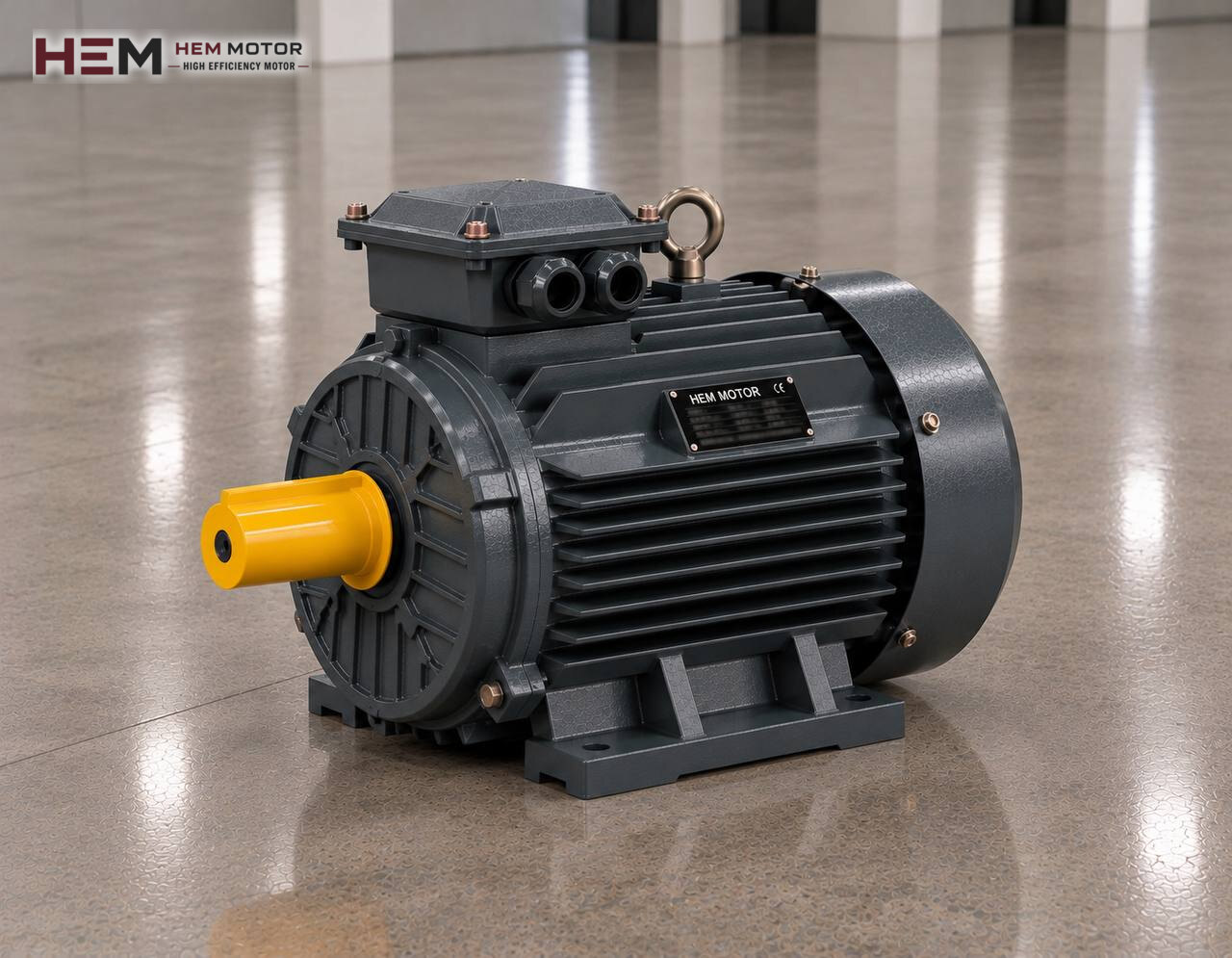
A wall-mounted axial fan is a propeller fan fitted into an opening in an outer wall or partition, usually carried on a mounting plate or square frame. These fans are expected to remove hot air from a workshop, bring fresh air into a warehouse or renew the air in a greenhouse or livestock building. The general overview of the fan family is on the fan and extractor motors page; this page explains what is different about the motor that turns a wall-mounted axial fan.

The Load a Wall Axial Fan Places on the Motor
An axial propeller pushes air parallel to the shaft axis. Because a wall fan only overcomes a short path, from one side of the wall to the other, the resistance it meets is low; in return it moves a very large volume of air. For the motor this means high airflow at low pressure and, as a result, a large propeller diameter.
The tip speed of a large propeller determines the noise. For this reason wall fans mostly use motors in the 1500 or 1000 rpm class; a 2-pole motor only makes sense for small-diameter fans that need high speed. The motor load also depends on the blade pitch: at the same diameter, a propeller with a steeper blade angle moves more air and needs more power. If the propeller is replaced or the blade angle adjusted, the motor current should be measured again against the nameplate.
Shutters, Wind and Reverse Rotation
The most important thing that separates a wall fan from a duct fan is direct contact with the outdoors. When the fan is stopped, wind outside can turn the propeller backwards. When the motor is then energised, the rotor first has to stop this reverse rotation and then accelerate in the correct direction; the starting current lasts longer than normal and the thermal protection can trip early. A gravity or air-pressure shutter reduces this risk; on wall fans without shutters, the longer start must be allowed for when setting the protection.
In systems with motorised shutters, starting the fan before the shutter is fully open runs the motor against a closed outlet. On an axial fan, running against a closed outlet does not reduce power and may even increase it; the control sequence should therefore open the shutter first.
How the Motor Is Carried and Mounted
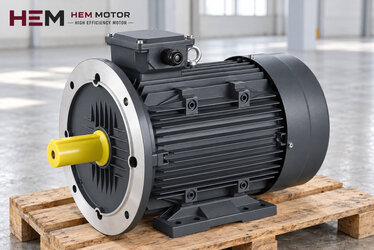
On wall fans the motor usually sits behind the propeller, fixed to arms welded to the mounting plate or to a support combined with the guard. The motor runs with a horizontal shaft and the propeller is fitted directly on the shaft end. Depending on the support design, a foot-mounted (B3) motor sits on a stand or a flange-mounted (B5, B14) motor is bolted to a ring. Which form is available for which frame can be seen on the flange-mounted electric motors page; flange and shaft dimensions are confirmed when ordering.
In some wall fans the motor is an external-rotor design built into the propeller hub; these motors do not follow standard IEC dimensions and are not in HEM Motor's 2026 catalogue. On wall fans that use a separate IEC motor, a replacement can be made once the old motor's power, speed, shaft diameter and mounting are known.
On box-type wall fans used in large buildings such as greenhouses and poultry houses, the motor is sometimes connected to the propeller by a belt; the motor then sits on a tensioning plate in a corner of the casing and the propeller turns slower than the motor. Belt tension puts a side load on the motor bearing, so it should be checked regularly.
Outdoor Conditions: Rain, Sun and Dust
The motor of a wall-mounted fan sits on the side facing outdoors or just inside the opening. A rain hood or sloped shutter on the outside of the fan is recommended so that rain does not fall straight onto the motor. The IP55 rating of our motors is designed against dust build-up and splashing water; however, it does not make the motor suitable for running permanently under water or in a place washed with pressurised water.
On a sunny façade the motor housing warms up during the day; while the propeller turns the airflow cools the motor, but on hot days when the fan stands still for long periods the housing temperature rises. In livestock buildings, ammonia and dust in the air settle on the motor surface. In these environments, keeping the motor surface and cooling fins clean, a sound terminal box gasket and a cable entry facing downwards are simple but effective measures. For outdoor fans that cool at night and warm up during the day, an anti-condensation heater, and a PTC sensor to monitor winding temperature, can be requested as order options.
Low-Power Wall Fans and the Single-Phase Option
Many wall fans need only a few hundred watts. The smallest motor in HEM's three-phase range is 0.25 kW; the 71M2-6 model runs at 855 rpm at this rating. Smaller fan motors, especially special motors integrated with the propeller and EC motors, are not in the 2026 catalogue. If the building only has a 230 V single-phase supply, our single-phase electric motors in the 0.18–5.5 kW range can be considered.
Example Motors for Wall Fans
| Fan arrangement | Motor position | Key selection point | Example HEM model |
|---|---|---|---|
| Small workshop exhaust fan | Behind the propeller, on arms | 6 poles for low noise | 0.25 kW, 855 rpm, 71M2-6 |
| Warehouse and workshop wall fan | Direct drive, flange mounted | Propeller diameter and blade angle | 1.1 kW, 945 rpm, 90L-6 |
| Belt-driven box fan (greenhouse, poultry house) | Corner of casing, on tensioning plate | Belt tension, humidity and dust | 0.75 kW, 1,420 rpm, 80M2-4 |
| Large-diameter wall fan with shutter | Direct drive, close to the façade | Starting after reverse rotation, protection setting | 1.5 kW, 949 rpm, 100L-6 |
The models are examples only; the final choice is determined by the propeller's actual power demand, the required speed, how the motor is carried and the environment the fan works in.
Order Information
For an accurate quotation for a wall fan motor, share: the machine or building type the fan serves, motor power (kW), speed (rpm), supply voltage (three-phase or single-phase), mounting type (foot, flange, belt) and quantity. A photo of the existing motor's nameplate together with the shaft diameter makes the replacement easier.
You can see our models with current prices on our shop page, and use the contact page to reach us by WhatsApp or phone.
Frequently Asked Questions
Why does the wall fan motor struggle to start in windy weather?
While the fan was stopped, the wind may have turned the propeller backwards. The motor first has to stop this rotation and then accelerate in the right direction, so the start takes longer. Using a shutter or setting the protection for the longer start reduces the problem.
If I increase the blade angle of the propeller, will the same motor be enough?
As the blade angle increases, the propeller moves more air and draws more power. Measure the motor current after the adjustment; if it exceeds the nameplate current, a more powerful motor is needed.
Can I replace a motor built into the propeller with a HEM motor?
External-rotor motors integrated with the propeller are not standard IEC motors and are not in our 2026 catalogue. Switching to a separate-frame motor depends on the fan maker's support design; in this case the whole fan is usually reviewed.
What number of poles suits a wall fan motor?
This depends on the propeller diameter and the speed it was designed for. On large propellers a low speed reduces both noise and tip speed; on small propellers 4 poles are more common. On a direct-drive fan the number of poles must match the speed given by the propeller maker.