English
 Français
 Türkçe
 Español
 Русский

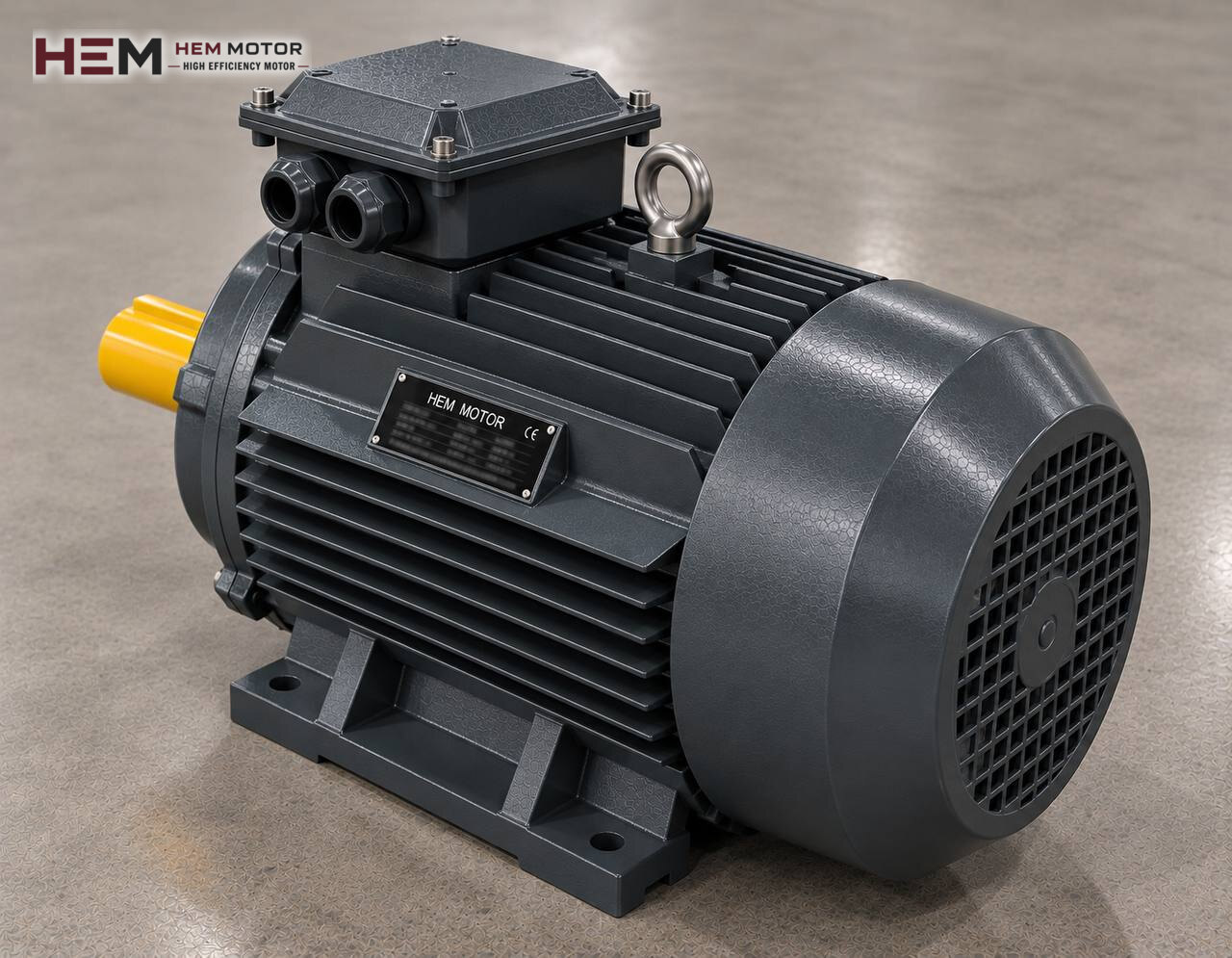
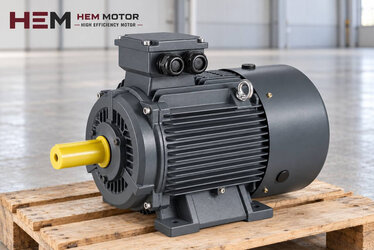
A mixed flow fan sits between the axial and the centrifugal fan. Air enters the impeller axially, is directed both forward and outward as it passes over blades mounted on a conical hub, and leaves at a diagonal angle. This gives higher pressure than an axial fan and a more compact housing, in line with the duct, than a centrifugal fan. This page covers the electric motor that drives this impeller type; for other fan types see the fan and extractor motors page.

Conical Hub and Diagonal Flow: What Does the Motor Feel?
In a mixed flow impeller the blades both push the air forward like a propeller and throw it outward through centrifugal effect. Part of the pressure comes from this outward throw, so at the same diameter and speed it produces more pressure than an axial fan. For the motor, this means the impeller can do its job on high-resistance duct systems without needing excessive speed. In practice, quiet operation is achieved with 4- and 6-pole motors, i.e. in the 1500 and 1000 rpm class.
The impeller mass is greater than that of an axial propeller and usually smaller than that of a large centrifugal wheel. The acceleration time at start-up also lies between these two extremes. Even so, on large-diameter models with cast impellers, the trip class of the thermal protection should be chosen according to the starting time.
Shape of the Power Curve and Motor Margin
On most mixed flow fans the shaft power stays relatively flat over a wide range of airflow. This means the motor load does not change sharply when duct resistance deviates slightly from the design value. However, this behaviour depends on the design; in some models power rises at low flow, in others it keeps increasing at high flow. The motor power is determined by reading the heaviest operating point that may occur in service on the fan manufacturer's curve.
When airflow is throttled too much, flow separation on the blades and unsteady running can occur, similar to axial fans. Keeping the fan in this region continuously places fluctuating loads on both the impeller and the motor bearings.
Direct Drive, Belt Drive and Bifurcated Casing Arrangements
Direct drive: In the most common arrangement the motor sits inside the tubular casing behind the impeller, and the impeller is mounted directly on the motor shaft. The motor is cooled by the conveyed air; if the air is clean and at normal temperature, this is good cooling. The shaft end and flange must suit the impeller hub and the motor support.
Belt drive: The motor is moved outside the casing onto a bracket; the impeller turns on its own shaft with bearings. Fan speed is set by the pulley ratio and the motor is separated from the airstream. Since belt tension puts a side load on the motor shaft, the pulley should be fitted close to the shaft shoulder and the motor pulley should not be chosen too small.
Bifurcated casing: Inside the casing there is a closed tunnel around which the air flows; the motor sits in this tunnel, outside the airstream, and is cooled by outside air. It is preferred for kitchen and process exhausts carrying hot, greasy or dirty air. Because the motor's cooling depends on outside air, the tunnel openings must not be blocked.
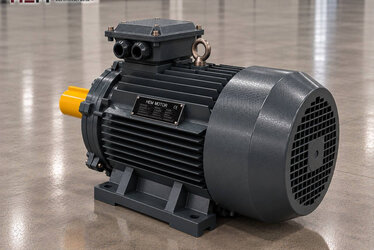
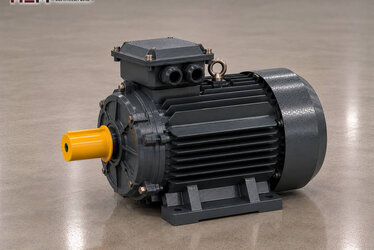
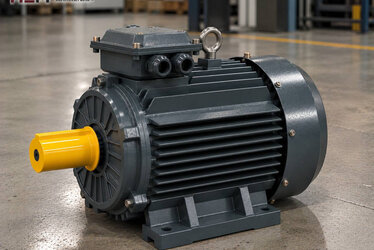
In tubular-casing fans the motor is usually fixed to the support plate by a B5 or B14 flange, and in belt-driven arrangements to the bracket by its B3 feet. Depending on frame size, B34, B35 and, for vertical installation, V1, V3, V5, V6, V15 options are also available; flange and shaft size are finalised in the order after seeing the fan drawing.
Applications and Example HEM Models
Mixed flow fans are found in in-duct ventilation, car park and kitchen exhaust, laboratory and process exhaust, and filter lines with high pressure loss. The table below gives an overview from the motor side for common arrangements.
| Arrangement / use | Motor position | Key points in the order | Example HEM model |
|---|---|---|---|
| In-duct direct-drive fan | In the airstream, behind the impeller | Flange and shaft end, air temperature | 2.2 kW, 1,450 rpm, 100L1-4 aluminium |
| Low-noise building exhaust | In the airstream, 6-pole | Speed, inverter use | 7.5 kW, 970 rpm, 160M-6 cast iron |
| Bifurcated kitchen/process exhaust | Outside the airstream, in a closed tunnel | Cooling by outside air, hot gas | 11 kW, 970 rpm, 160L-6 cast iron |
| High-resistance filter line, belt-driven | Outside the casing, on a bracket | Pulley ratio, side load on the shaft | 30 kW, 1,475 rpm, 200L-4 cast iron |
These rows are for orientation only; the final selection is made using the shaft power given by the fan manufacturer, impeller speed, drive arrangement and the condition of the conveyed air.
The Motor in Hot, Greasy or Humid Air
If a direct-drive fan conveys hot air, the motor also stays in that air and its cooling margin shrinks. That is why stating the temperature of the conveyed air in your order matters; at high temperature or in air with oil vapour, a bifurcated casing or a belt-driven arrangement may be more suitable. Fans requiring certification for smoke extraction during a fire are a separate class, and a standard motor is not offered for this duty.
For fans that stop and start while moving humid air, an anti-condensation heater against moisture in the winding, and for motors that are hard to reach inside the casing, a PTC/PT100 sensor for temperature monitoring are order options. Our IP55 motors are protected against dust and water splashes; hose cleaning, corrosive gas or an explosive atmosphere are outside this protection and require additional measures by the fan manufacturer.
Speed Control
Mixed flow fans are often used in variable-volume systems, and airflow is usually adjusted with a drive. Our three-phase motors can run on a frequency inverter. Because fan load falls quickly with speed, the motor is generally comfortable at low speed; if high torque is required at low speed for long periods, a separate cooling fan is considered, and if the cable between drive and motor is long, an output filter. Details are on the inverter-compatible electric motors page. Since fan power changes roughly with the cube of speed, check the motor power before increasing speed; the relationship is approximate and depends on the system.
What to Send for a Quotation
The machine or installation where the fan is used, the arrangement type (direct, belt-driven, bifurcated casing), the required power and speed, the supply voltage, the mounting type, the temperature of the conveyed air and how many units are needed are enough for us. You can look for an equivalent by sending the nameplate of the old motor.
Prices are on the product pages in our shop. WhatsApp and phone numbers are on the contact page.
Frequently Asked Questions
Does a mixed flow fan load the motor more than an axial fan?
Because it produces higher pressure at the same airflow, shaft power is usually higher. However, the power curve is flatter in most designs; the motor is selected for the heaviest operating point on the curve.
Why is the motor in a bifurcated casing not affected by hot air?
The motor sits inside a closed tunnel around which the air flows and is cooled by outside air. As long as the tunnel openings are kept clear, the hot conveyed air does not come into direct contact with the motor.
What matters most when replacing the motor of an in-duct fan?
Besides power and speed, check that the flange type, shaft end and key match the impeller hub. A mismatched hub upsets the balance and vibration is passed on to the motor bearings.
Are 4-pole or 6-pole motors more common on these fans?
Both are used. 4-pole motors are common on small and medium impellers, 6-pole on large-diameter fans where quiet running is required. The final decision is based on the fan manufacturer's curve.