English
 Français
 Türkçe
 Español
 Русский
 العربية

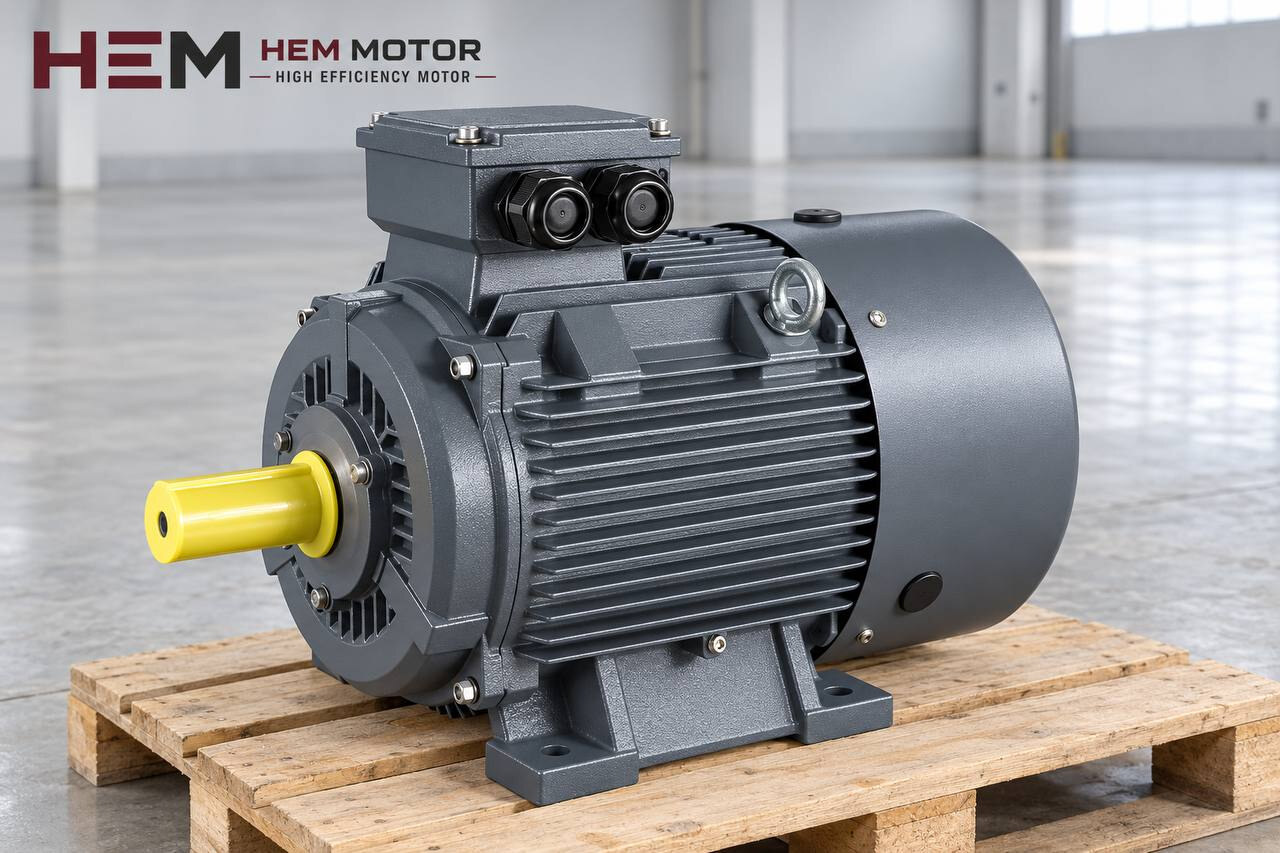
In an axial fan the air moves along the axis the impeller turns on. In most industrial axial fans the impeller hub is keyed straight onto the end of the electric motor shaft, with no belt, pulley or separate bearing block in between. That simplicity turns the motor into a load-bearing part of the fan. This page covers the three-phase asynchronous motor that drives an axial fan; the wider picture of fan types is on the Fan and Extractor Motors page.

What the Motor Takes On When the Impeller Sits on Its Shaft
In a belt-driven fan the motor only supplies torque; the fan shaft runs in its own bearings. In a direct-drive axial fan the motor does three jobs at once:
- It turns the impeller, and its own speed becomes the fan speed; there is no pulley ratio to correct it later.
- It carries the weight of the impeller on the shaft extension, just ahead of the drive-end bearing.
- It passes the reaction force created as the impeller pushes air into the bearings.
So the choice does not end with kW and speed; the shaft end, key, foot or flange connection and mounting position must match the impeller and the fan housing. The catalogue lists B3, B5, B14, B34 and B35 arrangements and, depending on frame, vertical V1, V3, V5, V6 and V15 options; flange and shaft dimensions are confirmed at order against the fan maker's drawing. For connection types see flange-mounted motors and mounting arrangements.
Axial Thrust, Bearings and Impeller Balance
When the impeller pushes air one way, the shaft is pushed the other way. This force exists as long as the fan turns and sits on one of the bearings as a constant axial load. Its direction depends on whether the air flows from the motor towards the impeller or from the impeller towards the motor; if the fan is installed the other way round, the bearing side that carries the load changes too.
In vertical mounting the weight of the impeller and rotor adds to or subtracts from this thrust. The bearing table in the HEM Motor catalogue treats horizontal and vertical mounting in separate columns, which is why we ask you to state the airflow direction and the mounting position together in your order.
The second topic is balance. A small imbalance in an impeller overhung on the shaft end loads the bearing at the same point on every turn. When blades collect dirt, a blade bends or blade angles are set unevenly, vibration grows and the motor bearing pays first. Vibration should be checked again after cleaning and blade adjustment.
The Motor Inside the Airstream: Cooling, Dust and Moisture
In cased axial fans the motor usually sits in the middle of the casing on support arms, and the air the fan moves sweeps over the outside of the motor. In clean, cool air this flow helps cooling, but it also brings everything in the air to the motor:
- In dusty exhaust the gaps between cooling fins and the fan cover fill up and heat dissipation weakens.
- In humid air, especially after the fan stops, condensation forms inside the frame.
- In hot-air exhaust the motor runs inside a stream that is hotter than the room.
Our models are IP55 protected with class F insulation. If the air being moved is above +40 °C, state this in your order. An anti-condensation heater and a PTC/PT100 winding sensor are order options. A standard IP55 motor is not designed for pressure washing or air carrying corrosive gas; the fan maker's protective measure or a special motor is needed, so state it in your order.
Wall-Mounted, Duct and Tower Fans
Wall-mounted axial fan
It sits in a wall opening or on a mounting plate and is common in workshop exhaust, warehouses, greenhouses and livestock buildings. The motor stands horizontally on a frame fixed to the plate, close to the outdoors. Rain, dust and sun act on it directly; the terminal box entry should face down and the cable should not collect water.
Duct axial fan
It runs inside a cylindrical casing as a continuation of the duct and is found in exhaust lines, paint booths and building shafts. Reaching the motor means opening the casing, so monitoring the winding with sensors such as PTC becomes more valuable. For building ventilation in general, see ventilation motors.
Cooling tower and condenser fans
Large, slow impellers turn in a horizontal plane above the tower or the condenser coil, so the motor runs vertically. Some towers add a right-angle gearbox in between and the motor stands horizontally. Water vapour, droplets and open air are the common challenge. For building systems, see HVAC motors.
Blade Angle, Speed and Absorbed Power
Many industrial axial impellers allow the blade angle to be adjusted on the hub. As the angle grows, each blade catches more air per turn; airflow rises and so does shaft power. As the angle shrinks, both fall together.
Two mistakes are common on site: opening up the blades when airflow falls short without checking motor current, or replacing a burnt motor with one of the same power without noticing that the blade angle had been changed earlier. After a blade adjustment, motor current should be compared with the nameplate value.
For speed the general rule is that the power required changes roughly with the cube of fan speed; the relationship is approximate and depends on system resistance. In many axial fans the absorbed power can also rise when the duct is throttled or a filter clogs.
4- or 6-Pole Choice, Starting and Speed Control
Motor speed is considered together with impeller diameter. Small and medium wall and duct fans often use 4-pole (1500 rpm class) motors; as diameter grows, 6-pole (1000 rpm class) motors come forward. For example, our 1.5 kW 90L-4 has a rated speed of 1,445 rpm and our 7.5 kW 160M-6 970 rpm. The final decision follows the fan maker's curve.
The inertia of a large impeller lengthens the start; the motor draws high current until it reaches full speed. Star-delta, a soft starter or an inverter softens this period. If thermal protection is not set for a long start, the fan may trip while coming up to speed.
To adjust airflow by season, our three-phase series are suitable for speed control with a frequency converter; long periods at low speed with full torque may need a separate cooling fan, and with long cables a dv/dt or sine filter is considered; these conditions are stated at order. Details on the inverter-compatible motors page.
Mounting and Order Notes by Application
| Application | Mounting position | Watch out for | State in your order |
|---|---|---|---|
| Wall-mounted exhaust fan | Horizontal, foot or flange on a frame | Rain, dust, sun; terminal box orientation | Airflow direction, outdoor use; example: 1.5 kW 90L-4 cast iron |
| Duct axial fan | Horizontal, inside the casing | Dust and heat in the airstream, difficult access | Air temperature, PTC; example: 7.5 kW 160M-6 cast iron |
| Vertical roof exhaust | Vertical, shaft up or down | Impeller and rotor weight add to the bearing load | Shaft direction and mounting code (such as V1, V3, V5, V6) |
| Cooling tower fan | Vertical, or horizontal with a gearbox | Water vapour, condensation, large impeller inertia | Anti-condensation heater, starting method; example: 18.5 kW 200L1-6 cast iron |
| Condenser fan | Vertical or horizontal, outdoors | Variable load, frequent starts | Inverter use, drive-to-motor cable length |
The linked models are examples only; the final choice depends on the fan's shaft power, impeller diameter, required speed, mounting and operating conditions.
What to Send With Your Motor Request
In your request please state: the machine or fan type the motor drives (wall, duct, tower), power (kW), speed (rpm), supply voltage, mounting arrangement and shaft direction, airflow direction, temperature of the air moved and quantity. A nameplate photo of the old motor answers most questions.
All power and speed options are listed in our electric motor shop; each model shows its price on its own page. Models delivered from stock ship from our warehouse in Türkiye. If you are unsure about the shaft end or the impeller hub, reach us with a photo via the contact page.
Frequently Asked Questions
My axial fan motor burnt out; can any motor of the same kW be fitted?
Power and speed alone are not enough. Shaft end, key, flange or foot connection, mounting position and airflow direction must match the old motor; if the impeller hub does not seat fully on the new shaft, balance is lost.
Will the motor be overloaded if I increase the blade angle?
It can be. As the angle grows, shaft power rises along with airflow. Measure motor current after the adjustment; it must not exceed the nameplate value.
Does a motor inside the airstream need extra cooling?
Not in clean, cool air; the motor has its own cooling fan. If the air is dusty or above +40 °C, state it in your order.
How many poles are used on a cooling tower fan?
Large direct-drive impellers mostly use 6 poles; gearbox arrangements may differ. The decision follows the tower maker's data.
Can I run an axial fan motor on an inverter?
Yes. Conditions such as long cables or long running at low speed are discussed at order; a filter or a separate cooling fan is added if needed.