English
 Français
 Türkçe
 Español
 Русский

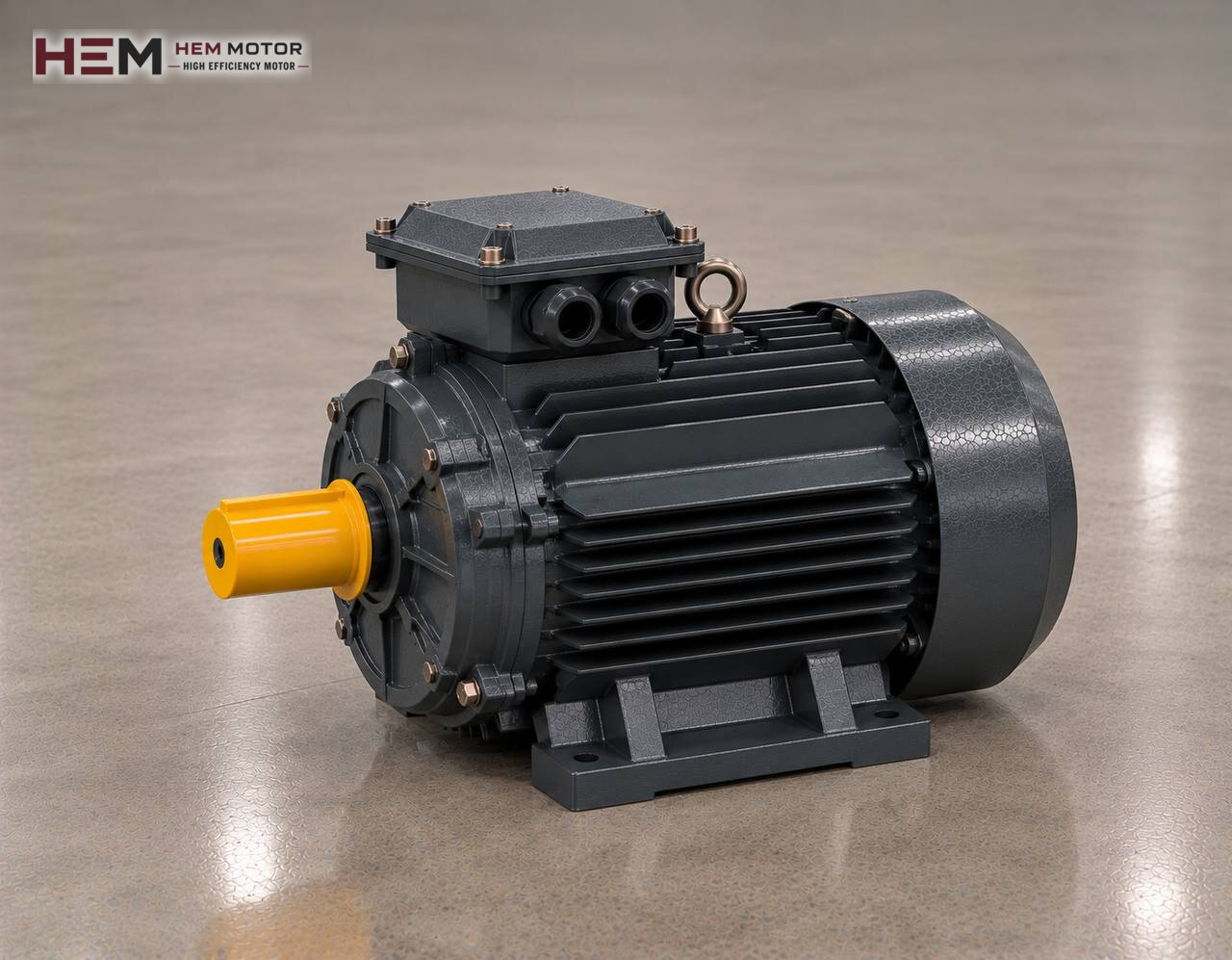
In the wheel of a radial straight-blade fan the blades run outward from the hub without any curvature. This simple geometry does not win the efficiency race, but it is one of the few wheel types that can carry air laden with chips, fibres, granules or sticky dust without clogging. Pneumatic conveying lines, fabric trim extraction, sawdust transport and high-pressure process air are typical duties for this fan. This page is not about the wheel itself but about selecting the motor that turns it; the overview of the fan family is on the industrial fan motors page.

What a Material-Handling Wheel Expects from the Motor
A straight blade has no pocket on its surface for particles to cling to; thrown material slides along the blade, strikes the housing and is ejected at the outlet. For this reason the wheel is made of thick plate, often reinforced with wear plates. The result is a rotor that is noticeably heavier than other centrifugal wheels of the same diameter.
Three consequences follow for the motor. First, a heavy wheel means high inertia and a longer start. Second, to reach high pressure at the blade tip the fan usually runs fast; a 2-pole (3,000 rpm class) motor or a belt-stepped-up 4-pole motor is common. Third, shaft power changes as the amount of material in the air changes; the motor is loaded more when carrying a dusty, dense mixture than with clean air.
Power Curve: Load Rises as Airflow Rises
In a radial straight-blade wheel, shaft power rises almost linearly with airflow. The increase is not as steep as with a forward-curved wheel, but the natural peak seen with a backward-curved wheel does not exist here. When a slide gate in the line is fully opened, the cyclone inlet is removed or the conveying pipe is shortened, the motor moves towards the more heavily loaded end of the curve.
Power selection therefore considers the freest state of the line together with the densest material load. The fan manufacturer usually gives a power value for clean air; the load of the conveyed material must be added on top. When replacing a motor in an existing plant, the most reliable starting point is the old motor's nameplate value and the current measured at the heaviest moment of operation.
Long Starting: Inertia, Current and Protection Setting
Bringing a heavy wheel from standstill to rated speed means the motor draws its starting current for a long time. An overload relay set for short acceleration may open during this time; conversely, loosely set protection may miss winding heating. For a correct setting, the wheel's moment of inertia and the motor's starting characteristics are evaluated together with the fan manufacturer's data.
The first way to ease starting is to keep the air path closed: with the inlet flap or slide gate closed, the wheel moves less air and the motor accelerates with less torque. To limit the current surge on the supply, star-delta, a soft starter or a frequency inverter can be used; the choice depends on the wheel's inertia and the strength of the supply. Not restarting the line while it is full of material spares the motor its heaviest start.
Direct Coupling or Belt?
In small and medium radial fans the wheel usually sits directly on the motor shaft; in this arrangement, where the material-laden air does not pass through the motor, fan speed equals motor speed. The mass and unbalance of the heavy wheel act directly on the motor bearings, so whether the wheel weight can be carried on the motor shaft must be confirmed with the fan manufacturer.
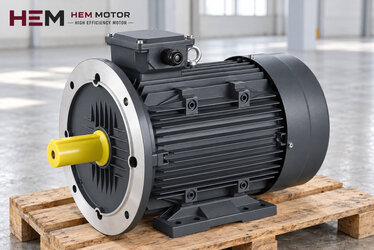
With large wheels the fan runs on its own bearing shaft and the motor stands on a separate base; drive is by coupling or belt and pulley. A belt lets the wheel speed be chosen independently of the fixed speed of a 2-pole motor. In a coupled arrangement the motor and fan shafts must be aligned precisely. Foot-mounted B3, foot-and-flange B35 or flange B5 arrangements are offered depending on frame size; flange and shaft dimensions are confirmed at ordering. For details see the foot-and-flange motors page.
Example HEM Models for Radial Straight-Blade Fans
| Fan duty | Drive and speed | Value to check | Example HEM model |
|---|---|---|---|
| Workshop chip extraction | Direct, 3,000 rpm class | Wheel weight on motor shaft | 5.5 kW, 2,930 rpm, 132S1-2 cast iron |
| Trim and fibre conveying | Belt and pulley | Material load, pulley ratio | 11 kW, 1,465 rpm, 160M-4 cast iron |
| High-pressure process air | Direct or coupled, 2-pole | Starting time, protection setting | 22 kW, 2,955 rpm, 180M-2 cast iron |
| Large pneumatic conveying line | Coupling or belt, fan on own bearings | Inertia, starting method | 37 kW, 1,485 rpm, 225S-4 cast iron |
This table is only a starting suggestion; the final motor is determined by the fan's actual shaft power, the conveyed material, wheel inertia, mounting arrangement and operating conditions.
Wear, Balance and Protecting the Motor
A material-carrying wheel wears over time or builds up deposits on its blades. Both upset balance and increase vibration. In a direct-coupled fan this vibration is felt first at the motor's drive-end bearing; noise or a temperature rise at the bearing signals that it is time to check the wheel. Blade cleaning and wear plate replacement should be placed in the same plan as motor maintenance.
The motor should stay outside the air stream that carries the material; however, dust around the fan still settles on the motor frame and cooling fins. A motor with clogged fins cannot cool properly, so regular cleaning of the frame matters. Our motors come with IP55 and class F insulation; a PTC/PT100 winding sensor can be added as an ordering option to monitor how much long starts heat the winding. For a heavy wheel and a shaky environment, the cast-iron frame series is a suitable choice.
Information for a Radial Fan Motor Order
To speed up matching, send: the machine or line the fan works on, the conveyed material, motor power (kW), speed (rpm), supply voltage, mounting type (foot, flange, belt or coupling), the starting method used and quantity. A nameplate photo of the old motor is often the shortest route.
All cast-iron and aluminium frame models are listed with current prices on our store page. To send your request by WhatsApp or phone, reach the numbers on the contact page.
Frequently Asked Questions
Why does the radial fan motor trip its overload during starting?
The heavy wheel reaches rated speed late and the motor draws high starting current during this time. If the overload protection is not set for this duration, it opens. Starting with the flap closed, a suitable starting method and a protection setting based on the fan manufacturer's inertia data solve the problem.
Is it a problem to restart the fan while the line is full of material?
In a full line the wheel meets both air and material, and the motor makes its heaviest start. If possible the line should be emptied, or the gate closed and material fed only after the fan has accelerated unloaded.
How does material load affect motor power?
Solids carried with the air require additional energy. The fan power given for clean air may be insufficient when dense material is being conveyed. Motor selection should consider the most heavily loaded moment and the freest state of the line.
Can the wheel be fitted directly on the motor shaft?
This is a common arrangement for small and medium fans. However, because the radial wheel is heavy, its weight and unbalance load the motor bearings; for large wheels a separate fan shaft on its own bearings with a coupling or belt is preferred.