English
 Français
 Türkçe
 Español
 Русский

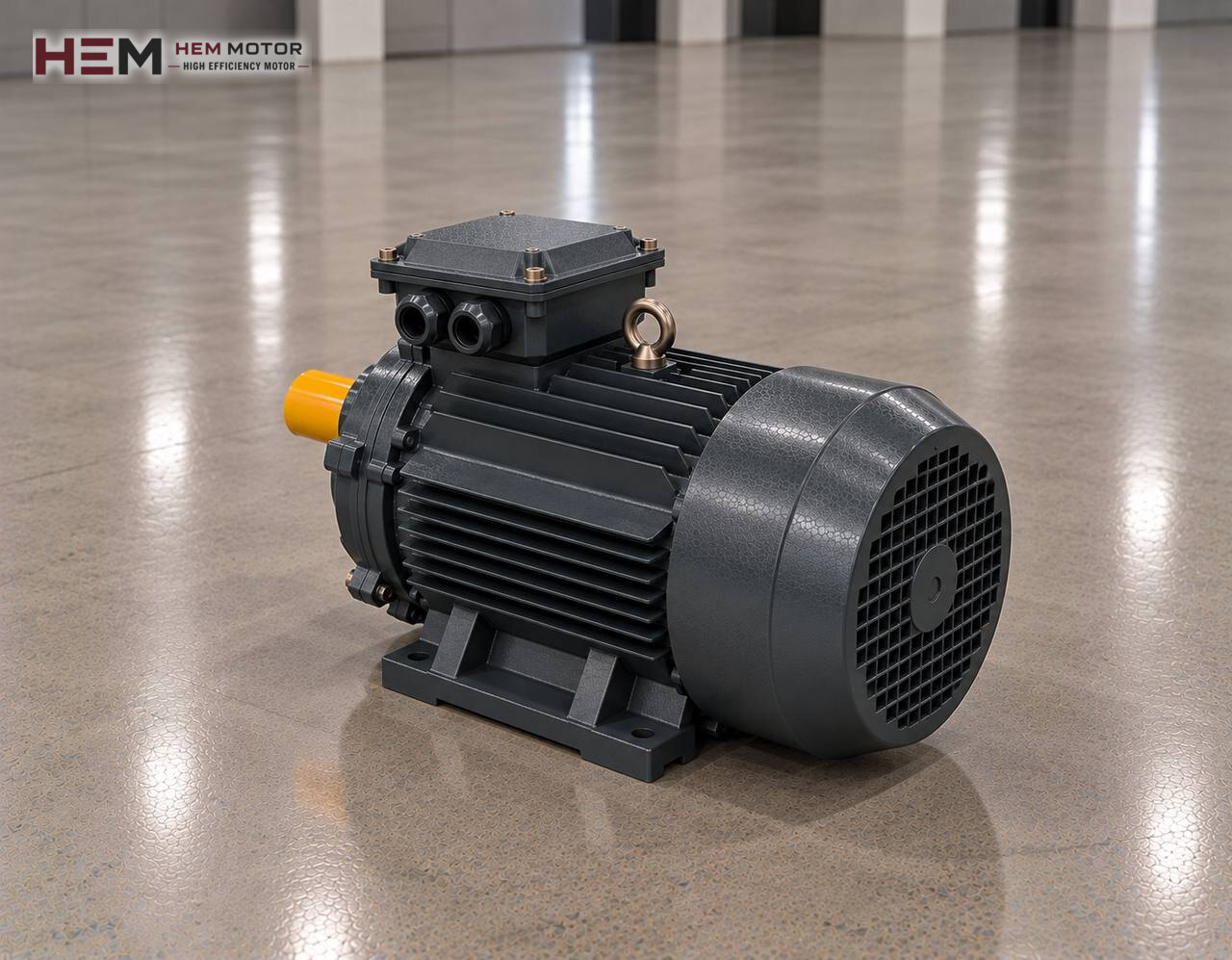
A reversible axial fan can move air in both directions with the same impeller. The blade profile is symmetrical or designed to work in both directions; when the motor's direction of rotation changes, the airflow reverses too. Switching the flow in tunnels according to traffic or wind, using the same opening in a building sometimes for fresh air and sometimes for exhaust, or adjusting the flow in livestock houses by season are typical tasks for this fan. This page explains what is expected from the motor of a fan that changes direction; the general framework of the sector is on the fan and extractor motors page.

The Motor Sets the Direction: Swapping Two Phases
The direction of rotation of a three-phase induction motor is reversed by swapping two of the supply phases. In reversible fans this is usually done with a reversing circuit of two interlocked contactors or with the direction command of a frequency inverter. No change to the motor itself is needed; a standard three-phase motor can run in either direction.
The point to watch is the timing of the reversal. Connecting the motor directly to the opposite direction while the impeller is still turning (plugging) draws a very high current, heats the winding and applies a hard torsional shock to the shaft, key and impeller hub. The control circuit therefore includes a waiting time for the motor to stop. With large impellers coasting to a standstill can take a long time; the waiting time should be set by observing that the impeller has fully stopped.
Smooth Reversal with a Frequency Inverter
In systems that reverse frequently, an inverter makes things noticeably easier. The drive first ramps the speed down to zero, then accelerates again in the opposite direction; the current surge and mechanical stress largely disappear. During deceleration the impeller inertia drives the motor as a generator; whether the drive can absorb this energy, and whether a braking resistor is needed, is assessed on the drive side.
On the motor side, the points to know are these: our three-phase motors can be supplied from a drive; if high torque is required at low frequency for long periods, separately ventilated cooling is considered, and if the line between drive and motor is long, an output filter. It is enough to state these conditions in your quotation request. Details are on the inverter-compatible electric motors page.
Axial Force in Two Directions and the Bearings
When an axial impeller pushes air, a reaction force acts on the shaft in the opposite direction. In a one-way fan this force always loads the same bearing. In a reversible fan, the direction of the force changes as the airflow changes; the motor's bearing arrangement must be able to take this force in both directions. Because the impeller is mounted directly on the shaft end, its weight and balance error are also transferred to the front bearing in both directions.
If the fan is installed vertically, for example in a roof opening, the weight of the impeller and rotor adds to the thrust in one direction and subtracts from it in the other. That is why we ask you to state the mounting position (horizontal or vertical codes such as V1, V3, V5, V6, V15), the shaft direction and the fact that the fan will run in both directions together in the order. Depending on frame size, B3, B5, B14, B34 and B35 arrangements are also available; flange and shaft size are confirmed against the impeller hub.
Cooling, Environment and the Thermal Effect of Frequent Reversal
The motor's own cooling fan sits on the shaft and changes direction with the motor. On small and medium frames this fan is designed to cool in both directions; on large frames, and especially on high-speed 2-pole models, the suitability of the cooling fan for bidirectional running should be confirmed in the order.
Every start and every reversal means extra heat in the winding. A tunnel fan that reverses several times an hour and a livestock-house fan reversed once a day do not see the same motor load. For frequent starting and stopping, a PTC/PT100 sensor embedded in the winding is the most direct way to monitor heating. In humid environments such as tunnels, car parks or outdoors, an anti-condensation heater is useful during the hours the motor stands still; both are order options. IP55 protection covers dust and water splashes; direct cleaning with pressurised water or an explosive atmosphere is outside this scope.
Example HEM Models for Reversible Fans
| Application | Reversal frequency | Key point on the motor side | Example HEM model |
|---|---|---|---|
| Livestock house or greenhouse wall fan | Seasonal, rare | Humidity, dust, outdoor air | 4 kW, 1,450 rpm, 112M-4 aluminium |
| Building supply/exhaust changeover fan | Daily | Interlocking of the reversing circuit | 7.5 kW, 1,460 rpm, 132M-4 cast iron |
| In-duct reversible fan | Programmed, hourly | Ramped changeover with inverter, PTC | 15 kW, 1,465 rpm, 160L-4 cast iron |
| Large-diameter tunnel fan | According to traffic or wind | Impeller inertia, long run-down time | 30 kW, 980 rpm, 225M-6 cast iron |
The rows give a starting point for selection. The final decision rests on the shaft power given by the fan manufacturer, the operating points in both directions, the impeller speed, the mounting arrangement and the ambient conditions. For thrust fans in underground car parks and tunnels, see also the jet fan motor page; certified fan-motor sets for fire scenarios are outside the scope of a standard motor.
Why Can Performance Differ Between the Two Directions?
Fully symmetrical impellers deliver roughly the same airflow in both directions, but a symmetrical profile runs at lower efficiency than a blade optimised for one direction. In some designs the blade favours one direction and moves less air in reverse. For the motor this means the power drawn may not be the same in both directions. During commissioning the current should be measured separately for each direction and the higher value compared with the rated current on the nameplate.
Information Required for an Order
In your request, state the machine or installation the fan works in, the required power and speed, the supply voltage, the mounting position and shaft direction, how often the direction will change, whether reversal is done by contactors or by a drive, and the quantity. If there is an existing motor, sending a photo of its nameplate speeds up matching.
Current prices are shown on each model's page in the buy electric motors section. For WhatsApp and phone, please use our contact page.
Frequently Asked Questions
Does a reversible fan need a special motor?
No, a standard three-phase induction motor turns in both directions. The points to watch are the reversing circuit, the axial force acting on the bearings in both directions and, on large frames, whether the cooling fan suits bidirectional running.
Can I change direction immediately while the fan is running?
This is not recommended. Reversing a spinning impeller creates a very high current and a mechanical shock. Allow a waiting time in the control circuit or use a ramped changeover with an inverter.
Why is the motor current different in the two directions?
The blade profile may not work with the same efficiency in both directions, and the system resistance may also vary with direction. Current is measured in both directions and the higher value is used.
How is the motor protected on a fan that reverses often?
Alongside the thermal relay, a PTC or PT100 sensor embedded in the winding directly monitors the heating caused by repeated starts. The sensor can be requested when ordering.