English
 Français
 Türkçe
 Español
 Русский

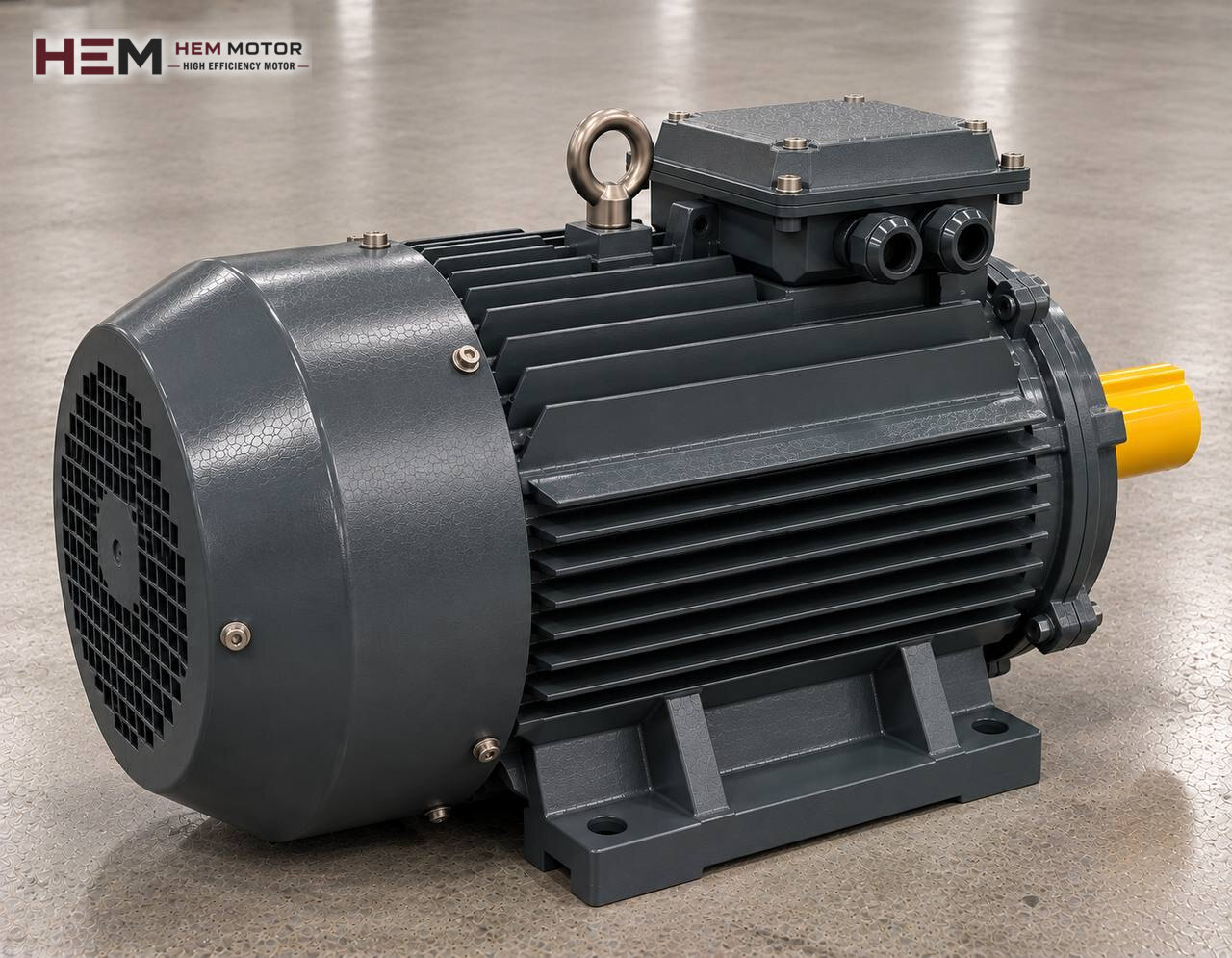
A duct axial fan consists of a propeller and the motor carrying it, placed inside a cylindrical sheet-metal casing; the flanges at both ends of the casing turn the fan into an intermediate piece of a round air duct. These fans are found in car park exhaust lines, tunnel and gallery ventilation, industrial paint booths and long duct runs. This page focuses on the conditions of the motor inside the casing; for an overview of fan types, see the fan and extractor motors page.

The Motor Sits in the Middle of the Casing, in the Airstream
In a duct axial fan the motor is fixed to a support stool or radial arms on the casing axis; the propeller sits directly on the shaft end. The conveyed air flows around the motor housing on all sides. This has two consequences. On the positive side, if the air is cool and clean the motor receives strong external cooling in addition to its own fan. On the negative side, everything the air carries — heat, moisture, dust and vapour — reaches the motor directly.
The motor's housing diameter narrows the cross-section through which air passes inside the casing. The fan designer therefore cannot exceed a certain frame size for a given casing diameter, and among motors of the same power the one with the smaller frame may be preferred. When replacing, the old motor's IEC frame number (e.g. 100L, 112M) and shaft dimensions are therefore as important as the kW rating. Our frame size table is a useful guide for dimensions.
How Does the Cable Leave the Casing?
Since the motor's terminal box stays in the airstream, the supply cable is taken out through a passage in the casing wall and usually ends in a separate junction box on top of the casing. The cable should be fixed to the support arm so that it cannot touch the propeller, and a sealed gland should be used at the casing passage. If the terminal box orientation is stated in the order, the cable can reach the casing wall by the shortest route.
If a PTC or PT100 sensor is requested to monitor winding temperature, the sensor leads also leave through the same passage; this should also be written in the order.
Horizontal and Vertical Ducts
Most duct fans work in horizontal ducts, with the motor on a horizontal shaft, foot- or flange-mounted to the support. In vertical ducts that open through the roof, however, the fan stands upright and the motor shaft points down or up. In this case the motor must be arranged for vertical mounting (V1, V3, V5, V6 or V15 depending on the frame); bearings are selected for the vertical load, and with the shaft pointing up an additional measure is needed so that rainwater cannot enter the motor. Details are in our article on vertical mounting. Which mounting arrangement is available for which frame is confirmed in the order.
Pressure Range and Stall: A Situation Specific to Axial Fans
Because a duct axial fan works against a longer duct run than a wall fan, it sees a higher pressure difference. The characteristic curve of an axial fan has an unstable zone (stall zone) where the flow separates from the blade once the airflow drops below a certain value. In this zone the fan vibrates, its sound changes and the motor shaft sees a fluctuating torque. Throttling a damper too far, a clogged filter or adding new resistances to the duct run can push the fan into this zone.
For the motor, the result is additional load on the bearings and on the shaft–propeller connection. On axial fans, working against a throttled outlet can also increase the power demand; in this respect an axial fan behaves differently from a backward-curved centrifugal fan, whose load falls at a closed outlet. Measuring the motor current after damper or duct changes is therefore important.
Speed Control and Two-Speed Operation on Duct Fans
In applications such as car parks and tunnels, the fan runs at low speed for normal ventilation and at high speed when pollution increases. A frequency converter can be used for this; our three-phase motors are suitable for converter operation. When the fan slows down, the motor inside the casing gets less cooling both from its own fan and from the conveyed air; since fan load drops at low speed this is usually not a problem, but if unusual operation is planned separate cooling may be needed. If the drive is far away, a filter is considered because of the cable length; details on the inverter compatible electric motors page.
Duct fans that must run for smoke extraction in a fire require a set certified together with the fan and motor. Our standard motors are not supplied with such certification; for these duties the motor must be of a design approved by the fan maker.
Example Motors for Duct Axial Fans
| Application | Motor condition | Point to check | Example HEM model |
|---|---|---|---|
| Exhaust fan on a short duct run | In cool, clean air | Frame number and shaft size | 1.1 kW, 1,445 rpm, 90S-4 |
| Paint booth duct fan | Paint particles and solvent vapour | Ambient condition, fan maker's requirement | 2.2 kW, 1,450 rpm, 100L1-4 |
| Small-diameter high-pressure fan | High speed, narrow casing | Propeller tip speed, bearings | 1.5 kW, 2,895 rpm, 90S-2 |
| Long-run car park / gallery fan | With VFD, two-stage operation | Cooling at low speed, cable | 5.5 kW, 1,460 rpm, 132S-4 |
These motors are given as examples; the final choice is determined by the fan's power demand, the required speed, the mounting arrangement in the casing and the properties of the conveyed air.
Lines carrying solvent vapour, such as paint booths, may involve an explosive atmosphere. A standard IP55 motor is not explosion-protected; Ex motors are not in HEM Motor's 2026 catalogue. If such an atmosphere exists, state it clearly in the order.
What We Need for an Order
When requesting a duct fan motor, send the following: machine or plant type, motor power, speed, voltage, mounting type (horizontal or vertical, foot or flange), IEC frame number, terminal box orientation, temperature and content of the conveyed air, and quantity. Photographing and sending the old motor's nameplate is often enough.
Models and current prices are on our purchase page; WhatsApp and phone details are on the contact page.
Frequently Asked Questions
Why is the frame number of a duct fan motor important?
Because the motor sits inside the casing, its housing diameter determines the air passage and the support dimensions. A motor of the same power with a larger frame may not fit in the casing or may narrow the air section; for a replacement, the old motor's frame number should be the reference.
Does throttling the damper relieve a duct axial fan motor?
On an axial fan it usually does not; a throttled outlet can increase the power demand and push the fan into the unstable zone. A better way to reduce airflow is to lower the speed with a frequency converter.
Can a normal motor be used for a fan in a vertical duct?
For vertical operation the motor must be arranged for a vertical mounting form such as V1 or V5. Bearings and rain protection change with this arrangement; the fan's shaft direction and mounting form should be stated in the order.
Can the motor stay inside the casing if the conveyed air is hot?
A standard motor is designed for normal ambient temperature. If the conveyed air is noticeably hot, the motor should be moved out of the airstream or a belt-driven fan arrangement chosen; the temperature value should be given in the order.