English
 Français
 Türkçe
 Español
 Русский

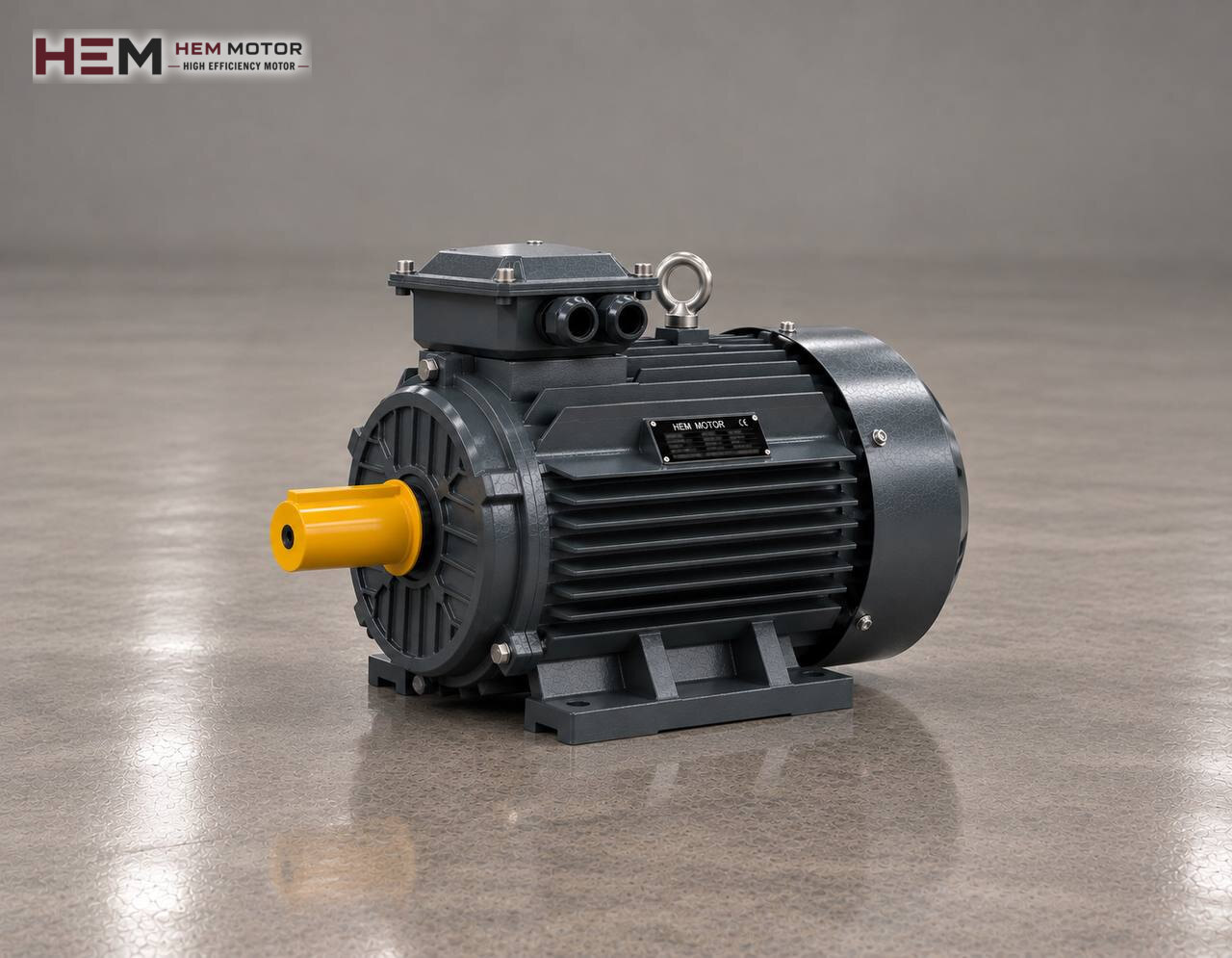
A tangential (cross-flow) fan is easy to tell apart from other fans by its wheel, which looks like a long cylinder: air enters on one side of the wheel, passes through the row of blades and leaves on the opposite side as a wide, thin sheet. Thanks to this behaviour it is preferred in over-door air curtains, wall-mounted air conditioner indoor units, convectors and drying compartments that need even air from narrow slots. This page explains how to select the electric motor that turns these fans and air curtains; the other fan types are gathered on the fan and extractor motors page.

An Honest Distinction First: Which Air Curtain Suits a Standard Motor?
Most air curtains on the market are light units made for shop and office doors. In most of them the motor is a small external-rotor or shaded-pole unit designed together with the wheel; some newer models use an electronically commutated (EC) motor. Such very small, unit-specific fan motors are not included in HEM Motor's 2026 catalogue. In case of failure, the right route is the unit manufacturer's spare part.
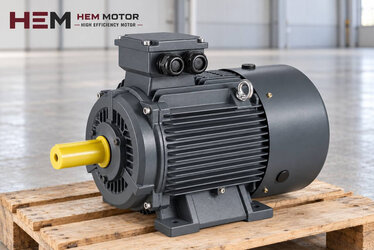
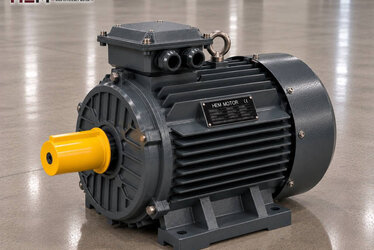
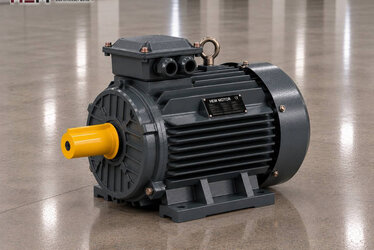
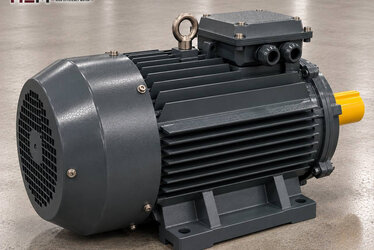
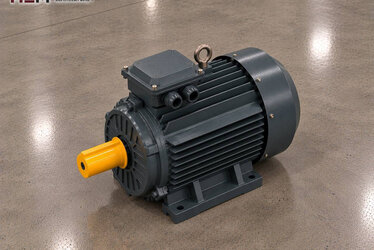
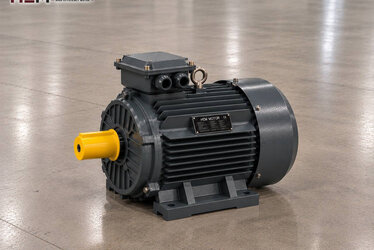
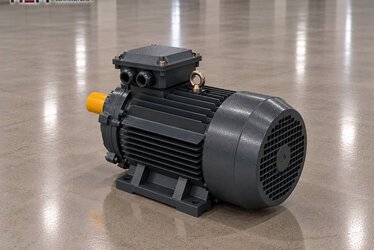
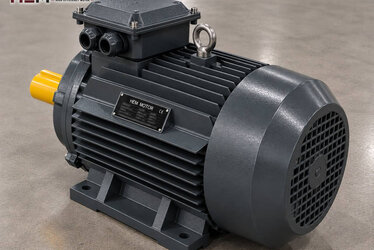
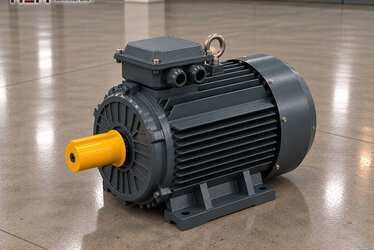
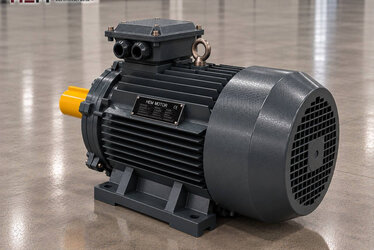
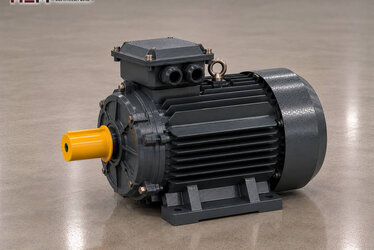
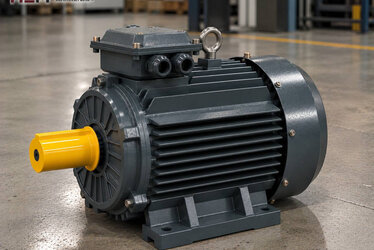
The place for a standard IEC-frame motor is larger applications: industrial air curtains on factory and warehouse doors, cold room entrances, loading docks and long tangential fans working like air knives on process lines. In these units the motor usually sits at one end of the housing and turns the wheel through a coupling or belt. HEM's smallest three-phase model is 0.25 kW; for 220 V applications needing less power, the single-phase electric motor series starting from 0.18 kW can be considered.
How the Long Cylindrical Wheel Affects the Motor
The wheel of a tangential fan is very long compared with its diameter; it can span the width of a door. For a long, slender rotor to run smoothly it must be well supported at both ends, free of axial misalignment and balanced. When the motor drives the wheel from one end, the smallest runout on the shaft grows at the far end of the wheel and comes back as vibration. For this reason the connection between motor and wheel is made with a flexible coupling and alignment is checked carefully.
In terms of load, the tangential fan is a calm load delivering high airflow at low pressure. The wheel's inertia is limited because of its small diameter, and starting is generally not demanding. Power rises quickly with wheel speed; so increasing speed for a curtain that needs very high air velocity can raise the motor load more than expected.
Speed Selection and Speed Steps
The purpose of an air curtain is to create an air wall that separates inside air from outside air while the door is open. Curtain velocity is set according to door height, wind direction and the inside-outside temperature difference. A door may need different summer and winter settings; that is why two or three speed steps or continuous speed adjustment are common in air curtains.
With a standard three-phase motor, the cleanest way to adjust speed is a frequency inverter. Connected to a door sensor, the inverter can also make the curtain run at high speed only while the door is open. HEM's three-phase motors are suitable for inverter drive; because fan load lightens as speed falls, the motor's own cooling fan usually remains sufficient. If conditions such as a very long cable run or long operation at very low frequency apply, they should be stated at ordering. For inverter use, the answer to can I run the motors on a frequency inverter offers a starting point.
Mounting Position: Over the Door, on the Wall and Vertical Arrangements
Industrial air curtains are mostly mounted horizontally above the door, sometimes vertically on both sides of it. In a vertical arrangement the direction of the motor shaft changes; for a motor with the shaft pointing up or down, bearing load and rain or dust ingress are assessed differently. That the motor will run in this position must be stated at ordering.
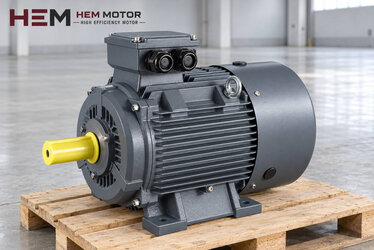
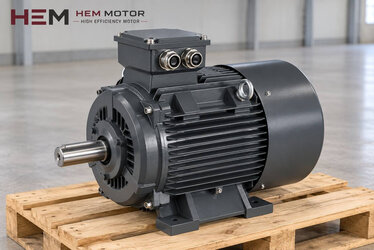
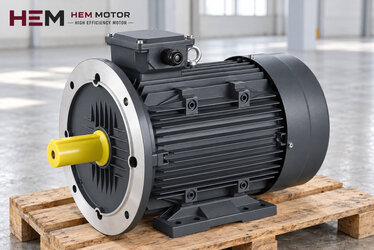
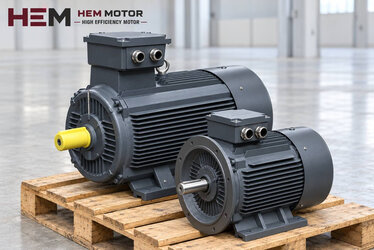
Depending on frame size, HEM motors are available in foot (B3), flange (B5, B14), foot-and-flange (B34, B35) and vertical V-type arrangements; the dimensions of the flange that will sit on the curtain housing and of the shaft end are verified together at ordering. In over-door applications, placing the motor at an accessible end makes maintenance easier; where forklifts pass under the curtain, it is important that the cable and terminal box are not exposed to impact. For detailed notes on vertical mounting, the V1/V5 vertical mounting guide can be read.
Example HEM Models for Tangential Fans and Air Curtains
| Application | Connection | Point to check | Example HEM model |
|---|---|---|---|
| Short door curtain, low power | Flexible coupling | Shaft end and flange | 0.25 kW, 1,340 rpm, 71M1-4 aluminium |
| Warehouse door air curtain | Coupling, two settings by inverter | Alignment on a long wheel | 0.37 kW, 1,340 rpm, 71M2-4 aluminium |
| Cold room entrance, low-speed curtain | Coupling or belt | Condensation in a cold environment | 0.37 kW, 890 rpm, 80M1-6 aluminium |
| Wide industrial door, two-motor curtain | Separate motor for each section | Motors running at equal speed | 0.75 kW, 1,420 rpm, 80M2-4 aluminium |
These models are for guidance; the right motor is selected by examining together the wheel's actual power demand, the required speed, the connection arrangement and the conditions at the installation site.
Protection and Maintenance in a Doorway Environment
A motor above a door is exposed to outside air, rain spray, winter cold and exhaust dust in the loading area. The IP55 protection of our motors is designed against dust and water splashes; for a façade installation directly exposed to rain, a canopy or protective cover should be considered. At cold room entrances, because the motor starts and stops often and sits between warm and cold air, condensation can form in the winding; an anti-condensation heater is an ordering option for this.
The dense blades of a tangential wheel collect dust over time and the curtain's air velocity drops. When the wheel is cleaned, the curtain effect returns and vibration caused by unbalance decreases. Wear of the coupling element, the centre bearing of a long wheel and the sound of the motor bearings should be listened to during periodic maintenance.
What You Need to Send Us for an Air Curtain Motor
So that we can find the right motor, send the following: the machine or door type where the curtain is installed, motor power (kW), speed (rpm), supply voltage (single-phase 220 V or three-phase 400 V), mounting type (horizontal, vertical, flange, foot), how it connects to the wheel and quantity. Sharing a nameplate photo of the existing motor speeds up finding an equivalent.
All three-phase models and their current prices are listed in our electric motor store. To reach us by WhatsApp or phone, you can use the numbers on our contact page.
Frequently Asked Questions
Is an IEC-frame motor suitable for the failed motor of a small shop-type air curtain?
In most small air curtains the motor is a small unit designed specifically for the wheel and housing and does not match standard IEC motor dimensions. Such very small fan motors are not included in HEM Motor's 2026 catalogue; the unit manufacturer's spare is recommended.
Can a single-phase motor be used in an industrial air curtain?
If only 220 V is available and the power demand is small, the single-phase series can be considered. If speed steps and inverter adjustment are wanted, a three-phase motor offers a more flexible option.
Why does a long tangential wheel vibrate?
On a long, slender wheel, shaft misalignment or dust built up on the blades grows at the far end and turns into vibration. Coupling alignment, wheel cleaning and bearing checks usually cure the problem.
Can the air curtain speed up automatically when the door opens?
Yes. If the motor is driven by a frequency inverter, a signal from the door sensor can bring the curtain to high speed on opening and to low speed when the door closes. The details of this arrangement are set up on the automation side.