English
 Français
 Türkçe
 Español
 Русский

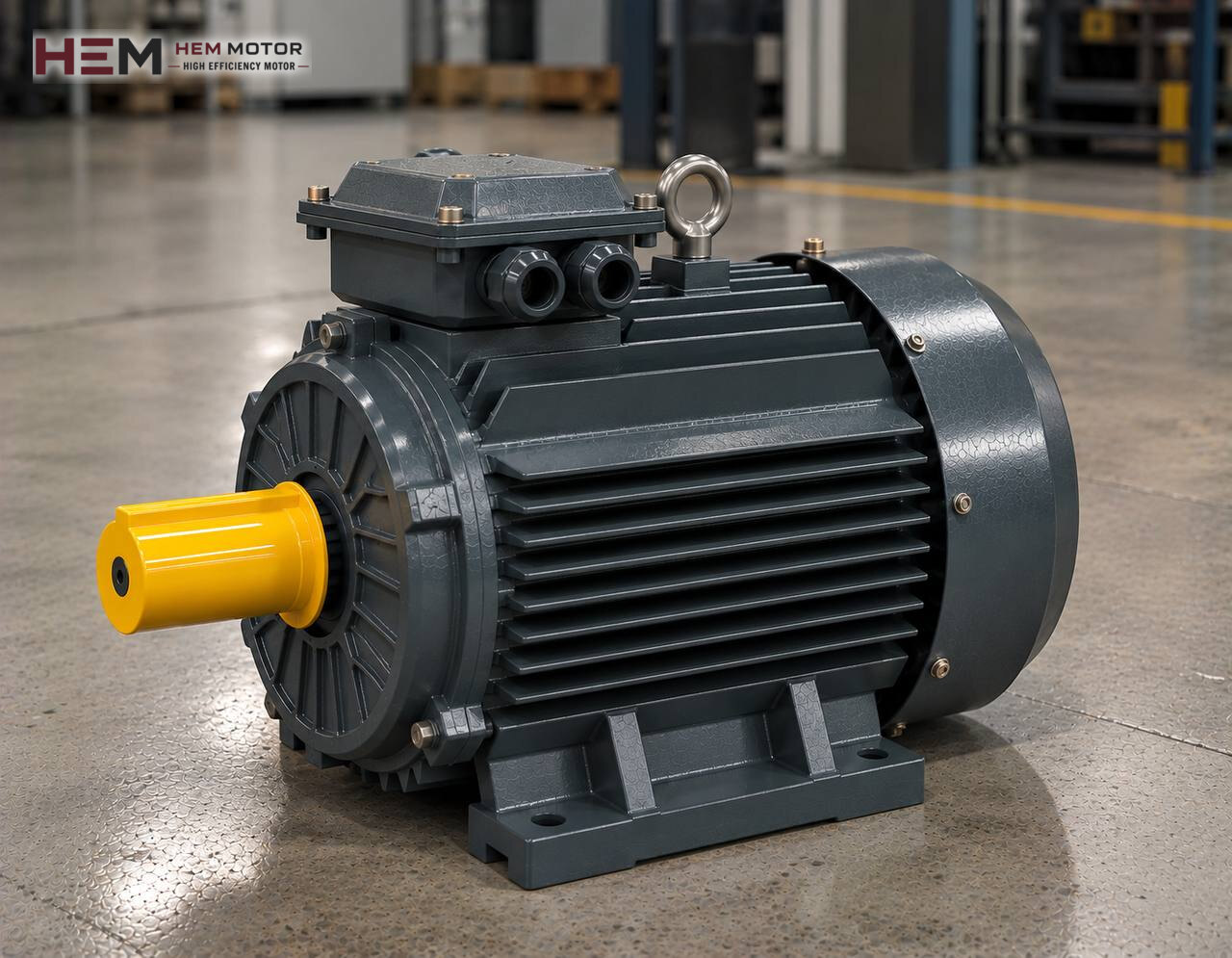
The dust collection fan is the heart of a system that draws air from a plant's dust sources, passes it through ducts, a filter and a cyclone, and discharges it cleaned. The same logic is used for very different jobs: welding fumes, grinding dust, flour and feed dust, marble cutting dust or venting cement silos. The fan itself is mostly a backward-curved centrifugal fan; this page explains how the motor that turns it behaves inside a filtered system. For an overview of fan types, see the industrial fan motors page.

Where the Fan Sits: Clean-Air Side and Dirty-Air Side
In a dust collection system, the fan's position relative to the filter determines the conditions the motor will face. In the most common arrangement the fan is behind the filter, on the clean-air side: the wheel meets only filtered air, so wear and build-up are low. Efficient backward-curved wheels are used comfortably in this arrangement.
In some older or simpler systems the fan runs in front of the filter, on the dirty-air side. Here the wheel is in direct contact with dust, deposits and wear form on the blades, and unbalance is passed on to the motor bearings. In such material-handling applications, sturdier radial-blade wheels are preferred. In both arrangements the motor should stand outside the air stream, beside the fan housing or on a base.
The Operating Point Shifts as the Filter Loads Up
The most important feature that sets a dust collection fan apart from other fan applications is that system resistance changes over time. Newly fitted bag or cartridge filters let air through easily; as they run, a dust cake forms on the surface and pressure loss rises. In jet-pulse cleaning systems this resistance rises and falls within a certain band with the cleaning pulses.
For the motor the result depends on the fan type. Because the power curve of a backward-curved fan has a peak, a motor chosen for this peak is not overloaded whether the filter is clean or dirty. As airflow falls, shaft power drops a little too; in other words a dirty filter strains suction performance, not the motor. But if the system is built with a forward-curved or radial-blade fan, the hardest moment is when the filters have just been replaced and resistance is lowest. Measuring motor current at the first start after maintenance is therefore a good habit.
Speed Control for Constant Suction
Because system resistance increases as the filter loads, the suction of a fan running at fixed speed weakens during the day. Insufficient suction at hoods and machine openings means dust escaping into the room. There are two ways to solve this: choose the fan oversized for the dirtiest filter and throttle with a damper, or adjust speed with a frequency inverter and keep the pressure in the duct constant.
In the inverter solution a pressure sensor measures the vacuum in the duct; the fan turns slowly while the filter is clean and faster as it loads. Since fan power changes roughly with the cube of speed, hours run at low speed noticeably reduce motor load; the exact difference depends on the system. HEM's three-phase motors are suitable for inverter operation. Because fan load lightens at low speed, a separate cooling fan is rarely needed; if the cable between inverter and motor is long, an output filter is considered. These conditions should be stated at ordering; details are on the inverter-compatible motors page.
Multi-Point Extraction and Damper Control
In a workshop a single fan is often connected to several machines: three grinding benches, two welding tables, one cutting machine. Not every machine runs at the same time; when the dampers of unused openings close, system resistance changes. In systems with automatic dampers the inverter follows this change and adjusts speed to the number of active openings.
In such multi-point systems the motor frequently runs at different loads. A PTC or PT100 sensor monitoring winding temperature can therefore be added as an ordering option; used together with a motor protection relay, overheating of the winding is noticed early. For protection settings and overload relay selection, the article motor protection: thermal relay and fuse selection may be useful.
Example HEM Models for Dust Collection Fans
| System | How the motor runs | Key selection point | Example HEM model |
|---|---|---|---|
| Single-machine mobile dust collector | Direct-coupled, short periods | Compact frame, 2-pole | 4 kW, 2,905 rpm, 112M-2 aluminium |
| Welding fume extraction system | Full shift, with dampers | Variable number of openings | 7.5 kW, 2,930 rpm, 132S2-2 cast iron |
| Central system with jet-pulse bag filter | Continuous, with inverter | Speed adjusted to pressure | 18.5 kW, 1,470 rpm, 180M-4 cast iron |
| Large cyclone + filter line | Non-stop, belt or coupling | Long start, bearing life | 30 kW, 1,475 rpm, 200L-4 cast iron |
The models above are for illustration; the final choice is made according to the fan's airflow and pressure requirement, the required speed, the connection method and the plant's operating conditions.
Motor Maintenance and Limits in a Dusty Environment
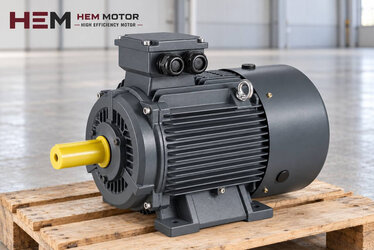
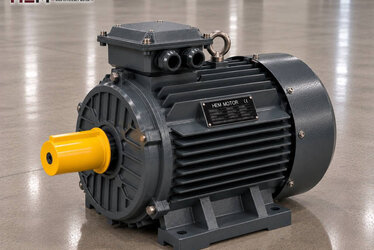
Even when the motor is on the clean-air side, dust around it settles on the frame and cooling fins. A motor whose fins are covered with dust cannot shed its heat; especially in plants where flour, feed or wood dust is sticky, frame cleaning should be on the maintenance list. Keeping the air inlet grille of the fan cowl unblocked is equally important. Our motors have IP55 protection and class F insulation; on heavy, vibrating fan bases the cast-iron frame series stands out.
Some dusts can form an explosive mixture under certain conditions. The explosion-protected motors required for such environments are not included in HEM Motor's 2026 catalogue; if the plant has such a classification, motor selection must follow the requirements set by the system designer. For fans running on the dirty-air side, regular checks of wheel balance directly affect the life of the motor bearings.
Request Information for a Dust Collection Fan Motor
So that we can prepare a quotation, send the following: the machine or department the system serves, filter type, motor power (kW), fan speed (rpm), supply voltage, mounting type (foot, flange, belt), whether an inverter will be used, and quantity. If you are replacing an existing motor, sending its nameplate photo may be enough.
All power and speed options are listed with current prices in our electric motor store. For contact via WhatsApp or phone, use the contact page.
Frequently Asked Questions
Does the dust collection fan motor strain as the filters get dirty?
With backward-curved fans, generally not; as resistance rises, airflow falls and shaft power decreases somewhat. What suffers is suction performance, not the motor. With forward-curved or radial-blade fans, however, the most loaded moment is when the filters are new and clean.
Why did motor current rise after a filter change?
A clean filter lowers resistance and the fan draws more air. With some wheel types this can bring motor current close to the nameplate value. Measuring current at the first start after maintenance is recommended.
Is an inverter really necessary in a dust collection system?
It is not mandatory, but in systems where filter resistance changes during the day or there are many dampered openings, it is the smoothest way to keep suction constant. In small single-machine systems a fixed-speed motor is often sufficient.
Can the motor be placed on the dirty-air side of the fan?
The motor should in all cases stay outside the dusty air stream. Even if the fan runs on the dirty-air side, the motor stands beside the housing on a base, connected to the wheel by shaft, coupling or belt.