English
 Français
 Türkçe
 Español
 Русский

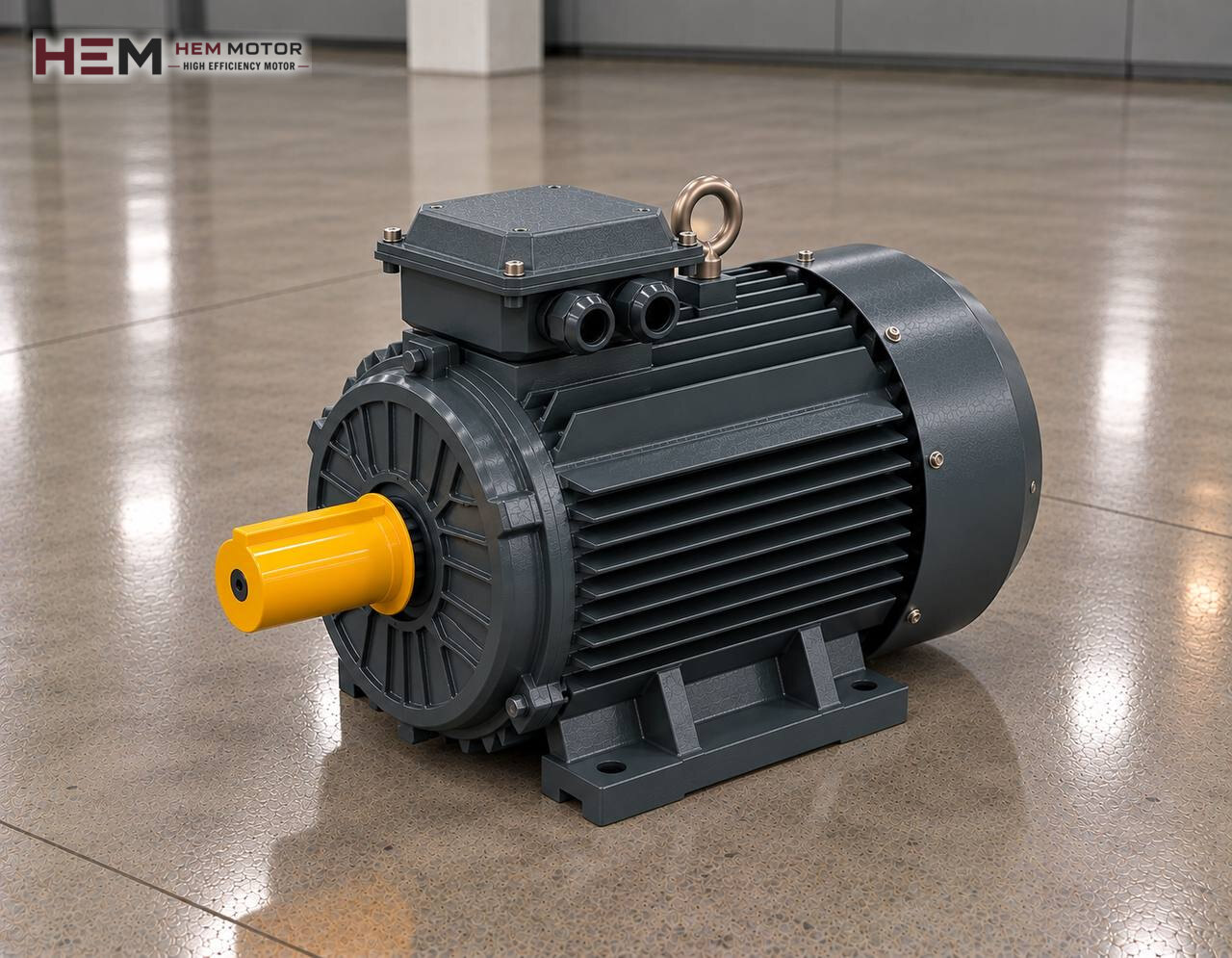
A backward-curved fan is a centrifugal fan whose blades are inclined against the direction of rotation. The blades may be flat plate (backward-inclined), curved or of aerofoil section. Air leaves the impeller at a relatively low tangential velocity; for the same pressure it therefore turns at a higher speed, but transfers energy to the air efficiently. It is used across a wide field, from air handling units to process exhaust and from burner combustion air to clean-air extraction. All fan types are covered on the fan and extractor motors page; here we focus on how the backward-curved impeller affects motor selection.

A Self-Limiting Power Curve
The best-known feature of the backward-curved impeller is that shaft power reaches a peak as airflow increases and then falls. This is called a non-overloading characteristic. Even if duct resistance turns out lower than expected, a damper stays fully open or a filter is removed, the power drawn does not exceed this peak.
When the motor is selected for this peak, changes in the system do not overload it. A motor chosen for the design point with no margin to the peak value, however, may be strained when operating conditions change. The sound approach is to read both the power at the operating point and the peak power on the fan manufacturer's curve and select the motor accordingly.
Higher Speed, Heavier Impeller
To produce the same pressure, this impeller type needs a higher tip speed than a forward-curved one. In direct-drive fans, 2-pole (3000 rpm class) and 4-pole (1500 rpm class) motors are therefore common; 6-pole motors are also seen with large-diameter impellers. In belt-driven arrangements the required fan speed is obtained through the pulley ratio.
Backward-curved impellers are usually made of thick plate with few but large blades, and their mass is high. Combined with high speed, the kinetic energy the motor must supply at start-up is large. This means a long starting time and high current throughout. The starting method (star-delta, soft starter or inverter) and the trip class of the thermal relay should be chosen for this time; otherwise the protection may trip before the fan reaches speed.
Drive Arrangement and Bearing Loads
When the impeller is mounted directly on the motor shaft, its weight and residual imbalance act on the motor bearings. At high speed even a small imbalance turns into noticeable vibration. A balance check should therefore follow any impeller replacement or cleaning.
In a belt drive the motor stands on a slide rail and belt tension applies a side load to its shaft. Tension should be kept at the value recommended by the manufacturer and the pulley fitted close to the shaft shoulder. On large fans where a high side load is expected, stating this in the order allows the bearing arrangement to be assessed.
Depending on frame size, foot-mounted (B3), flange (B5, B14), foot-and-flange (B34, B35) and vertical (V1, V3, V5, V6, V15) arrangements are offered; shaft and flange dimensions are finalised in the order according to the fan drawing. For foot-and-flange designs, see the B34/B35 motors page.
Blade Shape and Conveyed Air
A flat backward-inclined blade can work in slightly dusty air; dust adheres less to its surface. Aerofoil blades are the most efficient option but are usually hollow; in abrasive dust, if a blade is perforated it fills with material and the impeller balance is suddenly upset. This can cause rapid damage to the motor bearings. In dusty lines, matching the impeller type to the conveyed air is the fan manufacturer's job; on the motor side, the task is to monitor vibration and lubricate the bearings on time.
The motor should be positioned outside hot or dirty air. IP55 protection covers dust and water splashes; a hot gas stream, corrosive vapour, cleaning with pressurised water or an explosive atmosphere are not within this protection and require additional measures by the fan manufacturer or a special motor. In humid environments an anti-condensation heater for standstill periods, and a PTC/PT100 sensor to monitor winding temperature, can be added when ordering.
Speed Control at Variable Airflow
Because backward-curved fans are efficient, they are well suited to inverter drive in variable-volume systems. Reducing speed instead of throttling with a damper takes advantage of fan load falling roughly with the cube of speed; the relationship is approximate and depends on system resistance. Our three-phase motors can be supplied from a drive; when high torque is needed at low speed for long periods a separate cooling fan is considered, and when the motor cable is long, an output filter. Details are on the inverter-compatible electric motors page. Raising the speed above mains frequency, on the other hand, may exceed both the impeller's maximum permitted speed and the motor power; this step should only be taken with the fan manufacturer's approval.
Example HEM Models for Backward-Curved Fans
| Application | Drive | What to check | Example HEM model |
|---|---|---|---|
| Small clean-air extractor | Direct drive, 6-pole | Impeller diameter, quiet running | 3 kW, 968 rpm, 132S-6 cast iron |
| Combustion air or process fan | Direct drive, 2-pole | High tip speed, balance | 15 kW, 2,945 rpm, 160M2-2 cast iron |
| Process exhaust, variable airflow | Belt or direct, with inverter | Peak power of the curve, starting time | 45 kW, 1,485 rpm, 225M-4 cast iron |
| High-volume main fan | Belt or coupling | Heavy impeller inertia, starting method | 90 kW, 1,486 rpm, 280M-4 cast iron |
These motors are only a starting suggestion; the final choice is determined by the fan's peak power, the required speed, the mounting arrangement and the ambient conditions. Our models of 75 kW and above have a service factor of 1.15.
When Requesting a Quotation
The machine or installation the fan is in, the impeller type, the required power (preferably together with the peak power of the curve), speed, supply voltage, mounting type, drive arrangement, starting method and quantity are enough for a quotation. If you are replacing an existing motor, adding a photo of its nameplate speeds things up.
Product prices are shown on our shop pages. To reach us via WhatsApp or by phone, use the contact page.
Frequently Asked Questions
Can the motor of a backward-curved fan be overloaded?
If the motor was selected for the peak power of the curve, changes in airflow will not overload it. A motor chosen only for the design point without margin, however, may be strained when system resistance drops.
Why does this fan take so long to start?
The impeller is made of thick plate and is heavy, and it also turns at high speed. Since the kinetic energy the motor must supply is large, the starting time is long; the starting method and thermal setting are chosen accordingly.
Can I raise the fan speed above 50 Hz with an inverter?
First check the impeller's maximum permitted speed and the motor power. Because power rises quickly with speed, even a small increase can push the motor beyond its rated value.
Do aerofoil impellers cause problems in dusty air?
In abrasive dust a hollow blade can be perforated and fill with material, upsetting the impeller balance. The vibration reaches the motor bearings; on such lines the impeller type should be decided together with the fan manufacturer.