English
 Français
 Türkçe
 Español
 Русский
 العربية

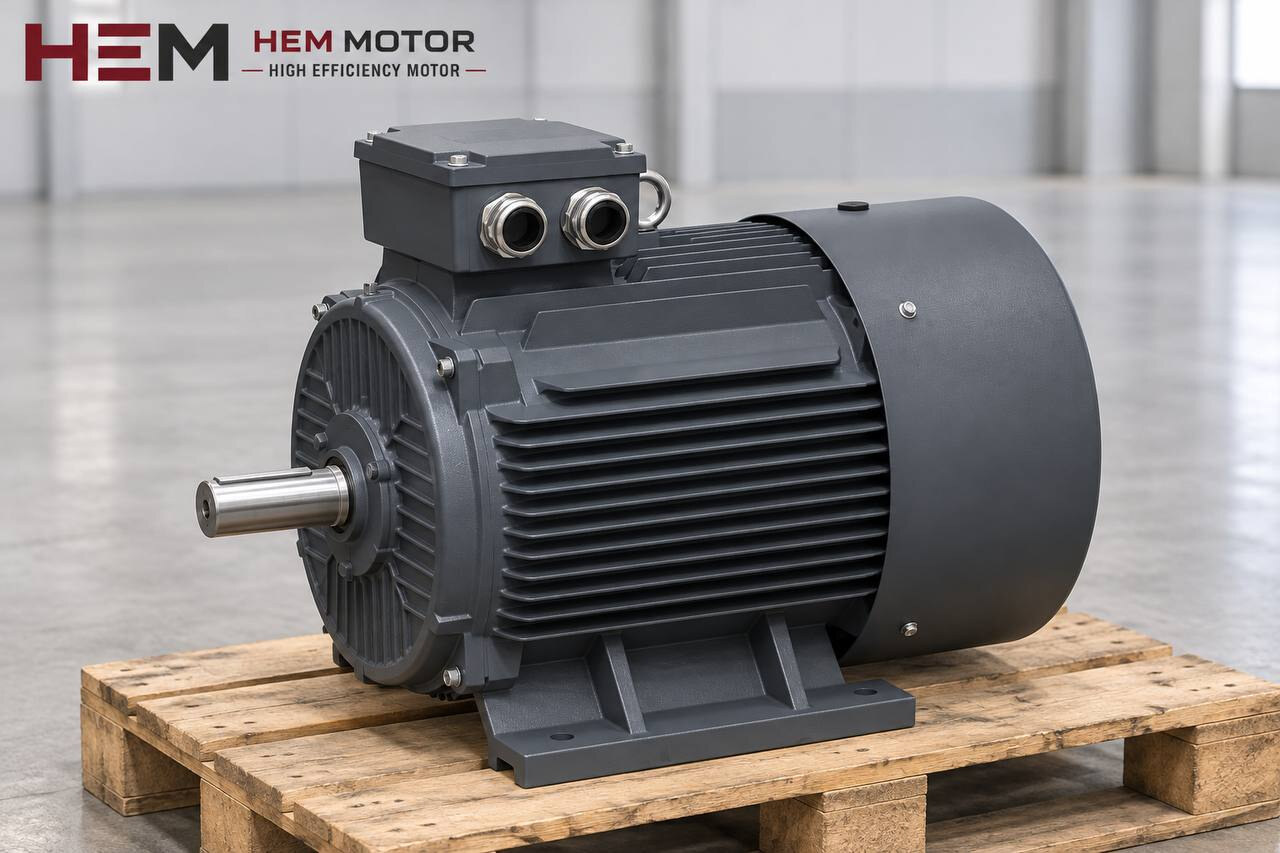
An inline pump is fitted into the middle of a pipeline much like a valve: the suction and discharge ports sit on the same line, the casing rests on the pipe itself, and the electric motor usually stands on top of the pump with its shaft pointing down. The layout saves space for the installer, but it puts loads on the motor that a horizontal pump never does. This page covers the three-phase asynchronous motor that drives an inline pump; an overview of the other pump types is on our Pump Electric Motors page.

The Pump Sits in the Line, the Motor Sits on the Pump
On a conventional end-suction pump the motor and pump stand side by side on a separate baseplate. An inline unit has no baseplate: the pipe carries the pump casing, and the motor sits on a lantern bracket fixed to that casing. The motor becomes the heaviest and highest part of the pump set.
This arrangement has direct consequences for motor selection:
- The motor is attached by its flange, not by feet; the flange both carries and centres it.
- Because the shaft runs vertically, the rotor weight and the hydraulic thrust of the impeller reach the bearings as axial load.
- The fan cover faces upwards, so water dripping from the ceiling and settling dust fall straight into the cooling-air inlet.
Horizontally installed inline pumps also exist; there the motor is usually connected with feet and flange together (such as B35). The sections below are based on the far more common vertical layout.
Vertical Flange Connection: V1 Position and Centring
The pump lantern holds the motor by its large flange, and the shaft goes down to a coupling or directly into the impeller hub. In the HEM Motor catalogue mounting list this arrangement appears as V1: large flange, vertical, shaft down. Standard mountings are B3, B5, B14, B34 and B35; vertical V1/V3/V5/V6/V15 variants are offered depending on frame size. The flange type and shaft dimensions are confirmed against the pump lantern when ordering.
The spigot of the flange keeps the motor shaft on the same axis as the pump shaft. If the replacement does not have the same frame size and flange as the old motor, the coupling is strained and the seal starts leaking early. For flange options see flange-mounted electric motors; for an explanation of the mounting codes see the mounting arrangements question.
The Load Carried by the Bearings on a Vertical Shaft
In a horizontal motor the bearings mainly carry radial load. In a vertical motor the rotor's own weight pulls down continuously, and the axial force generated on the discharge side of the impeller is added to it. In some inline pumps this thrust is taken by the pump's own bearing; in others it is transferred straight to the motor bearing.
The bearing table in the HEM Motor catalogue has separate columns for horizontal and vertical mounting, so vertical use is not a detail but a selection input. When ordering, state that the motor will run vertically and whether the pump transfers axial load to the motor. The pump manufacturer's documentation usually gives this under a heading such as "motor bearing" or "axial load".
A rising hum, heat or vibration from the bearing is often the first sign of axial strain; in that case the coupling setting and the tightness of the lantern bolts are the first things to check.
A Fan Cover Facing Upwards: Water, Dust and Condensation
All our models have IP55 protection and class F insulation. IP55 protects against water splashed from the surroundings, but on a vertical motor the fan-cover grille faces the sky or the ceiling. Water dripping from a leaking valve in a boiler room, rain on a rooftop pump, dust and leaves all fall straight into that opening.
For these cases a protective canopy (rain cover) is added above the fan cover. As it is not listed as standard equipment in the catalogue, specify it in your order if needed. The standard IP55 motor is not designed for submersion or high-pressure washing; in such a location the installer's protective measures or a special motor are required.
On chilled-water lines condensation also forms on the motor surface and inside the frame. PTC/PT100 winding sensors and anti-condensation heaters are order-time options.
Heating and Cooling Circuits and Tight Plant Rooms
The most common home of an inline pump is a building's plant room: boiler and calorifier circuits, the chilled-water line between the chiller and fan coils, cooling-tower return lines and circulation lines in riser shafts. In these circuits the pump does not lift water; it keeps it moving by overcoming the losses of a closed loop. The motor therefore runs for months without stopping, and reliable bearings and clean cooling air decide its life. For building systems in general, see HVAC sector motors.
Flow is often adjusted with the season. Our series are suitable for speed control with a frequency inverter; if the motor will run at full torque at low speed for long periods, an external fan is considered, and if the cable between drive and motor is long, a dv/dt or sine filter is considered; these conditions are stated in the order. Details: inverter-compatible motors.
In tight rooms the motor height also matters: between the ceiling and the motor there must be room both for cooling air and for lifting the motor out.
Motor Selection by Application
| Application | Mounting position | What to watch in selection | To state in the order |
|---|---|---|---|
| Boiler and calorifier circulation | Vertical, shaft down (V1) | Continuous duty, warm room air | Ambient above +40 °C, if so; example: 2.2 kW 90L-2 aluminium |
| Chiller chilled-water line | Vertical (V1) | Condensation, seasonal flow adjustment | Anti-condensation heater, inverter use; example: 4 kW 112M-4 aluminium |
| Rooftop or outdoor pump | Vertical (V1) | Rain and dust falling onto the fan cover | Need for a protective canopy |
| Cooling tower and process water | Vertical or horizontal line | Axial load, bearing arrangement | Whether axial load is transferred to the motor; example: 7.5 kW 132M-4 cast iron |
| Building water supply main | Vertical (V1) | Frequent starts, direction of rotation | Flange and shaft dimensions; example: 11 kW 160M-4 cast iron |
The linked models are only for orientation; the final choice is made from the pump's shaft power, the required speed, the mounting position and the operating environment.
Removing the Motor During Service
The design idea of an inline pump is maintenance without dismantling the pipework. The lantern bolts are undone, the motor is separated from the coupling and lifted up; the casing stays in the line. The motor's lifting eye must therefore be reachable, and there must be room above it for a hoist or chain block.
If the spare motor has the same frame size, the same flange and the same shaft, the swap is quick; a different frame means changing the lantern and coupling. After the new motor is connected, the direction of rotation should be checked against the arrow on the pump casing with a short run.
The Information We Need for Your Order
To match the right motor quickly, send us: the machine or installation the pump serves (e.g. a chilled-water line), the required power (kW) and speed (rpm), the site voltage, the mounting type and position (such as V1), the flange, any special conditions such as outdoor use or condensation, and the quantity. Sending a photo of the old motor's nameplate is the shortest route.
All frame and speed options are listed in our shop; each model shows its price on its own page. Motors in stock are shipped from our warehouse in Turkey. If you are unsure about the pump lantern or coupling dimensions, write to us and we will look at it together from a photo.
Frequently Asked Questions
Can I fit a foot-mounted motor to an inline pump?
Not in the vertical layout. The motor sits on the pump lantern by its flange, and the flange also centres the shaft; a foot-mounted motor has no such centring. The right choice is the same flanged V1 arrangement as the old motor.
Does an inline pump motor need a protective canopy?
In a closed, dry plant room it is usually not needed. Outdoors, on a rooftop or where there is a risk of dripping from above, it is recommended to keep water and dust out of the fan cover; specify it in your order.
Why should I state that the motor will run vertically?
In vertical operation the rotor weight and impeller thrust bear on the bearings axially. Because the catalogue treats the bearing arrangement differently for horizontal and vertical mounting, this information is part of the selection.
Can the speed of an inline pump in a heating circuit be adjusted?
Yes, with a frequency inverter. If there will be long periods at full torque and low speed, or a long cable, the need for an external fan and a filter is discussed when ordering.
Does the pipework have to be dismantled to change the motor?
No. The lantern bolts are undone and the motor is lifted out, while the pump casing stays in the line. Choosing a motor with the same frame, flange and shaft dimensions shortens the job.