English
 Français
 Türkçe
 Español
 Русский
 العربية

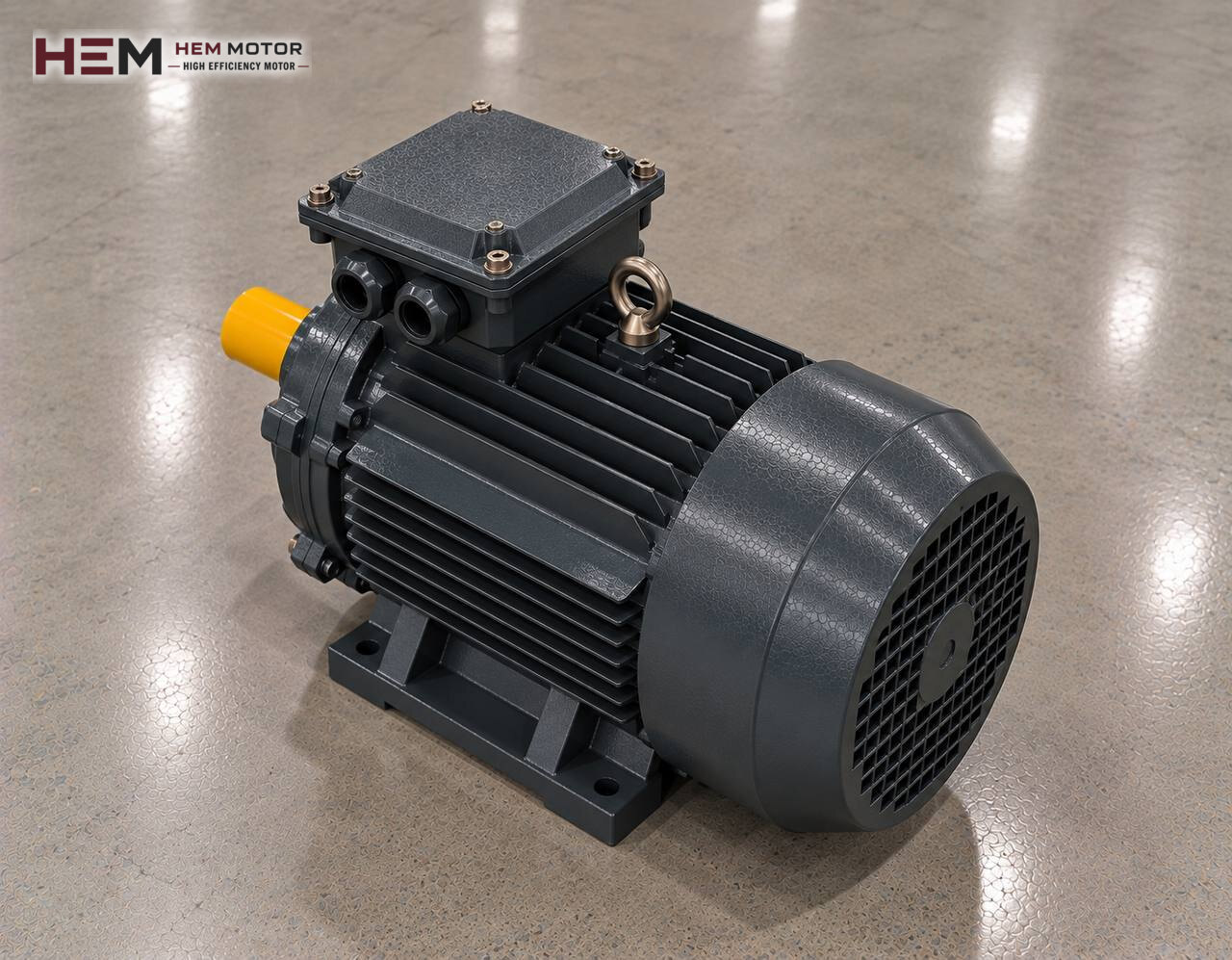
A multistage pump raises water step by step with several impellers lined up on the same shaft: each impeller takes the water delivered by the previous one and raises its pressure a little more. This design reaches heads that are hard to achieve with a single impeller, in a compact casing. The subject here is the three-phase asynchronous motor that turns these stages; a general summary of pump types is on the Pump Electric Motors page.

The Load on the Motor Grows with the Number of Stages
In a multistage pump series, models in the same flow class are mostly distinguished by the number of stages. As stages are added, the head rises roughly in proportion, and the shaft power needed to push water higher grows too. That is why two models in the same pump family that look almost identical from the outside can have quite different motors.
This is the reason to look at the pump's own nameplate rather than its family when replacing a motor. The number of stages and motor power on the nameplate are the lower limit for the replacement motor. On pumps whose number of stages has been changed later (stages added or removed), the motor power must be rechecked against the pump manufacturer's curve.
2-Pole Speed and Impeller Tip Speed
The head produced by an impeller grows with the square of its tip speed. Since multistage pumps work with small-diameter impellers, they obtain this speed through high rotation; the motor is mostly 2-pole, in the 3,000 rpm class. Fitting a 4-pole motor to the same pump cuts the head to roughly a quarter; in other words, speed is not negotiable on this pump.
The rated speed of the 2-pole models in our catalogue ranges from 2,730 to 2,980 rpm depending on power. In replacement work, choosing a model close to the speed on the old motor's nameplate keeps the pump at its design point. Large-flow horizontal multistage pumps also come in 4-pole arrangements; check this on the pump nameplate.
Connection Differences in Vertical and Horizontal Designs
In a vertical multistage pump the stages are stacked inside a stainless steel sleeve; suction and discharge ports are in line at the base. The motor sits on the lantern at the top in the V1 position on its large flange and turns the pump shaft through a coupling. Because the stages produce an upward thrust, depending on the pump design this axial force may also be transferred to the motor bearing; state in the order that the motor will run vertically and what the axial load situation is.
In a horizontal (ring-section) multistage pump the stages sit side by side like rings clamped together with tie bolts. The motor is placed on a common baseplate as foot-mounted (B3) or foot-and-flange (B35) and connected with a flexible coupling. Coupling alignment is decisive here: a small misalignment on the long pump shaft strains both the gland packing or mechanical seal and the motor's drive-end bearing.
In both designs, the flange type and shaft size are confirmed at the order stage. For mounting codes, see the question on which mounting arrangements are available; for foot-and-flange frames, the B34/B35 motors page gives information.
Starting and Stopping in High-Pressure Applications
In jobs such as boiler feed, reverse osmosis (RO) pre-pressure, high-pressure washing lines and mine dewatering, the pump runs continuously at high head. Since the impellers are small and light, rotor inertia is low and the motor reaches full speed quickly. The point that really needs attention is stopping: if the discharge line is long and high and the check valve does not close quickly, water flows back and water hammer occurs. For this reason some plants ramp both starting and stopping with a soft starter or an inverter.
If a multistage pump runs against a closed valve for a long time, the water inside heats up quickly. A minimum flow line and dry-running protection are the job of the pump and the installation; the motor does not detect this condition by itself. Our three-phase series can be driven by a frequency inverter; if there is a long cable or long operation at very low speed, filters and an external fan are addressed in the quotation. Details: inverter-compatible electric motors.
Hot Water, Humidity and Maintenance Intervals
In boiler feed pumps the pump casing is hot and this heat is conducted through the lantern to the motor flange; the boiler room itself may also be hot. If the ambient temperature is high, report it at the quotation stage. All our models have IP55 protection and Class F insulation; a PTC/PT100 sensor for operators who want to monitor winding temperature and an anti-condensation heater for damp pump rooms are order options.
In maintenance, leakage at the mechanical seal, the coupling insert and the noise of the motor bearing are checked regularly. If a seal leak splashes water onto the motor or the coupling area, this damages the bearing in the long run; do not delay replacing the seal.
Example Motors by Application
| Multistage pump duty | Pump design | Motor selection detail | Example HEM model |
|---|---|---|---|
| Small RO unit pre-pressure | Vertical, motor on top | V1 flange, 2-pole speed | 3 kW 100L-2 (2,895 rpm) |
| Industrial washing line | Vertical, motor on top | Axial load, seal splashing | 7.5 kW 132S2-2 (2,930 rpm) |
| Boiler feed pump | Horizontal ring-section | Hot room, coupling alignment | 15 kW 160M2-2 cast iron (2,945 rpm) |
| High-head transfer | Horizontal ring-section | Stop ramp, water hammer | 22 kW 180M-2 cast iron (2,955 rpm) |
The table is for guidance; the exact model is determined by the power and speed on the pump nameplate, the mounting design and the plant conditions.
What to Send Us for a Multistage Pump Motor
When preparing a quotation we need to know: the machine or plant where the pump is used, the pump brand and number of stages, motor power and speed, voltage, mounting (vertical V1 flange or horizontal on a baseplate), inverter use if any, and the quantity. A photo of the old motor's nameplate answers most questions in one go.
Model cards and prices are listed in our electric motor shop; if you are unsure about the flange or shaft size, you can send photos via the WhatsApp line on the contact page.
Frequently Asked Questions
What happens if I fit a 4-pole motor to a multistage pump?
The speed halves and the head drops to roughly a quarter; the pump cannot reach its design pressure. If the pump is designed for 2 poles, the motor must also be 2-pole.
Will the motor be enough if I have stages added to the pump?
Adding stages increases the required shaft power. Check the power requirement for the new number of stages on the pump manufacturer's curve; if necessary, choose a motor one power step higher.
Why should a vertical multistage pump motor be specified separately in the order?
The motor runs with the shaft pointing down, and the pump's axial thrust may reach the bearing. The V1 position and axial load information are part of the selection for the bearing arrangement.
Is the motor damaged if the pump runs against a closed valve?
The motor is usually not overloaded, but the water inside the pump heats up and the seal is damaged. A minimum flow line and dry-running protection should be present in the installation.