English
 Français
 Türkçe
 Español
 Русский
 العربية

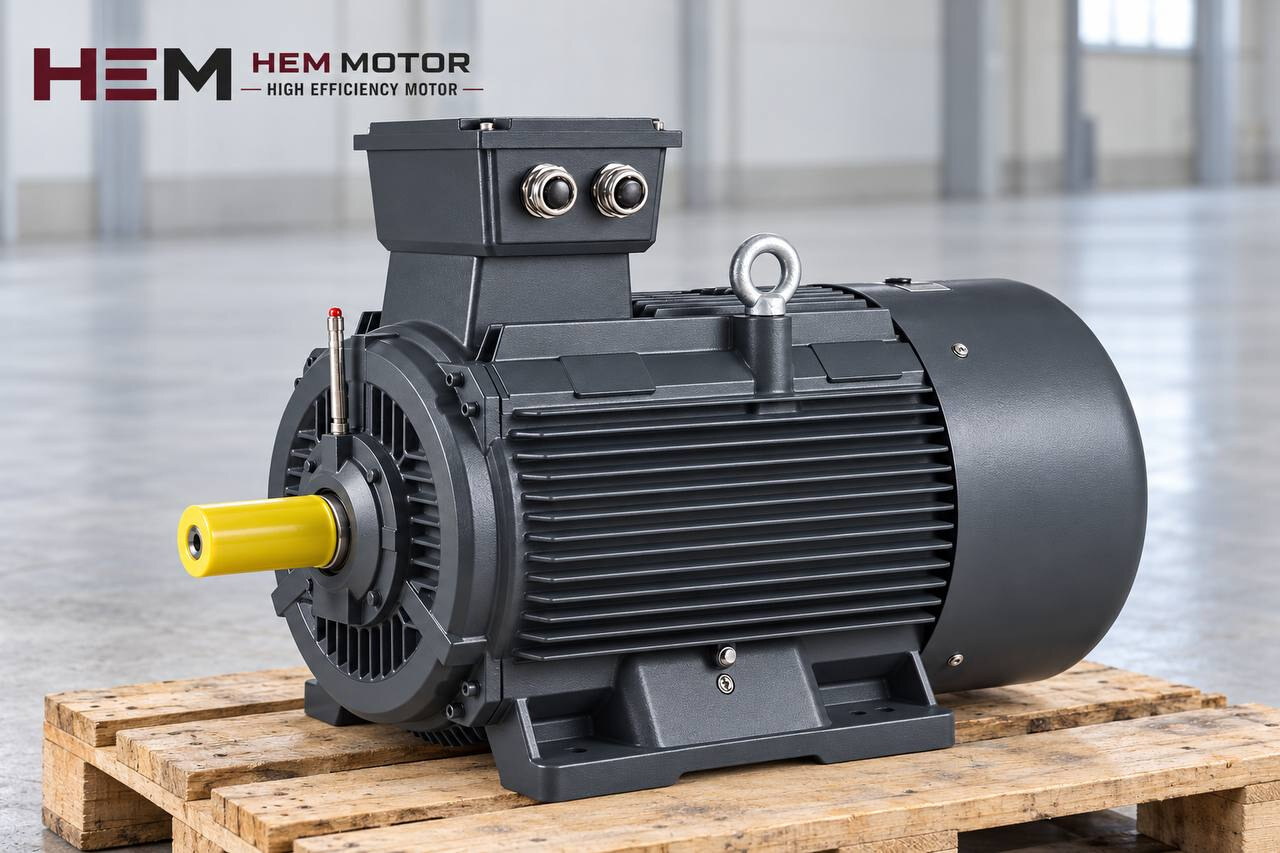
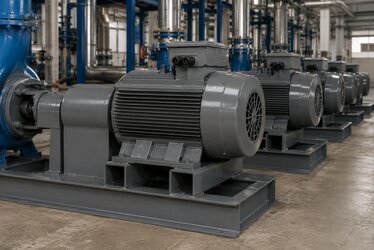
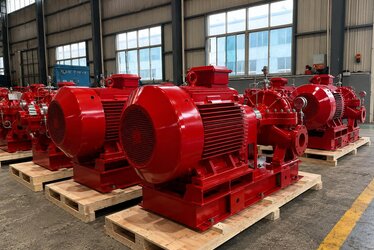
In pumping stations that feed municipal networks, on irrigation main lines and in power-plant cooling circuits, the largest flows are very often handled by horizontally split case pumps. In these pumps the impeller takes in water from both sides, and the upper half of the casing is lifted off to reach the impeller and bearings. This page covers the electric motor that drives the pump; for an overview of all pump types, see the pump electric motors main page.

The load a motor carries on a double-suction pump
In a double-suction impeller, water enters symmetrically through both faces of the impeller. This symmetry largely balances the axial thrust that loads the motor and pump bearings in single-suction pumps. For the motor, the result is that the shaft load is mainly torque, transmitted through the coupling.
On the other hand, these pumps run for long periods without a break. The deciding value is therefore not a short peak load but the motor's ability to stay within its heating limit continuously at the rated point. In a system that drifts toward the right end of the pump curve, that is, toward low head and high flow, shaft power rises; the motor should be selected on the maximum shaft power given by the pump manufacturer.
Power and speed: large cast iron frame motors
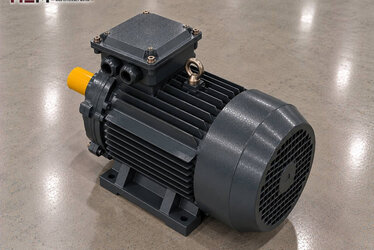
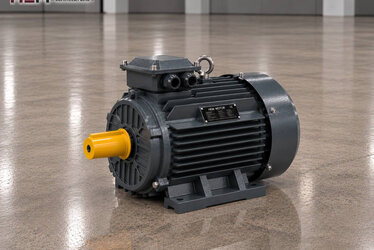
Because split case pumps are designed for large flows, the motors that drive them usually sit in the upper frame sizes of the range. HEM Motor's cast iron frame motor family extends up to 355 kW; in this class, 4-pole (1,500 rpm) and 6-pole (1,000 rpm) models are the usual partners for split case pumps. Lower speed is often preferred in pump design to limit the impeller's peripheral speed and the risk of cavitation on the suction side.
As an example, the 90 kW 1,500 rpm cast iron 280M-4 delivers 578.4 Nm of torque at a rated speed of 1,486 rpm. For a larger station, the 160 kW 1,500 rpm cast iron 315L1-4 has a rated speed of 1,488 rpm and a rated current of 271 A at 400 V. For slow-running large impellers, the 132 kW 1,000 rpm cast iron 315L2-6 produces 1,276 Nm at 988 rpm. These models of 75 kW and above have a service factor of 1.15; this is a safety margin, not a reason to choose a smaller motor. These models are examples; the final selection depends on the pump's shaft power, required speed, mounting and operating conditions.
Direction of rotation: information to settle before ordering
Split case pumps are built to turn either clockwise or counter-clockwise, depending on where the suction and discharge nozzles sit. The pump's direction defines the baseplate layout and the pipe connections, and therefore the side on which the motor is coupled. The direction is shown on the pump nameplate or by an arrow on the casing, and is usually defined as seen from the motor end.
The direction of a standard three-phase asynchronous motor is reversed by swapping two of the supply leads. Even so, at first commissioning the motor should be run briefly uncoupled to confirm the direction before the coupling is connected. A pump turning the wrong way does not deliver the expected pressure; if this continues, pump parts can be damaged. State the motor's position on the baseplate and the direction in your order.
Alignment on the baseplate and a second check when hot
Motor and pump are bolted to a common steel baseplate, and the flexible coupling between them tolerates small deviations; but a coupling is not a part that corrects poor alignment. Misalignment shortens bearing life, raises vibration and leads to leaks at the gland packing or mechanical seal.
Cold alignment
First confirm that the baseplate sits on the concrete and that the anchor bolts are tightened. Check that each motor foot bears fully on the baseplate; a foot left hanging distorts the frame when it is bolted down. Then measure radial and angular offset with a dial indicator or a laser alignment tool, and correct it with stainless shims placed under the motor feet. Pipework must be connected to the pump without strain; a pulling flange shifts the casing out of alignment.
Thermal growth and the second measurement
Once at operating temperature, motor and pump do not grow by the same amount. The motor frame warms up, while the pump takes on the temperature of the water it carries; in hot-water or cooling circuits the difference is more pronounced. The pump manufacturer gives the offset to leave during cold alignment. After a few hours of running, the machine should be stopped and the alignment measured again immediately, and corrected if needed.
Starting method and bearing temperature monitoring
At high power, direct-on-line starting draws a high starting current from the network and can cause a surge in the water column. For this reason star-delta starting, soft starters or frequency inverters are common on split case pumps. Which one to choose depends on transformer capacity, pipeline length, check-valve arrangement and the need for flow control; the decision belongs to the plant's electrical and hydraulic design. For star-delta starting, the motor's delta voltage must match the supply voltage.
Our three-phase series are suitable for speed control with a frequency inverter; for long periods of full-torque running at low speed an external fan may be needed, and with long cables a dv/dt or sine filter is considered; large frames may need insulated bearings or shaft grounding. These conditions are stated in the order. For details, see the inverter-compatible motors page.
On a pump that runs unattended for long periods, the first sign of a fault is often a temperature rise around the bearings. A PT100 temperature sensor is an order option; the sensor location and the monitoring relay it connects to are agreed at the time of ordering. For standby pumps that stand idle for long periods, an anti-condensation heater can also be requested.
Selection table by application
| Application | Common speed | Point to watch | State in the order |
|---|---|---|---|
| Municipal water pumping station | 1,500 rpm (4-pole) | Continuous duty, starting current affecting the network | Shaft power, starting method, PT100 request |
| Irrigation main line | 1,500 or 1,000 rpm | Long seasonal running, moisture after long standstill | Anti-condensation heater, direction of rotation |
| Process and power-plant cooling water | 1,500 rpm | Thermal growth with hot water, hot alignment | Water temperature, mounting side |
| Main fire pump | 1,500 rpm | Long standby, sudden start at full load | Documents and conditions required by the project |
| Large-diameter low-head transfer | 1,000 rpm (6-pole) | Large impeller, high torque, long pipeline | Torque, voltage, starting method |
The speeds in the table are values commonly seen in practice, not a final selection; the pump manufacturer's data and the nameplate of the existing motor are the reference.
For split case pumps feeding a fire water network, motor selection follows local regulations and the system designer's requirements; any required documents or approvals are confirmed at the time of ordering. This subject is covered separately on the fire pump electric motors page.
Information needed for a quotation
So that we can prepare the quotation in one go, please send: the machine or pump type the motor will drive, the required power (kW), speed (rpm), site voltage, mounting type, direction of rotation and quantity. Also add the starting method, whether an inverter will be used and whether you want a PT100 or an anti-condensation heater. Foot-mounted B3 and other mounting types are offered according to frame size; flange and shaft dimensions are confirmed in the order.
If you are replacing an existing motor, the fastest route is to send a photo of the motor nameplate. You can see models and current prices in the buy electric motors shop, and reach us through the contact page with any questions. Models available for delivery from stock are shipped from our warehouse in Turkey.
Frequently Asked Questions
Does alignment have to be redone when the motor of a split case pump is replaced?
Yes. Even if the new motor has the same shaft height and foot plane as the old one, the shims and anchor tightness change. A cold alignment should be done and then measured again hot after a few hours of running.
If the pump's direction of rotation changes, does the motor change too?
The motor's direction is reversed by swapping two phase leads. However, if the pump is an opposite-hand model, the motor may move to the other side of the baseplate; in that case the position of the terminal box and cable entry is reconsidered.
Can a 1,000 rpm motor be used instead of 1,500 rpm on a split case pump?
A pump should run at the speed it was selected for. If the speed drops, flow and head drop as well; a speed change is made only with the pump manufacturer's approval and together with impeller selection.
Can a sensor be added to the motor later to monitor bearing temperature?
A PT100 sensor is an order option, and the soundest route is to state the need at the ordering stage. Whether it can be retrofitted to an existing motor is assessed separately according to the motor frame.
Which starting method should be chosen for a high-power pump motor?
There is no single right method. Star-delta, a soft starter or a frequency inverter is chosen according to network capacity, water hammer risk and the need for flow control; the decision is made together with the plant's electrical design.