English
 Français
 Türkçe
 Español
 Русский
 العربية

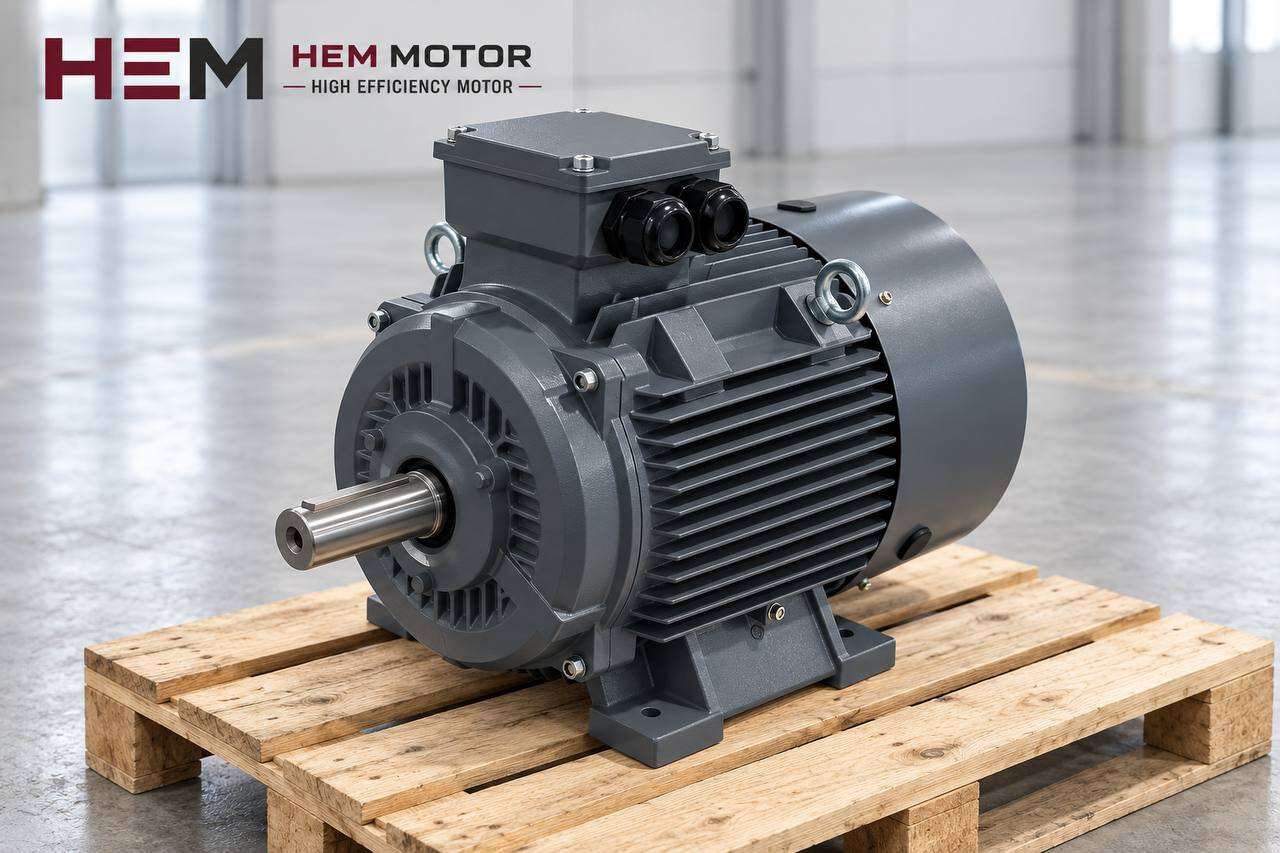
In a wastewater treatment plant the motors are not gathered in one machine; from the moment water enters the plant until the sludge is loaded onto a truck, each stop gives them a different job. Some start and stop several times an hour, others run for months without being switched off. This page covers the surface-mounted three-phase motors that drive the pumps, mixers and blowers at these stops. Other pump applications are described together on the Pump Electric Motors page.

Inlet Lift Station: Pump Motors in a Dry Room
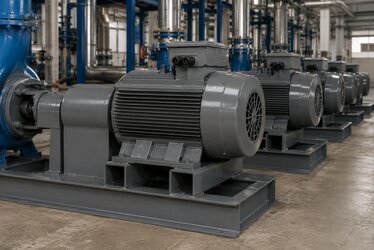
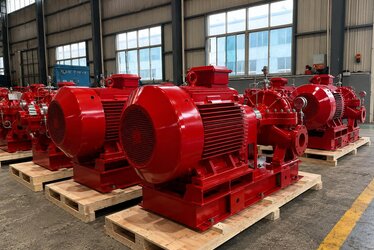
In most plants, water arriving from the sewer is first collected in a lift structure and raised from there. Where the pumps sit in a dry room and the motors stand above or beside it, a standard three-phase induction motor is used. On a horizontal pump the motor is connected by a coupling; on a vertical pump it sits on top of the pump casing with the shaft pointing down.
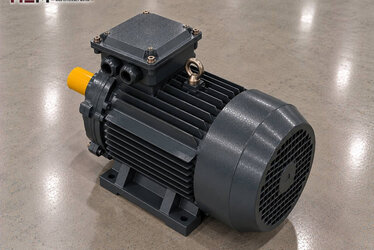
A lift pump sees a flow that changes with the time of day. Flow drops at night, while on rainy days several pumps start together. Arrangements in which pumps run in sequence and one waits on standby are therefore common. As an example, for a lift pump in the 22 kW class, the 22 kW 1,500 rpm cast iron 180L-4 model, with a rated speed of 1,470 rpm, suits this kind of dry-room installation.
The motors of submersible pumps and submersible mixers lowered into a wet well form one unit with the pump and fall outside the scope of this page; only motors standing above the tank or well are covered here.
Screen, Grit Chamber and Sieve Drives
After the lift station the water passes through screens. The rake of a mechanical screen cleaner carries the retained solids up and drops them onto a screw conveyor or a compactor. These drives are low power, turn slowly through a gearbox and run intermittently depending on the level difference.
The classifier screw and grit pump that remove settled sand from the grit chamber work in a similar way. The main risk here is jamming: a piece of cloth caught on the rake or sand piling up in the screw can lock the motor within seconds. A protection relay that trips quickly and a torque limiter on the gearbox protect the motor in these situations.
Aeration Basin and Blower Motors
The heart of biological treatment is aeration, which supplies oxygen to the bacteria. Air is pushed to diffusers on the basin floor by rotary lobe (Roots type), side channel or centrifugal blowers. This section usually takes the largest share of the plant's electricity consumption.
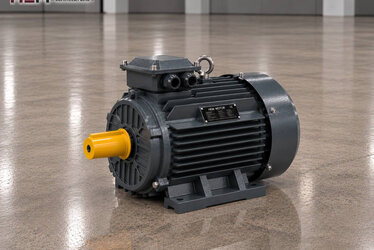
A rotary lobe blower is a positive displacement machine: the air volume delivered is proportional to speed, while the required torque is set by the water depth above the diffusers. The motor must therefore deliver almost the same torque even at low speed. Two-pole motors are common on large belt-driven blowers; for example, the 55 kW 3,000 rpm cast iron 250M-2 model has a rated speed of 2,970 rpm.
For general motor selection on fan-type machines see fan and exhaust fan motors, and for buildings and enclosed spaces see ventilation electric motors.
Mixers and Settling Tank Scrapers
In anoxic basins, coagulation and flocculation tanks and sludge equalisation tanks, the mixer impeller goes down into the tank on a shaft, while the motor stands vertically on the gearbox on a bridge above the tank. The impeller turns slowly, so the drive is almost always geared. The motor flange and shaft are chosen to match the gearbox; for details see electric motors for reducers.
Circular or longitudinal scraper bridges in settling tanks gather the sludge towards the centre of the tank. The bridge moves very slowly and the motor power is small, but it is exposed to sun, rain and frost in the open air. For a small bridge drive the 1.5 kW 1,500 rpm cast iron 90L-4 can serve as an example. If a rain canopy is needed for vertical mounting, state it in the order.
Pumps and Dewatering Equipment on the Sludge Line
Settled sludge is sent by progressive cavity (screw) pumps or centrifugal sludge pumps to the thickener and from there to the dewatering unit. A progressive cavity pump needs constant torque and meets high resistance at start-up; flow is usually set with a frequency converter. For a pump in this class the 7.5 kW 1,500 rpm cast iron 132M-4 can be taken as an example.
On the dewatering side there are belt filter presses, screw presses and decanter centrifuges. Belt presses and screw presses turn slowly and use geared drives. The decanter bowl, by contrast, has high inertia; start-up takes long, and the starting method (soft starter or inverter) is set according to the machine maker's recommendation. Polymer preparation and dosing units also contain small mixer and pump motors.
The Motor's Task by Plant Section
| Plant section | Equipment | Motor operating condition | What to watch when selecting |
|---|---|---|---|
| Inlet lift | Horizontal or vertical pump in a dry room | Sequential start by flow, standby operation | Mounting type, motor installation level against flooding |
| Screens and grit chamber | Rake, screw, grit pump | Intermittent duty, jamming and humid air | Fast protection, gearbox flange, H2S atmosphere |
| Aeration | Rotary lobe or centrifugal blower | Continuous day and night, constant torque at low speed | Number of poles, pulley ratio, cooling on inverter |
| Mixing and settling | Surface mixer, scraper bridge | Very slow geared rotation, open air | Vertical mounting, rain canopy, condensation |
| Sludge line | Progressive cavity pump, belt press, decanter | High starting resistance, long acceleration | Starting method, winding sensor |
The models in the table and text are only examples; the final decision is made by looking at the actual load of the pump or blower, the required speed, the mounting type and the ambient conditions of the section.
Protecting the Motor in Humidity, H2S and Continuous Duty
In the enclosed sections of a treatment plant the air is both humid and laden with hydrogen sulphide (H2S). This gas gradually corrodes copper connections, terminal screws and unpainted metal surfaces. HEM Motor series have IP55 protection and are supplied with RAL 7012 or RAL 7024 electrostatic powder coating. An IP55 motor is not designed for submerged operation or pressure washing; in an installation with heavy gas or flood risk the protective measure is set by the project, so state the special condition in the order.
Standby pump motors develop condensation inside as they cool. When ordering, you can request an anti-condensation heater to prevent this and, on blower and pump motors running 24/7, a PTC or PT100 sensor placed in the winding.
Our three-phase series are compatible with the frequency converter used for speed control on blowers and sludge pumps. If the motor will stay at low speed and full torque for hours, its own fan may not be enough and a separately powered cooling fan is added; if the cable between the drive and the motor is long, a dv/dt or sine filter is considered. State both in the order. Details are on the inverter-compatible electric motors page. For a section-by-section technical review of the plant, read our article on electric motors in treatment and biogas plants.
What Information Should You Send for a Quote?
So that we can propose the right motor quickly, send the machine type (lift pump, blower, mixer, scraper, sludge pump), motor power (kW), speed (rpm), supply voltage, mounting type and quantity. If it will run on an inverter and the motor will stand in an enclosed, humid section, add that as well.
If there is an old motor to replace, send a photo of the motor nameplate and we will find its equivalent together. You can see models and prices in the buy electric motors store and reach us through the contact page with any questions.
Frequently Asked Questions
Why does a treatment plant blower motor keep running hot?
The blower runs day and night, and on rotary lobe types the torque does not fall at low speed. On a motor run at low speed on an inverter for long periods, its own fan may not cool it enough; a separate fan and a winding sensor should be considered. The pulley ratio and filter clogging should also be checked.
Why can a standby pump motor fail on its first start?
A motor that stands idle for a long time cools in humid air and condensation collects in the winding. An anti-condensation heater is an order option; running standby pumps briefly at regular intervals is also recommended.
Which motor is chosen for a settling tank scraper?
The scraper bridge turns very slowly through a gearbox, so a low-power motor is enough. The deciding factor is the gearbox flange and shaft size; the nameplate of the existing motor and the gearbox data should be shared in the order.
Can a standard motor be used in a screen building with H2S?
A standard IP55 motor can be used in a ventilated screen building; however, an enclosed space with heavy gas build-up is not what this motor is designed for. Ventilation of the section and any special protection should be set by the project and stated in the order.
Is an inverter needed on a sludge pump?
Inverters are common on progressive cavity pumps because flow is easily changed by adjusting speed. Since the pump needs constant torque, cooling at low speed and cable length should be stated in the order.