English
 Français
 Türkçe
 Español
 Русский
 العربية

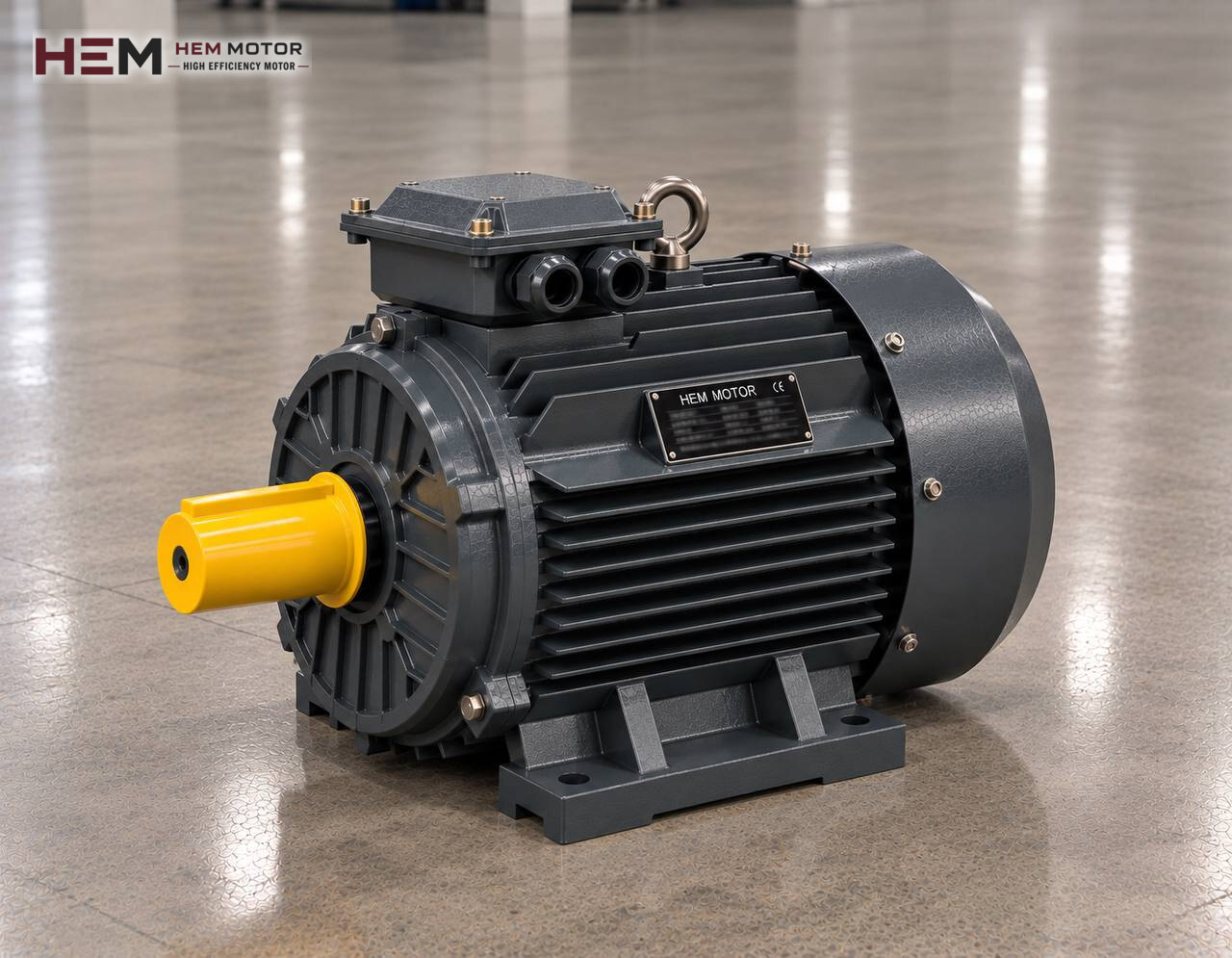
In chemical, paint, detergent and petrochemical plants, the process pump that carries acids, alkalis, solvents or resins is usually driven by a standard three-phase asynchronous motor. This page is not about the liquid or the pump material but about that motor: how density and viscosity affect shaft power, how the type of seal reflects on the motor side, how to protect the frame in a corrosive vapour atmosphere, and where the hazardous area limit lies. For the pump family in general, see our Pump Electric Motors page.

What Sets a Process Pump Apart from a Water Pump
The power calculation for a water pump is built on the density of water. In a chemical line, however, the liquid may be heavier or lighter than water. In a centrifugal pump, the shaft power drawn for the same flow and head changes in direct proportion to the specific gravity of the liquid: a pump delivering a solution one and a half times as dense as water needs roughly one and a half times the power at the same point. Choosing a motor from the curve the pump maker gives for water can therefore be misleading.
The second difference is continuity of operation. Process lines run for shifts, often for weeks without stopping; when one pump stops, the reactor, the mixing tank or the filling line waits. Motor selection does not aim at an operating point close to the rated power but at one that leaves some margin; how much margin is decided jointly by the process engineer and the pump supplier.
Motor Load by Density, Viscosity and Pump Type
Centrifugal process pumps (end-suction, on a base frame) are common for thin liquids. As viscosity rises, impeller efficiency drops and the motor delivers more power to do the same work. With heavy liquids such as resin or thick syrup this effect is clear.
Positive displacement types such as gear, lobe and screw pumps are chosen for thick fluids. In these, torque depends more on line pressure than on speed and stays almost constant from start-up. A liquid that has solidified in cold weather strains the motor on the pump's first turn; in lines with heated jackets, the motor should not be started before preheating is complete. Since these pumps run at low speed, a gearbox is often placed in between; for geared arrangements, the electric motors for reducers page gives guidance.
Dosing pumps are low-power and add chemicals to the line in set quantities. Flow is usually adjusted by stroke setting or by changing motor speed.
Packing, Mechanical Seal and Magnetic Coupling
The type of sealing also affects the load seen by the motor. In pumps with double mechanical seals, friction of the seal faces adds a small but continuous torque. Seal failure is usually noticed when liquid leaks along the shaft towards the motor side; the leaking liquid must be drained from the drip tray on the pump base before it reaches the motor's front end shield and bearing housing.
In magnetically coupled (sealless) pumps there is no direct shaft connection between motor and impeller; torque is transmitted by magnets through a containment shell. This arrangement has a limit: if the starting torque exceeds what the magnets can carry, the coupling slips. For impellers with high inertia a gentle starting ramp is therefore preferred; the starting condition given by the pump maker is decisive.
Corrosive Vapour and the Hazardous Area Limit
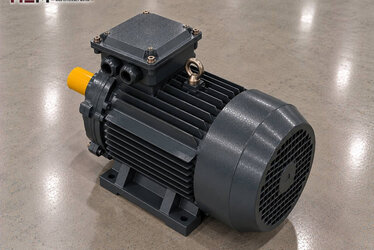
In a pump room containing acid vapour, chlorine or ammonia, the parts of the motor most affected are the fan cover, terminal box screws and shaft end. The enclosure is IP55 and the winding insulation class F; IP55 protects against dust and splashing water and does not mean an extra coating against chemical corrosion. If special paint or coating is needed for a permanently corrosive atmosphere, state it in your order; we assess its feasibility separately.
Areas where flammable solvent vapour may be present are a separate matter. Motors for explosive atmospheres (Ex/ATEX) are not included in HEM Motor's 2026 catalogue; the motors on this page are only for areas that do not require hazardous area classification. Area classification is carried out by the plant's authorised engineer.
Condensation collects moisture inside the frame of pumps that stand still at night; an anti-condensation heater and PTC or PT100 sensors in the winding are order options.
Speed, Coupling Alignment and Speed Control
Process pumps delivering thin liquids usually run with a two-pole motor at around 2,900 rpm; for liquids that carry solid particles, foam or pose a wear risk, a slower four-pole motor may be preferred. The exact speed comes from the pump curve.
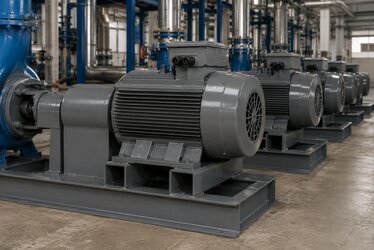
In a base-mounted set, motor and pump sit on separate feet and the flexible coupling between them is aligned. In pumps delivering hot liquid, the casing heats up and expands in operation; alignment made cold may shift when hot. Rechecking alignment at operating temperature extends coupling and bearing life. Foot-mounted B3 is common; B5, B14, B34, B35 and vertical V1/V3/V5/V6/V15 are also offered depending on the frame, with flange and shaft dimensions confirmed in the order.
Changing motor speed instead of throttling flow with a valve is common, especially in dosing and transfer lines. Our three-phase series can be driven by a frequency inverter; for positive displacement pumps that turn at low speed with full torque for long periods a separate fan, and for installations with long cables a dv/dt or sine filter, come into question and are stated in the order. See inverter compatible electric motors.
Example Motors by Process Pump Type
| Pump and liquid | Situation for the motor | What to check when selecting | Example HEM model |
|---|---|---|---|
| Gear pump, thick resin or oil | Constant torque, hard start when cold | Viscosity, preheating, gearbox | 4 kW cast iron, 112M-4 |
| Magnetically coupled transfer pump | Coupling slip limit at start | Starting ramp, impeller inertia | 5.5 kW cast iron, 132S1-2 |
| End-suction centrifugal, acid solution | Shaft power rising with density | Specific gravity, corrosive vapour | 15 kW cast iron, 160M2-2 |
| Large circulation, reactor cooling line | Uninterrupted long operation | Power margin, hot alignment | 37 kW cast iron, 225S-4 |
The models are examples; the final choice depends on the pump load, the properties of the liquid, required speed, mounting and operating conditions. The power and speed on the existing motor's nameplate are a good starting point.
Request Information for a Process Pump Motor
For a quotation, send the machine or pump type, the name, density and temperature of the liquid, motor power (kW), speed (rpm), supply voltage, mounting arrangement, starting method and quantity. If there is corrosive vapour in the area, mention that too. A photo of the old motor's nameplate gives most of the information; how to send it is described in the article send the motor nameplate.
Current prices are shown on the products on the buy electric motors page. For WhatsApp and phone, you can use our contact page. Drives on the wastewater side of the plant are covered on the treatment plant pump and mixer motors page.
Frequently Asked Questions
The pump curve is given for water; is the same motor enough for a dense solution?
Not always. In a centrifugal pump, shaft power rises in proportion to the specific gravity of the liquid; with a dense liquid the motor may exceed its rated power. Give the density to the pump supplier and have the power recalculated.
Can I use these motors for a solvent pump?
Not if the area is classified as an explosive zone; Ex/ATEX motors are not included in HEM Motor's 2026 catalogue. In areas that do not require zone classification, a standard motor can be used.
Why does my magnetically coupled pump spin freely at start-up?
When the starting torque exceeds the limit the magnets can transmit, the coupling slips. Applying a starting ramp with a soft starter or inverter instead of direct-on-line starting usually solves the problem.
Can a seal leak damage the motor?
Yes, if the leaking liquid travels along the shaft to the front end shield and bearing. Check that the leak is carried away by the drain tray on the base, and replace the seal without delay.